Main Facts: The Core Divide in Urban Transit Governance
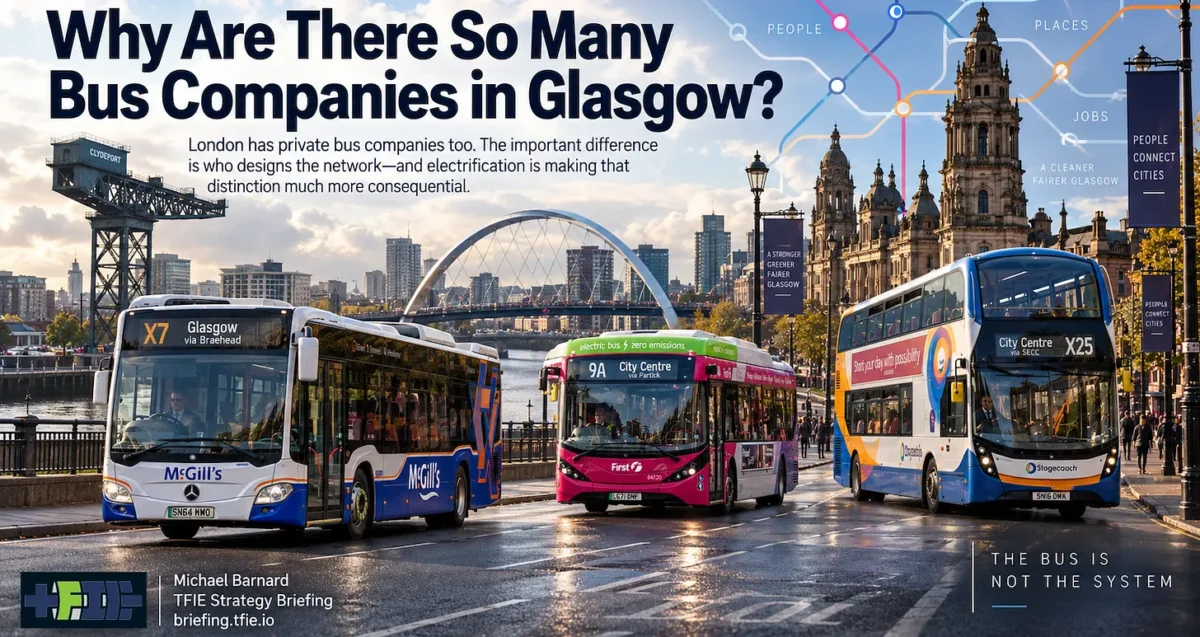
When visitors walk through Glasgow, the fragmentation of the city’s public transport system is immediately visible. A patchwork of private operators—including First Glasgow, McGill’s, and Stagecoach—plies the streets, each displaying distinct corporate brands, liveries, and pricing structures. To the casual observer, it appears as though the city’s public mobility network has been carved up and distributed among competing commercial entities.
Yet, comparing Glasgow to London reveals a crucial structural paradox. London’s public transport system is also heavily reliant on private bus operators. Numerous private companies run vehicles across the English capital, yet passengers experience a single, unified transit ecosystem governed by Transport for London (TfL). Under this model, fares, timetables, information systems, and service standards are centrally coordinated. Private companies are simply contracted to operate specific pieces of the puzzle.
The fundamental difference between Glasgow and London is not whether private companies are allowed to drive buses. Rather, the decisive factor is who designs the passenger network that those buses collectively deliver.
This governance distinction sits at the heart of a broader urban transit debate. For decades, the privatization of public transport has been viewed primarily through an ideological lens—a debate over public versus private ownership. However, as cities worldwide accelerate their transitions toward fleet electrification, this governance model has transformed from an abstract political argument into a critical operational constraint. Electric buses require multi-megawatt grid connections, specialized charging depots, and long-term infrastructure investments that cannot simply be re-routed overnight like a diesel bus. Consequently, how a city structures its transit governance today will determine whether its clean-energy transition succeeds or stalls.
Chronology: Four Decades of the British "Natural Experiment"
To understand how Glasgow and London arrived at such divergent transit models, it is necessary to examine the legislative history that reshaped Britain’s public transport landscape over the past forty years.
The 1980s: Deregulation and the Great Divergence
The modern structural split in British bus operations traces back to the Transport Act 1985. Implemented in October 1986, this landmark legislation deregulated local bus services across Great Britain—outside of London.
Under the new rules, commercial operators were granted broad operational freedom to register routes, set timetables, and dictate fares based on commercial viability. Simultaneously, former public operating businesses were separated from local authorities and steadily privatized.
In regions like Strathclyde (which includes Glasgow), this unleashed a chaotic "natural experiment." The early years of deregulation triggered a flurry of market activity, characterized by dozens of new operators and thousands of notified service changes. Companies rushed to capture lucrative routes, operating independently without a metropolitan transit authority coordinating a cohesive, region-wide network.
Meanwhile, London was deliberately quarantined from this free-for-all. Instead of deregulating routes, London introduced competition through competitive tendering. The capital’s transport authority retained absolute control over route design, service frequencies, fare structures, and quality standards. Private operators then competed fiercely for contracts to run specified segments of this centrally planned network.
The Interim Decades: Tinkering with Integration
As the decades progressed, cities operating under the deregulated model recognized the friction caused by a complete lack of coordination. In Glasgow, patchwork solutions were introduced to bridge the gaps. Initiatives like the ZoneCard allowed passengers to travel across participating bus networks, ScotRail, and the Glasgow Subway, while the Strathclyde Partnership for Transport (SPT) stepped in to subsidize socially necessary routes that the commercial market ignored.
However, while these measures offered piecemeal relief, they failed to address the systemic flaw: a multi-operator ticketing scheme cannot force two distinct companies to coordinate their schedules, nor can it redesign a poorly integrated transit corridor.

The Present Day: The Franchise Assessment in Glasgow
Recognizing the limitations of the deregulated framework, Glasgow and its surrounding regional authorities are actively re-evaluating their options. The Strathclyde Partnership for Transport (SPT) has been conducting a statutory franchising assessment for the wider region.
If implemented, a franchising model would allow the public authority to take back control of specifying the regional passenger network—mirroring the London model—while letting private operators bid for contracts to deliver those services. While this assessment represents a potential turning point, transit advocates emphasize that franchising is still under review and does not, by itself, guarantee flawless network planning.
Supporting Data: The Economics of Competition vs. Network Cohesion
The four-decade divergence between London and deregulated British cities offers robust empirical data on how market forces interact with public transit. Contrary to the assertions of dogmatic planners, the data shows that competition itself was not an unmitigated failure.
Operating Cost Reductions
Extensive research into Britain’s first decade of bus deregulation revealed substantial reductions in the real cost of operating bus services. Freed from rigid bureaucratic structures, private operators found leaner ways to maintain vehicles, schedule labor, and manage depots.
Crucially, London achieved similarly dramatic operating-cost improvements through its system of competitive tendering. This proves a vital economic point: cost discipline derived from market competition does not require private operators to control the overarching passenger network. Efficiency can be achieved at the operational level while network design remains firmly in public hands.
The "Journey" vs. "Route" Economic Mismatch
The core failure of pure deregulation lies in a mismatch of economic incentives. Passengers do not purchase an efficiently operated individual bus in isolation; they purchase a complete journey.
A frequent, highly profitable first route is of little value to a commuter if the connecting service runs only once an hour, terminates too early for an evening shift, or requires a secondary fare structure that prices them out of the trip. While the operating economics of each independent route might make financial sense on paper for separate companies, the combined journey often performs poorly for the end-user.
Other metropolitan areas offer compelling comparative data:
- Edinburgh retained a dominant, municipally owned operator (Edinburgh Bus Corporation/Lothian Buses) within Scotland’s deregulated framework, utilizing scale to maintain network coherence.
- Dublin operates under a model where the National Transport Authority (NTA) designs a unified network delivered by a mix of public and private operators.
These global variations demonstrate that ownership, competition, and network planning are distinct policy choices rather than a single ideological package.
Official Responses and Stakeholder Perspectives
As metropolitan transit authorities grapple with modernization, stakeholders across the political and industrial spectrum are weighing in on the future of bus governance.
Transit Authorities and Regional Planners
Regional bodies like the SPT argue that historical deregulation left metropolitan areas vulnerable to commercial whims, where profitable corridors enjoy surplus service while marginalized communities face transit deserts. SPT officials maintain that exploring statutory franchising is a necessary step to restore democratic accountability to transit planning.

Private Operators
Private bus companies, for their part, point to their agility in managing complex supply chains, labor relations, and fleet maintenance more efficiently than municipal bureaucracies. Industry representatives argue that private capital and operational expertise have historically kept transit systems solvent during periods of severe public funding constraints. They contend that punitive regulatory overhauls could discourage private investment in the sector.
Academic and Policy Analysts
Urban planning experts emphasize that the debate has evolved far past the privatization arguments of the 1980s. Analysts point out that modern transit policy must be evaluated through the lens of physical permanence—specifically, the realities of zero-emission fleets.
Implications: Why Electrification Changes Everything
The true urgency behind rethinking bus governance lies in the ongoing transition from diesel engines to zero-emission electric fleets. This technological shift introduces physical constraints that render outdated governance models obsolete.
The Permanence of Electrification Infrastructure
While diesel buses required basic depot space and fuel supplies, electric buses depend on a vastly more complex and capital-intensive infrastructure ecosystem. Transitioning a fleet requires:
- High-capacity, multi-megawatt grid connections negotiated with local utility providers.
- Specialized heavy-duty charging equipment installed at strategic depots.
- Digital control systems and software for smart-charging management.
These assets feature useful lifespans that extend far beyond a standard operating contract or the tenure of a single private operator. A bus route can be easily altered, and an operating contract can be retendered every few years. However, a multi-megawatt high-voltage grid connection cannot be easily moved across a city when an operator loses a contract or goes out of business.
Governance as a Practical Imperative
Consequently, public governance is no longer an abstract ideological debate; it is a vital risk-management strategy. A metropolitan authority can procure a fleet of state-of-the-art electric buses, yet still create multi-generational liabilities if critical depot capacity, grid access, charging rights, and proprietary data systems are tied too tightly to a single private operating arrangement.
If an operator holding the lease to a strategically vital, grid-connected depot decides to pull out of a region, the incoming operator may find themselves locked out of the necessary physical infrastructure to keep the electric fleet running.
Conversely, public ownership of every single asset is not a guaranteed silver bullet. Public bureaucracies can be slow to upgrade and maintain capital assets. The ultimate determining factor is whether the metropolitan network can maintain continuous, uninterrupted access to the physical assets and data rights it needs, regardless of which private or public entity wins the next operating contract.
Conclusion
The forty-year natural experiment shared by Glasgow, London, and the broader UK offers an enduring, pragmatic lesson for transit authorities worldwide. Competition in operating buses and responsibility for designing a metropolitan network are fundamentally different functions.
As cities invest heavily in electrification, the cost of getting this governance boundary wrong has never been higher. When transit decisions are permanently embedded in heavy physical infrastructure, modern authorities must ensure that network design, grid access, and passenger outcomes remain anchored in the public interest—long after the buses leave the depot.