PAINESVILLE, Ohio — As global demand for renewable energy continues to scale at an unprecedented rate, the infrastructure required to store and distribute that power is undergoing a quiet, yet critical, manufacturing revolution. At the heart of this transition are Battery Energy Storage Systems (BESS), massive installations that capture energy from wind and solar farms and release it to the grid when demand peaks.
However, manufacturing these complex systems presents unique engineering challenges, particularly regarding thermal management, high-voltage insulation, and production-line efficiency. Addressing these vulnerabilities head-on, manufacturing materials giant Avery Dennison has introduced a specialized portfolio of pressure-sensitive adhesive (PSA) tapes tailored specifically for BESS architecture.
Announced from the company’s operations in Painesville, Ohio, the new product line aims to streamline the assembly of lithium iron phosphate (LiFePO4) battery cells while offering enhanced protection against electrical faults and the catastrophic risk of thermal runaway.
Main Facts: A Specialized Adhesive Line for High-Stakes Energy Storage
The newly unveiled portfolio is engineered to address three primary pain points in battery manufacturing: thermal safety, high-voltage dielectric protection, and assembly speed.
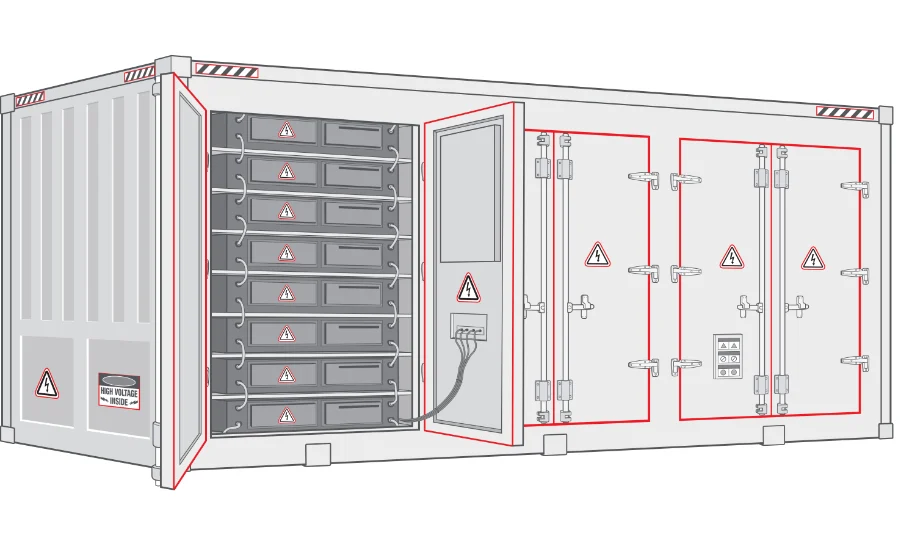
BESS units typically rely on lithium iron phosphate cells—chosen for their thermal stability and longevity—grouped meticulously into modules, large packs, and containerized outdoor units. Within these tight spaces, adhesives do much more than simply hold components together; they act as critical electrical insulators and thermal barriers.
Avery Dennison’s new suite of tapes is divided into specific performance tiers:
- Flame Tough™ Adhesives: Designed to mitigate thermal runaway propagation, these acrylic- and rubber-based formulations feature proprietary flame-retardant properties. They enable manufacturers to bind fragile thermal barriers—such as mica sheets, aerogel pads, and ceramic paper—into cohesive, multi-layer packs without destroying the underlying materials.
- Volt Tough™ Dielectric Tapes: Engineered to withstand the rigors of high-voltage environments exceeding 1,000 volts DC. These tapes insulate individual cells, busbars, cooling plates, and module housings, protecting against electrical breakdown.
- No-Cure Assembly Solutions: By replacing traditional liquid adhesives and structural resins, these pressure-sensitive tapes eliminate the need for mixing equipment, messy dispensing nozzles, and lengthy curing cycles, allowing for seamless integration into automated factory floors.
Chronology: The Evolution of BESS Manufacturing Challenges
To understand the significance of Avery Dennison’s latest offering, it is helpful to examine the rapid evolution of the energy storage sector over the past decade.
Phase One: The Automotive Spillover (Early-to-Mid 2010s)
In the early days of commercial grid-scale energy storage, manufacturers largely borrowed battery components and manufacturing methodologies directly from the electric vehicle (EV) sector. While automotive batteries prioritize high energy density and compact footprints to maximize driving range, stationary BESS units have vastly different operational profiles. They are stationary, often massive in scale, and subjected to decades of continuous cycling in varying outdoor climates.
Phase Two: Scaling Up and The Safety Imperative (2018–2022)
As global clean energy mandates accelerated, BESS installations grew from localized pilot projects to massive, multi-megawatt grid-support stations. With this massive scaling came heightened scrutiny regarding safety. High-profile incidents involving thermal runaway in energy storage facilities prompted international regulatory bodies to tighten safety codes (such as NFPA 855 in the United States). Manufacturers rushed to incorporate robust thermal barriers—like aerogel pads and mica sheets—into their designs. However, engineers quickly discovered that these materials were difficult to work with using traditional mechanical fasteners or liquid glues.
Phase Three: The Shift to Specialized Materials (2023–Present)
Recognizing that off-the-shelf industrial tapes were insufficient for next-generation energy storage, chemical and materials science companies began developing application-specific solutions. The introduction of Avery Dennison’s BESS-focused portfolio represents the culmination of this trend: a targeted effort to engineer adhesives specifically around the chemical, electrical, and mechanical realities of modern grid-scale storage units.
Supporting Data: Technical Specifications and Performance Metrics
The demands placed on materials inside a modern BESS unit are extreme. Operating environments routinely feature high mechanical stress, fluctuating temperatures, and electrical potentials exceeding 1,000 volts DC.
Thermal Management and Fragile Substrates
Thermal runaway—a self-accelerating chain reaction where a single failing cell overheats and triggers neighboring cells—remains the single greatest engineering challenge in battery design. To combat this, manufacturers interleave thermal barriers like aerogel pads, ceramic paper, and mica sheets between cells.

The challenge lies in the physical nature of these materials: they are notoriously fragile, prone to shedding microscopic fibers, and easily crumbled during manual or semi-automated handling. Avery Dennison’s Flame Tough™ portfolio provides an elastomeric or acrylic carrier matrix that supports these delicate sheets. This allows manufacturers to process thermal barriers as stable rolls, die-cut them to exact specifications, and laminate them into multi-layer configurations without destroying the structural integrity of the barrier material.
High-Voltage Dielectric Integrity
With utility-scale systems pushing operating voltages past the 1,000V DC threshold to maximize transmission efficiency, the risk of electrical arcing and short-circuiting is ever-present. The Volt Tough™ dielectric tapes have been rigorously tested to ensure they can withstand extreme electrical loads.
According to company data, these materials undergo rigorous breakdown voltage and dielectric strength evaluations in accordance with international standards:
- GB/T 1408.1-2016: The Chinese national standard for determining the dielectric strength of insulating materials.
- ASTM D3755: The standard test method for dielectric breakdown voltage and dielectric strength of solid electrical insulating materials under direct-voltage stress.
By meeting these stringent benchmarks, the tapes ensure that busbars, cooling plates, and aluminum module housings remain electrically isolated, even under prolonged high-stress operation.
Manufacturing Efficiency and Automation Metrics
Beyond safety and insulation, the economic viability of green energy infrastructure hinges on manufacturing throughput. Traditional liquid adhesives and structural epoxies introduce significant bottlenecks to the factory floor:
- Cure Times: Liquid adhesives often require minutes or even hours to cure chemically or thermally before subsequent assembly steps can occur.
- Equipment Overhead: Dispensing systems require constant calibration, purging, and maintenance to prevent clogging and inconsistent bead sizes.
- Mess and Waste: Liquid application carries a high risk of over-application, leading to material waste and contamination of sensitive electrical contacts.
Pressure-sensitive adhesives eliminate these variables entirely. They provide instant bonding upon contact, allowing battery modules to move immediately down automated assembly lines. Furthermore, the tapes can be precision die-cut to achieve tight dimensional tolerances—a crucial feature when packing hundreds of prismatic or pouch cells into a rigid module housing. To further enhance factory automation, Avery Dennison offers these tapes in distinct color variants, enabling machine vision systems to quickly detect, inspect, and verify proper placement on the production line.
Industry Implications: Transforming Production and Safety Standards
The introduction of specialized adhesive technologies has far-reaching implications for the entire energy storage ecosystem, touching manufacturing economics, supply chain resilience, and public safety.
1. Accelerating Time-to-Market for Tier-1 Manufacturers
As global demand for grid storage surges, battery pack assemblers are under intense pressure to increase production volume without sacrificing quality. By eliminating cure times and integrating smoothly with high-speed, automated die-cutting and pick-and-place machinery, PSA tapes help reduce cycle times. For manufacturers operating multi-gigawatt-hour (GWh) factories, even fractional improvements in assembly speed translate to massive operational cost savings and increased yearly output.
2. Raising the Bar for BESS Safety Compliance
Public and regulatory perception of energy storage safety is delicate. A single thermal event at a commercial utility site can stall local approvals, damage public trust, and invite heavy regulatory intervention. By providing robust, integrated solutions for thermal propagation barriers and high-voltage insulation, material innovations like Flame Tough™ and Volt Tough™ give system integrators a reliable tool to achieve compliance with stringent international fire and electrical safety codes. This reduces liability and protects capital investments over the 15-to-20-year operational lifespan typical of modern storage facilities.
3. Enabling Advanced Thermal Architecture
As energy density increases, managing heat dissipation becomes exponentially more difficult. Batteries perform best within narrow temperature windows; too hot, and degradation accelerates; too cold, and capacity plummets. Adhesives in a BESS do not just hold components together—they form the thermal interface between cells and cooling plates. By engineering tapes that maintain high bond strength while optimizing thermal transfer, manufacturers can design more compact, efficient cooling systems that prolong battery life and improve overall round-trip efficiency.
Conclusion
The green energy transition is ultimately a manufacturing challenge. While much of the public focus centers on the chemistry of the cathode and anode, the physical assembly, insulation, and thermal management of those components are what dictate whether a battery system will operate safely and efficiently for decades.
Avery Dennison’s new portfolio of pressure-sensitive tapes demonstrates a sophisticated understanding of the modern BESS manufacturing environment. By solving the dual problems of fragile thermal barrier handling and high-voltage electrical insulation—while simultaneously unlocking the speed and precision of automated assembly—these materials bridge the gap between laboratory battery chemistry and rugged, industrial-scale deployment. As the world continues to wire itself for a renewable future, innovations on the factory floor will remain the unsung heroes of the clean energy revolution.