





In the modern global economy, the outsourcing of logistics services has evolved from a simple cost-cutting measure into a sophisticated strategic partnership. Today, approximately 80% of businesses engage with Third-Party Logistics (3PL) providers to manage their supply chain operations. As these partnerships become more complex, the spotlight has shifted toward the structural integrity of the contracts that govern them.
For companies looking to outsource their warehousing—or those seeking to renegotiate existing agreements—the contract is not merely a legal document; it is the blueprint for operational success. This guide explores the nuances of 3PL warehousing contracts, the criticality of pricing mechanisms, and the strategic foresight required to ensure long-term viability in an increasingly volatile market.
The Strategic Imperative: Why Outsource?
The primary driver for outsourcing is no longer just the pursuit of lower overheads. While cost reduction remains a significant objective, many organizations realize that replicating an in-house operation at a lower cost while still allowing the provider to maintain a healthy profit margin is mathematically challenging.
Instead, the true value proposition of outsourcing lies in operational flexibility. By offloading warehousing to a 3PL, firms gain the ability to scale up or down in response to market demand, seasonal fluctuations, and rapid business expansion. Furthermore, when an in-house operation is plagued by inefficiencies or lack of expertise, a 3PL can integrate these processes into a larger, more optimized network, unlocking economies of scale that would be impossible for an individual company to achieve alone.
The Anatomy of a 3PL Contract
A 3PL contract is a legally binding framework that defines the partnership’s scope, service levels, and financial obligations. Industry experts often point to a sobering statistic: approximately 80% of a company’s supply chain costs are "locked in" during the initial design and facility location phase. Consequently, post-implementation cost reductions are notoriously difficult to achieve.
Most failures in outsourced logistics are not the result of poor performance by the 3PL, but rather the result of "information asymmetry"—where the customer fails to disclose critical operational data, or the contract is constructed without a clear alignment of incentives.
Defining Expectations: The Role of Service Level Agreements (SLAs)
A robust contract must explicitly detail the scope of work. This includes:
- Performance Metrics: Defining what constitutes "on-time" delivery, inventory accuracy, and pick-and-pack efficiency.
- Operational Constraints: Setting clear boundaries on handling, storage, and throughput capacity.
- Remediation Processes: Establishing how the parties will handle disputes before they escalate to litigation.
The Cost vs. Price Dilemma
A common pitfall for organizations is treating logistics outsourcing as a commodity procurement exercise. When the overriding goal is the lowest possible unit price, quality invariably suffers.
The Importance of Data Transparency
To build a sustainable commercial framework, both parties must conduct a deep-dive analysis of operational data. This involves:
- SKU Profiling: Analyzing size, weight, and velocity of all Stock Keeping Units.
- Order Patterns: Reviewing historical order line items to forecast future resource requirements.
- Resource Mapping: Using this data to calculate the exact number of pick locations, labor hours, and equipment needs required to execute the operation.
By having a shared understanding of these requirements, the 3PL and the client can create a pricing model that reflects reality rather than guesswork.
Pricing Mechanisms: Choosing the Right Model
There are three primary archetypes for warehousing contract pricing, each with distinct advantages and risks.
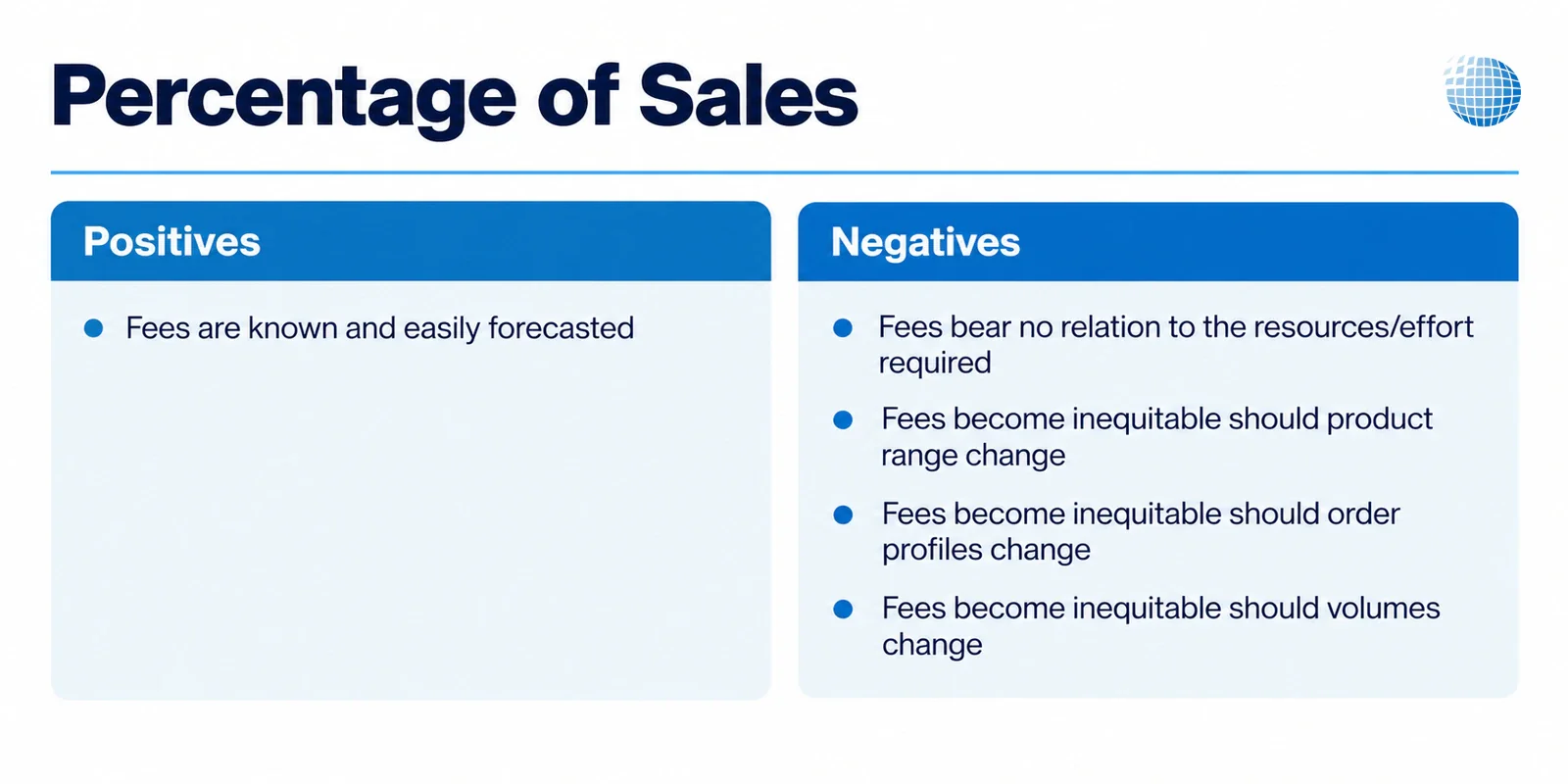
1. Percentage of Sales
This approach is often criticized as a "lazy" pricing strategy. It involves charging the client a set percentage of the value of goods processed.

- Pros: Simple to administer.
- Cons: It often bears no relation to the actual labor or storage costs involved. It fails to incentivize efficiency, and the client receives no benefit from the 3PL’s potential economies of scale.
2. Rate-Based Pricing
This is the industry standard for a reason. It uses specific rates for specific activities (e.g., cost per pallet storage, cost per line item picked, cost per unit packed).
- Strategic Advantage: It creates a fair, transparent cost structure that mirrors the actual work performed.
- Best Practice: Most effective contracts combine a fixed monthly management fee (to cover the 3PL’s overhead and fixed facility costs) with variable rates based on volume. This ensures that the 3PL is compensated for the resources they dedicate to the client while providing the client with predictable costs during fluctuations in volume.
3. Gain Sharing
Gain sharing is a performance-based incentive that can be applied to almost any contract. If either party identifies an innovation that reduces operating costs, those savings are split between the two entities (a 50/50 split is the industry benchmark).
- Implication: Without a gain-sharing clause, there is a distinct lack of incentive for the 3PL to innovate. In fact, if a 3PL makes an improvement that reduces the labor required, they may actually lose revenue under a strictly volume-based rate card. Gain sharing aligns the interests of both parties toward continuous improvement.
Performance-Based Logistics (PBL)
Borrowing from the US defense sector, Performance-Based Logistics (PBL) shifts the focus from inputs (how many hours were worked) to outcomes (how well the job was done).
In a PBL model, the 3PL’s profit margins are directly tied to performance targets. If the 3PL exceeds accuracy and speed benchmarks, their profit increases. If they fall short, the profit is docked. This approach fosters a culture of excellence without immediately endangering the core business relationship. However, it is vital to include "escalation clauses," ensuring that persistent underperformance leads to a reduction in base fees, not just profit, while maintaining mediation channels to prevent unnecessary termination of the contract.
Legal Protections and Risk Management
No matter how strong the relationship, a contract must account for the unexpected.
Duration and Renewal
Contracts typically span one to five years. It is essential to include clear renewal terms and, equally importantly, defined termination notice periods. This allows both parties to plan for contingencies, such as the transition to a new provider or the bringing of operations back in-house.
Warranty, Damage, and Liability
The contract must explicitly state the 3PL’s liability for lost or damaged goods. These clauses should cover:
- Insurance Requirements: Minimum coverage levels for the 3PL.
- Claims Procedures: The step-by-step process for filing and resolving damage claims.
- Liability Limits: Defining the maximum dollar value of the 3PL’s responsibility to prevent catastrophic financial exposure.
Strategic Implications: Moving Forward
The success of an outsourcing engagement is determined long before the first box is shipped. It begins with the rigorous analysis of internal data and the creation of a contract that encourages cooperation rather than conflict.
As supply chains become more integrated and consumer expectations for speed rise, companies that treat their 3PL as a strategic partner—rather than a vendor—will gain a significant competitive edge. The "locked-in" costs of poor design can haunt a balance sheet for years; therefore, investing time in the contracting phase is not an administrative burden, but a vital business investment.
Whether you are embarking on a new outsourcing journey or looking to revitalize a stale agreement, the principles remain the same: transparency in data, fairness in pricing, and a shared commitment to continuous improvement. By moving away from commodity-based thinking and toward value-based partnerships, businesses can transform their logistics operations into a engine for growth rather than a source of operational friction.
Disclaimer: This guide is intended for informational purposes. When drafting or amending legal contracts, always consult with qualified legal counsel and supply chain experts to ensure compliance with regional laws and industry-specific requirements.