





By Damian Brett
Published in Air Cargo News
Main Facts
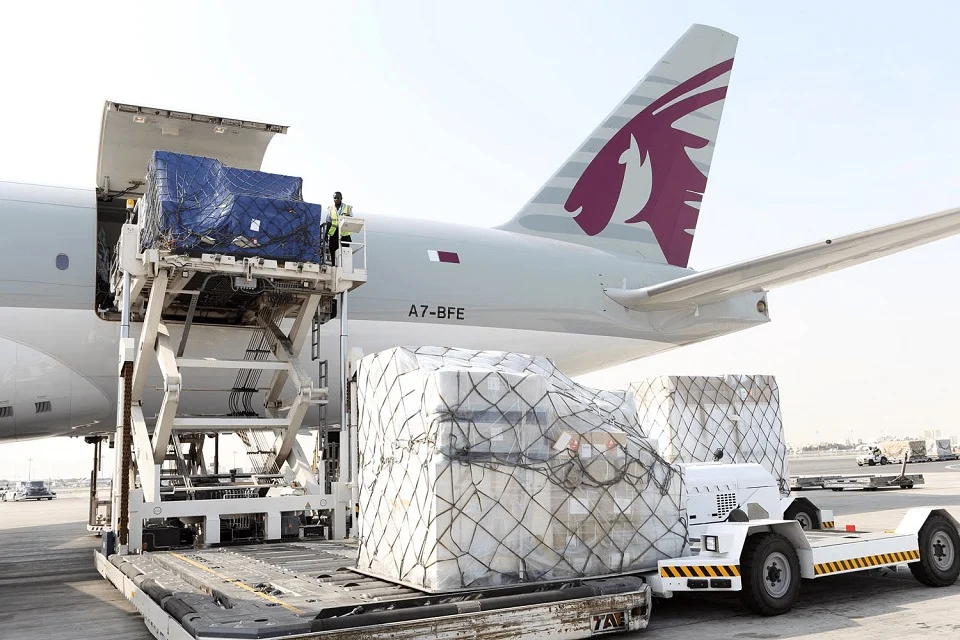
Qatar Airways Cargo has officially unveiled a major expansion of its global freighter network, introducing strategic new services tailored to meet escalating international trade demands ahead of the upcoming winter season. The carrier is leveraging its state-of-the-art Boeing 777 freighter (777F) fleet to bridge key economic hubs across Europe and North America.
The primary components of this winter network rollout include:
- Copenhagen, Denmark: A new weekly Boeing 777 freighter route operating on a Doha–Budapest–Copenhagen–Doha loop, launching on October 25.
- Warsaw, Poland: A direct freighter service operating on a Doha–Warsaw–Chicago–Brussels–Doha routing, scheduled to commence on October 26.
- New York (JFK) and Atlanta, USA: A transatlantic weekly 777F rotation routing Doha–Liège–New York (JFK)–Atlanta–Liège–Doha, effective November 1.
- Dallas, USA: An additional weekly Boeing 777 freighter service routing Doha–Liège–Dallas–Doha.
These new routes are engineered to support specialized vertical sectors, including pharmaceuticals, healthcare, aerospace, advanced technology, energy, perishables, time-sensitive shipments, automotive vehicles, and oversized industrial freight. The expansion directly reinforces Qatar Airways Cargo’s expansive global footprint, which now spans more than 160 specialized cargo destinations.
Chronology of Network Enhancements
The rollout of Qatar Airways Cargo’s winter schedule has been systematically structured to align with seasonal shifts in global supply chain demand, optimizing asset utilization while offering seamless connectivity for manufacturers and freight forwarders.

October 25: Unlocking Northern European Exports
The winter schedule kicks off with the introduction of the Copenhagen service. Operating once a week, the Boeing 777F flight is strategically routed through Budapest before arriving in the Danish capital, subsequently returning to Doha. This specific multi-stop routing is designed to capture surging export volumes originating from Denmark as well as neighboring Southern Sweden, where high-tech and pharmaceutical products require rapid deployment to Middle Eastern and Asian markets.
October 26: Bridging Central Europe with North America
Just one day later, on October 26, the carrier will inaugurate its Warsaw freighter connection. Utilizing a complex and highly efficient multi-hub routing loop (Doha–Warsaw–Chicago–Brussels–Doha), the service gives Polish manufacturers and exporters direct, uninhibited capacity access to the lucrative United States market via Chicago—one of North America’s premier cargo gateways.
November 1: Deepening Transatlantic Capacity
Entering November, Qatar Airways Cargo will further solidify its North American presence. Effective November 1, the carrier introduces a weekly Boeing 777F service linking Doha and Liège with New York’s John F. Kennedy International Airport (JFK) and Atlanta. This trans-Atlantic loop complements a previously quiet rollout of an additional weekly 777 freighter flight routing Doha–Liège–Dallas–Doha, amplifying the airline’s capacity profile across the southern and eastern United States.
These adjustments are part of a broader industry-wide realignment. Major carriers have aggressively optimized their winter schedules in recent weeks; for instance, Air Canada Cargo announced expansions into Europe and Latin America, while Lufthansa Cargo bolstered its Asia-Pacific capacity to capture seasonal spikes.
Supporting Data and Capacity Metrics
To fully understand the impact of Qatar Airways Cargo’s winter schedule, one must examine the profound scaling of cargo capacity across the carrier’s bellyhold and main-deck freighter networks. The combination carrier model allows Qatar Airways to offer robust redundancy and scalability for its freight forwarder clientele.

Copenhagen Capacity Boost
- Freighter Frequency: 1x weekly Boeing 777F.
- Complementary Capacity: 10 weekly Boeing 787 passenger flights servicing Copenhagen.
- Bellyhold Yield: Over 100 tonnes of capacity in each direction, every week.
- Synergy: The introduction of the 777F allows the airline to lift oversized or bulk commodities that exceed the physical dimensions or weight constraints of wide-body passenger aircraft bellies.
Poland Operations Expansion
- New Warsaw Service: Direct Boeing 777F operations commencing October 26.
- Existing Freighter Footprint: Twice-weekly freighter services to Katowice.
- Passenger Integration: 10 weekly wide-body passenger flights operating into Warsaw.
- Total Capacity Metric: The combined network adjustments elevate total cargo capacity to and from Poland to more than 435 tonnes each way, every week. This establishes Qatar Airways Cargo as a dominant logistics pipeline connecting Central European industrial heartlands with global markets.
North American Transatlantic Scale
- New York (JFK) Operations: The weekly 777F service (Doha–Liège–JFK–Atlanta–Liège–Doha) adds to an existing baseline of 14 weekly bellyhold flights operating to and from New York.
- Total New York Capacity: Combined belly and main-deck operations will surge the weekly cargo capacity on the route to more than 226 tonnes each way.
- Global Reach: These North American nodes feed directly into Qatar Airways Cargo’s hub at Doha Hamad International Airport (DOH), allowing cargo originating in Dallas, Atlanta, or New York to seamlessly connect onward to over 160 destinations worldwide.
Official Responses and Strategic Intent
In an official press release detailing the winter network enhancements, airline representatives emphasized the deliberate focus on high-yield, specialized verticals.
"All these services will cater to key industries including pharmaceuticals and healthcare, aerospace, technology and energy, perishables, high-value and time-sensitive shipments, vehicles and oversized cargo, as well as general and industrial shipments while providing customers access to the airline’s global network of over 160 destinations," the airline stated.
The carrier specifically highlighted the strategic value of the Warsaw route for Polish exporters. By tying Warsaw into a loop that includes Chicago—a major global pharmaceutical and e-commerce distribution hub—and Brussels—Europe’s premier pharma-handling airport—Qatar Airways Cargo is directly targeting the life sciences and temperature-controlled logistics sectors, which demand unbroken cold chains and rapid transit times.
Furthermore, by positioning Liège as a pivotal European touchpoint on its North American loops, the airline is tapping into one of Europe’s most robust dedicated cargo communities, allowing for seamless interline transfers and trucking operations across Western Europe.
Implications for the Global Air Cargo Market
The introduction of these winter schedule freighter connections carries several important implications for the international supply chain landscape:
- Mitigation of Seasonal Bottlenecks: As global supply chains brace for peak season shopping periods and year-end inventory balancing, the injection of massive wide-body freighter capacity (such as the 435+ weekly tonnes in Poland and expanded US lift) helps stabilize freight rates and prevents localized capacity crunches.
- Strengthening the Combination Carrier Advantage: By pairing high-frequency wide-body passenger bellies with dedicated Boeing 777 freighters, Qatar Airways Cargo demonstrates the structural resilience of the combination carrier model. Shippers benefit from the frequency of passenger schedules coupled with the payload flexibility and volume of main-deck freighters.
- Intensified Transatlantic Competition: With carriers like Air Canada, Lufthansa Cargo, and Qatar Airways all adjusting their networks simultaneously, the transatlantic and Europe-to-Americas corridors are witnessing fierce competition. Forwarders and beneficial cargo owners (BCOs) stand to benefit through enhanced service reliability, competitive pricing, and expanded routing options.
- Support for Advanced Manufacturing and Pharma: The targeted inclusion of hubs like Warsaw, Copenhagen, and Dallas underscores the air cargo sector’s ongoing evolution toward high-value, non-cyclical commodities. As pharmaceutical manufacturing and high-tech semiconductor supply chains demand greater security and speed, airlines deploying modern, fuel-efficient freighters like the Boeing 777F are best positioned to capture long-term market share.