
By Roland Wooster
Chairman, VESA Display Performance Metrics Task Group
Variable refresh rate (VRR) technology has quickly transitioned from a niche enthusiast feature into a fundamental baseline requirement across modern digital displays. Whether evaluating high-end gaming monitors, professional editing rigs, or everyday consumer laptops, native support for Adaptive-Sync protocols is now ubiquitous. Supported broadly by modern graphics processing units (GPUs) and standardized display interfaces like HDMI and DisplayPort, VRR has fundamentally changed how hardware synchronizes frame delivery to eliminate screen tearing and minimize stutter.

However, as VRR adoption has scaled massively across the consumer electronics landscape, the display industry has run into a significant transparency hurdle: ensuring that performance claims made by manufacturers are consistent, directly comparable, and reflective of actual behavior in the wild.
Two displays can advertise identical headline specifications—such as 144 Hz, 240 Hz, or even higher refresh rates—yet deliver vastly different user experiences. These discrepancies stem from hidden variables, including gray-to-gray (G2G) transition behavior, overdrive-induced visual artifacts, micro-flicker, jitter, and complex frame handling characteristics. Consequently, relying on spec-sheet numbers alone makes true apples-to-apples comparisons nearly impossible for engineers, OEMs, and everyday consumers alike.

The Pitfalls of Cherry-Picking Performance
The root of the problem lies in historical testing and marketing methodologies. For years, display manufacturers have leaned heavily on isolated, best-case metrics to market panel capabilities.
Take G2G response time as a primary example. G2G measures the duration required for a pixel to transition from one shade of gray to another. In marketing materials, this metric is routinely reported as a single, highly optimized "best-case" value representing the fastest transition the panel can achieve. Yet, in real-world usage, G2G performance fluctuates wildly depending on the specific shade transition taking place. Highlighting only the absolute fastest transition obscures the sluggishness of harder-to-manage transitions, giving a false impression of overall display speed.

Furthermore, testing environments can heavily distort performance metrics. For instance, raising a panel’s internal temperature can dramatically improve measured response times—sometimes cutting transition times in half with only modest increases in ambient room temperature.
To counteract sluggish pixel response and artificially lower G2G figures on spec sheets, manufacturers often employ aggressive pixel overdrive settings. While overdrive can successfully quicken response times, pushing it too far introduces severe visual artifacts, most notably inverse ghosting and trailing artifacts. Without standardized, real-world test methodologies, these disparate testing conditions and marketing tricks render raw performance claims essentially incomparable.

A More Rigorous Approach to VRR Measurement
While underlying Adaptive-Sync protocols dictate how a GPU and display coordinate refresh timing, they do not inherently regulate how well a display performs while executing those instructions. Recognizing this standardization gap, the Video Electronics Standards Association (VESA) introduced the Adaptive-Sync Display Compliance Test Specification (CTS), accompanied by the recognized AdaptiveSync and MediaSync logo programs.
The Adaptive-Sync Display CTS was engineered specifically to evaluate panels under strict conditions that reflect actual, everyday usage rather than isolated laboratory extremes. Rather than boiling display performance down to a single subjective metric, the CTS delivers a multi-dimensional assessment encompassing over 50 distinct test criteria enforced through automated, repeatable methodologies.
This approach introduces several strict guardrails designed to eliminate traditional marketing biases:
- Averaged G2G Response Times: G2G performance is calculated as an average across multiple transition paths, entirely eliminating best-case bias.
- Controlled Overdrive Tolerances: Strict limits are placed on overshoot and undershoot, forcing manufacturers to carefully balance pixel response speed against visual fidelity.
- Trained Ambient Environments: Testing conditions—such as ambient room temperature—are tightly controlled (between 72.5°F and 76°F / 22.5°C and 24.5°C) to prevent thermal anomalies from artificially inflating performance scores.
- Comprehensive Flicker & Jitter Metrics: Flicker and frame jitter are explicitly defined and measured across all major international video frame rate standards used for media playback, including EDID Minimum, 23.976, 24, 25, 29.97, 30, 47.952, 48, 50, 59.94, and 60Hz.
This insistence on rigorous measurement ensures that a display’s certified tier directly aligns with what users perceive visually.

Evolving with New Display Capabilities
As underlying display technologies—ranging from high-refresh IPS and OLED to microLED—continue to evolve rapidly, the standards governing them must adapt in lockstep. VESA’s test specification version 1.1 marked a major leap forward, expanding both the scope and precision of compliance testing.
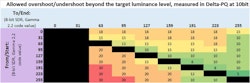
A prime example is the transition from a traditional 5×5 G2G test matrix to a much broader 9×9 G2G test matrix, which dramatically increases coverage of real pixel response behavior. Additionally, the specification replaced fixed percentage-based limits for overshoot and undershoot with Perceptual Quantization (PQ)-based limits when overdrive is enabled. By tying measurement thresholds to human visual sensitivity, the standard aligns much more closely with how the human eye actually perceives visual artifacts, resulting in significantly tighter undershoot allowances.

These Delta-PQ tolerance values are evaluated across precise gray-level transitions using the SMPTE ST 2084 transfer function. If overdrive is active, limits dictate how many transitions are permitted to overshoot or undershoot without failing certification, ensuring that aggressive factory tuning does not degrade the user experience.
Moreover, recent standard updates accommodate bleeding-edge display capabilities, such as factory overclocking modes and "dual-mode" operations (which allow panels to switch dynamically between high-resolution/lower-refresh and lower-resolution/ultra-high-refresh configurations). To achieve VESA certification under these conditions, original equipment manufacturers (OEMs) must subject displays to rigorous testing at both out-of-the-box factory defaults and maximum overclocked states at native resolution. For dual-mode certifications, every single requirement of the CTS must be successfully satisfied across all tested resolutions, including maintaining a floor of 144 Hz at maximum resolution and at least 1080p vertical resolution in reduced-resolution modes.

Building on the Proven DisplayHDR Model
The creation of the Adaptive-Sync Display program didn’t happen in a vacuum; it was built upon the highly successful framework established by VESA’s DisplayHDR specification. DisplayHDR proved conclusively that open, industry-wide, front-of-screen performance standards could successfully drive market transparency, eliminate consumer confusion, and accelerate the adoption of higher-quality hardware.
By applying this validated philosophy to variable refresh rates, VESA addressed a different yet equally critical dimension of overall display quality. The development of the standard reflects unprecedented, cross-industry collaboration involving panel manufacturers, major GPU vendors, system OEMs, and component suppliers.
The industry response has been overwhelmingly positive. To date, more than 300 distinct display models have achieved certification under the Adaptive-Sync Display program. This rapid, widespread adoption underscores a shared industry realization: the market desperately needed a credible, consistent methodology to characterize display performance. For OEMs, certification provides a trusted mechanism to market product quality based on verifiable metrics rather than inflated spec-sheet claims.
Establishing Clear Benchmarks for the Future of VRR
As variable refresh rate technology solidifies its place as an uncompromised baseline feature in modern computing and entertainment, the competitive battleground has shifted entirely to execution quality. Achieving smooth, artifact-free motion requires standardized, transparent, and reproducible testing protocols.
By defining exactly how VRR performance must be measured—and anchoring those measurements firmly in real-world operating conditions—the Adaptive-Sync Display CTS provides a reliable foundation for meaningful comparisons across competing displays.
For hardware engineers and product designers, this clarity enables more consistent system architecture and honest product differentiation. For the broader market, it grants consumers and enterprise buyers alike a dependable set of metrics to evaluate how well a display performs, moving the conversation past simple binary feature support ("Does it have VRR?") to a deeper understanding of true visual excellence.