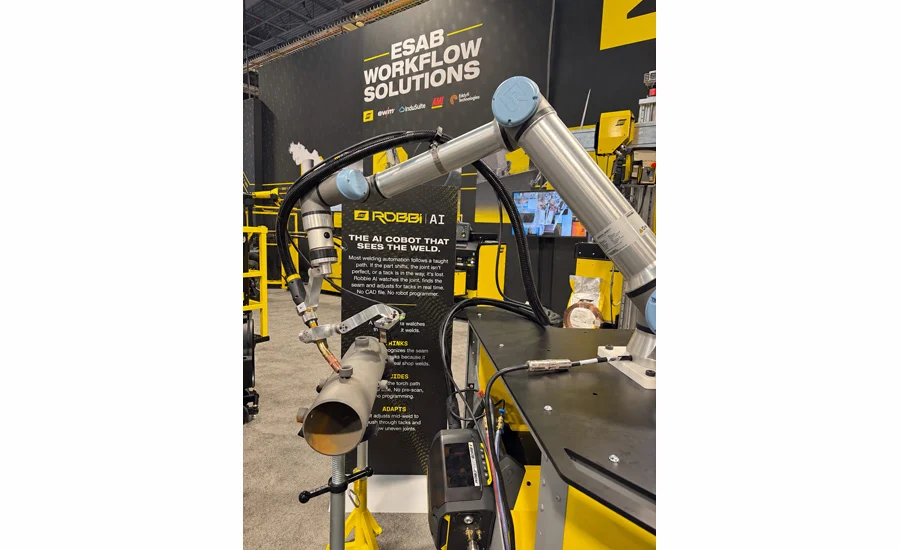
NORTH BETHESDA, MD — In a development poised to reshape the landscape of modern manufacturing and automated metal fabrication, ESAB has officially introduced ROBBI AI. This advanced collaborative robot (cobot) system leverages physical artificial intelligence (AI) to dynamically sense, interpret, and respond to real-time, unpredictable conditions during both Metal Inert Gas (MIG) and Tungsten Inert Gas (TIG) welding operations.
Unlike conventional industrial automation systems that strictly depend on rigid, pre-programmed robot paths and fixed welding sequences, ROBBI AI integrates advanced optical sensing—specifically high-resolution cameras and laser technology—to assess the immediate welding environment. The system can autonomously make critical decisions in real time, adjusting its physical welding motion, travel speed, oscillation, and process parameters on the fly as environmental variables shift. Designed to drastically simplify deployment, ROBBI AI eliminates the labor-intensive requirement for human operators to manually "teach" complex weld paths, even when managing multiple distinct parts fixtured simultaneously on a single work table.
Compatible with industry-leading power sources including the EWM Titan XQ, EWM Tetrix XQ, and ESAB Aristo Edge, the system is engineered specifically to tackle some of the manufacturing sector’s most notoriously difficult welding challenges. These include high-mix, low-volume production runs, intricate pipe fabrication, specialized TIG applications, and projects suffering from inconsistent joint fit-ups—areas that have traditionally demanded highly skilled human welders and resisted automation.
Main Facts: Understanding the ROBBI AI System
At its core, ROBBI AI represents a major leap forward by embedding physical AI directly into heavy industrial processes. Dan Colvin, Vice President for Advanced Technology Solutions at ESAB, encapsulates the breakthrough: "Physical AI brings intelligence directly into the welding process. Instead of programming every movement and anticipating every possible variation, ROBBI AI assesses the joint, determines how to proceed, and makes adjustments while welding. It is also designed to learn from every weld, helping it recognize conditions that can lead to defects and respond by adjusting welding parameters or stopping the weld when needed."
Key System Specifications and Capabilities:
- Autonomy Without Manual Teaching: ROBBI AI generates its own precise weld paths. Operators simply position the cobot at or near the joint, input basic parameters derived from standard Welding Procedure Specifications (WPS)—such as material type, consumable details, and joint classification—and initiate the sequence.
- Real-Time Adaptability: If a joint gap inadvertently opens or closes during a pass, the cobot automatically modifies its travel motion, oscillation width, or arc parameters dynamically within safe, predefined parameters.
- Edge Computing Architecture: All critical AI processing takes place locally on an onsite facility computer rather than relying on an external, cloud-based architecture. This ensures immediate decision-making at the point of weld and keeps proprietary operational data secure onsite.
- Hardware Configurations: Built around a Universal Robots UR10e or UR20e six-axis robot arm, the system can be mounted on a specialized seventh-axis configuration to expand reach and part envelopes. It can also be integrated into a mobile, wheeled cart equipped for organized component storage and shop floor mobility.
Chronology: The Evolution Toward Physical AI in Welding
To understand the disruptive nature of ROBBI AI, it is helpful to examine the historical trajectory of robotic and automated welding technologies over recent decades.
1. Traditional Robotic Welding (Pre-2010s)
For decades, robotic welding was synonymous with high-volume, highly repetitive manufacturing lines—such as automotive body assembly. These systems required absolute precision in part stamping and fixture alignment. If a part varied by even a millimeter, or if a joint fit-up drifted, the robot would blindly follow its programmed path, frequently resulting in weld defects, burn-throughs, or incomplete fusion. Programming these systems required specialized robotic engineers spending hours at the teach pendant.
2. The Rise of Seam Tracking and Basic Cobots (2010s–2020s)
As sensors improved, adaptive technologies such as through-arc seam tracking (TAST) and laser-based vision systems emerged. These tools allowed robots to compensate for minor deviations in real time. Concurrently, collaborative robots (cobots) entered the market, designed to work safely alongside humans without safety fencing. While cobots lowered the barrier to entry through hand-guiding and simplified interfaces, they still fundamentally relied on predefined paths and struggled significantly with high-mix, low-volume chaos or complex TIG operations.
3. The Introduction of Physical AI (Present)
With the launch of ROBBI AI, ESAB bridges the gap between software-based artificial intelligence and physical industrial execution. By combining multi-modal sensor inputs (cameras and lasers) with localized machine learning algorithms, the technology moves past simple seam tracking into genuine autonomous decision-making. The system evaluates the environment, executes the weld, analyzes the metallurgical and visual results post-weld, and stores localized data to refine future performance.
Supporting Data: Power Sources, Hardware, and Performance Metrics
ROBBI AI’s effectiveness is heavily amplified by its compatibility with ESAB and EWM’s elite suite of welding power sources. Each power source brings specialized capabilities tailored to specific industrial sectors:
EWM Titan XQ (MIG/MAG Welding)
- Features conventional, pulsed, and advanced welding modes.
- Integrates EWM React, a proprietary technology that actively controls wire movement and droplet transfer.
- Performance Gain: Achieves up to 100 percent faster welding speeds, significantly higher overall weld quality, and a 35 percent reduction in heat input compared to standard short-arc welding methods.
EWM Tetrix XQ DC and AC/DC (TIG Welding)
- Delivers versatile conventional and pulsed TIG capabilities.
- Utilizes the EWM tigSpeed Drive 45, which continuously feeds the welding consumable as cold wire (mirroring MIG mechanics) where it is melted by the arc to form the seam.
- Hot Wire Functionality: Uses an integrated power source to preheat the welding consumable before feeding it into the weld puddle. This increases deposition rates by up to 60 percent compared to conventional manual TIG welding.
ESAB Aristo Edge and Warrior Edge Series
- Aristo Edge 500R: Provides advanced weld modes, including advanced pulse, craft, and speed processes.
- Warrior Edge 500 CX/DX: The DX variant introduces specialized thin-material, root-pass, and root-pipe weld modes, expanding the cobot’s utility in critical structural and pressure vessel applications.
Official Responses: Insights from ESAB Leadership
The commercial introduction of ROBBI AI arrives at a critical juncture for industrial manufacturing, which continues to grapple with an aging workforce and a persistent skilled labor shortage. ESAB executives emphasize that the technology is not designed to replace skilled professionals, but rather to augment human capabilities and protect procedural compliance.
Addressing how the system maintains quality control while utilizing AI, Dan Colvin noted: "We use our existing InduSuite software to help keep AI-driven welding decisions within predefined welding procedure specifications and qualification requirements. ESAB’s approach is designed to reduce the risk of AI-driven adjustments that could result in welding outside those specifications or with an unapproved procedure."
Colvin further underscored the philosophical shift represented by the product: "With ROBBI AI, we are extending the role of AI beyond digital analysis and into the physical welding process—where intelligent decisions can directly influence how a weld is made."
Implications: Addressing the Welder Shortage and Expanding Automation
The broader implications of ROBBI AI for the manufacturing, fabrication, and assembly sectors are profound. For years, heavy industries such as data center construction, pipe fabrication, aerospace, and heavy equipment manufacturing have faced a bottleneck: jobs requiring high-skill TIG welding or dealing with high-mix, low-volume parts cannot easily be automated using traditional robotics. Programming a robot for a run of five custom pipes is economically unviable.
By streamlining setup—eliminating manual path teaching—and accommodating natural part-to-part variations, ROBBI AI democratizes advanced welding automation.
Key Industry Impacts:
- Mitigating the Labor Shortage: As experienced welders reach retirement age, facilities can deploy cobots like ROBBI AI to handle intricate, demanding welds, allowing human operators to transition into supervisory, programming, or quality-assurance roles.
- Unlocking Complex Automation: TIG welding, long considered an art form requiring years of specialized training, can now be executed with consistent, repeatable high quality, thanks to hot-wire feeding and adaptive AI path generation.
- Continuous Improvement Loops: Because ROBBI AI logs weld data and video locally, every completed project contributes to a traceable digital archive. If a weld anomaly occurs, the system stops operations, allowing operators to review the incident, provide feedback, and continuously train the AI to preempt similar defects in future production runs.
As manufacturers look toward the future, technologies like ROBBI AI signal a definitive turning point: automation is no longer restricted to mass-production monotony. Through physical AI, even the most chaotic, variable, and skill-intensive shop floor environments can finally achieve scalable, high-precision automation.