By David Manners
Published: October 2026
Main Facts
The global electronics and semiconductor landscape in 2026 is defined by a striking paradox: while overall manufacturing output is experiencing historic, unprecedented acceleration, traditional consumer hardware markets are enduring a punishing slump. According to recent data compiled by Semiconductor Intelligence, worldwide electronics production has entered a robust upward trajectory, fueled almost entirely by the insatiable, capital-intensive expansion of artificial intelligence (AI) infrastructure.
However, this AI-driven boom has created a severe zero-sum ecosystem for critical components. The insatiable demand for high-bandwidth memory (HBM), DRAM, and flash storage from AI data centers has created immense supply chain bottlenecks. Consequently, memory costs have skyrocketed by an astronomical 350% year-over-year by the third quarter of 2026.
This hyper-inflation of memory components has inflicted severe collateral damage on mainstream consumer electronics. Shipments of personal computers (PCs) and smartphones have plummeted dramatically, as original equipment manufacturers (OEMs) struggle to absorb soaring component costs or pass them onto price-sensitive consumers. What emerges is a tale of two distinct sectors: a high-flying industrial engine powered by generative AI hardware modules, and a struggling consumer electronics market forced to grapple with unprecedented supply shortages and pricing pressure.
Chronology of the 2026 Electronics Shift
The trajectory of the global electronics market throughout 2026 illustrates a rapid and volatile pivot toward AI-centric manufacturing, accompanied by a sharp squeeze on consumer hardware:
- Late 2025 (The Turning Point): Following a prolonged post-pandemic correction period, global electronics production hit a definitive inflection point around October 2025. Industrial metrics bottomed out, and year-over-year production comparisons began shifting from contraction to steady recovery, particularly in Western economies.
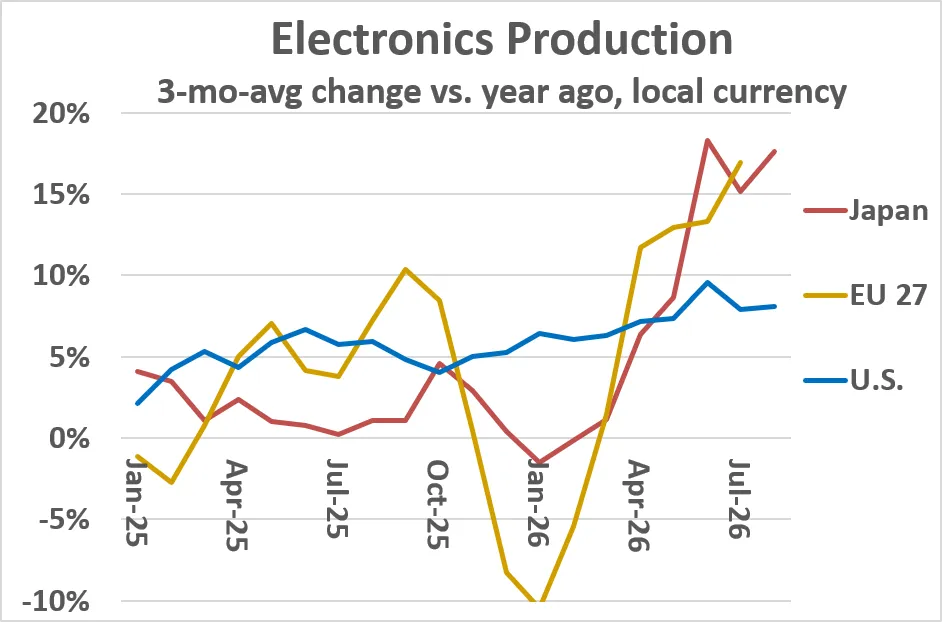
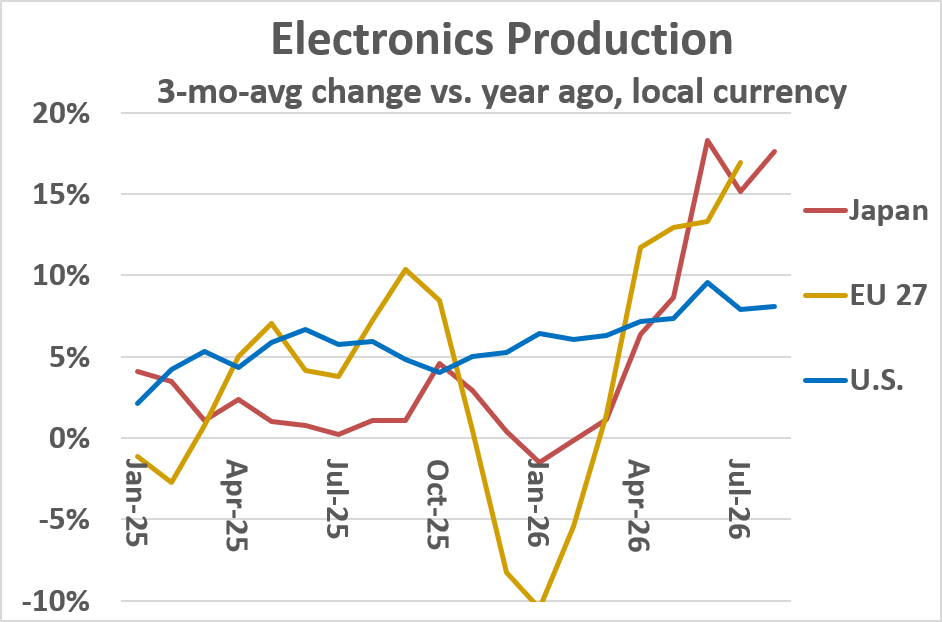
- January 2026 (Regional Divergence): At the start of the year, regional recovery was uneven. While the U.S. was already seeing positive momentum, major international hubs were lagging. Japan’s electronics production contracted by 1.5% year-over-year, and the European Union’s 27 member states (EU 27) faced a steep 10.5% decline. Meanwhile, Taiwan had already begun its exponential climb, driven by early waves of high-performance computing (HPC) and AI module assembly.
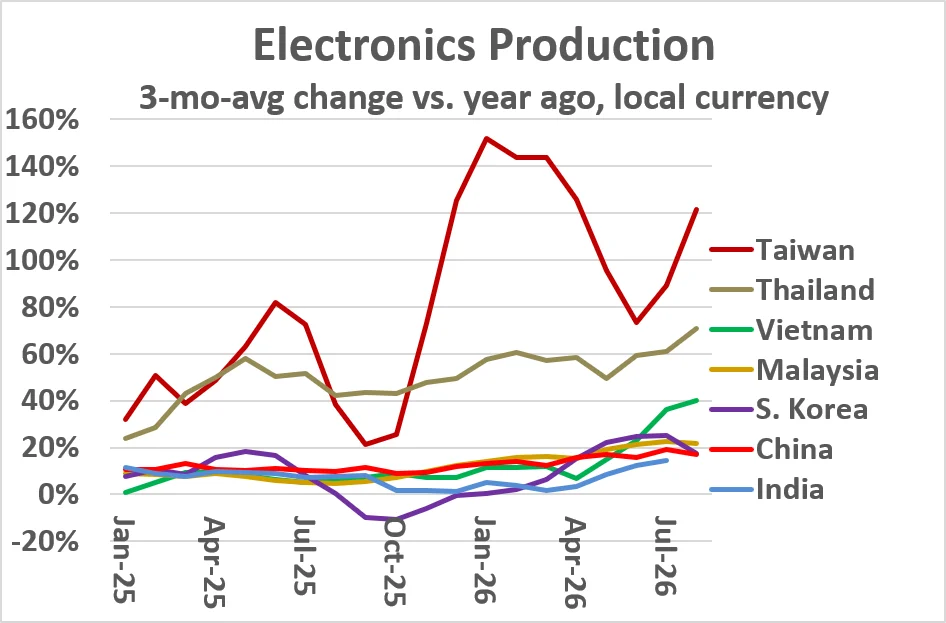
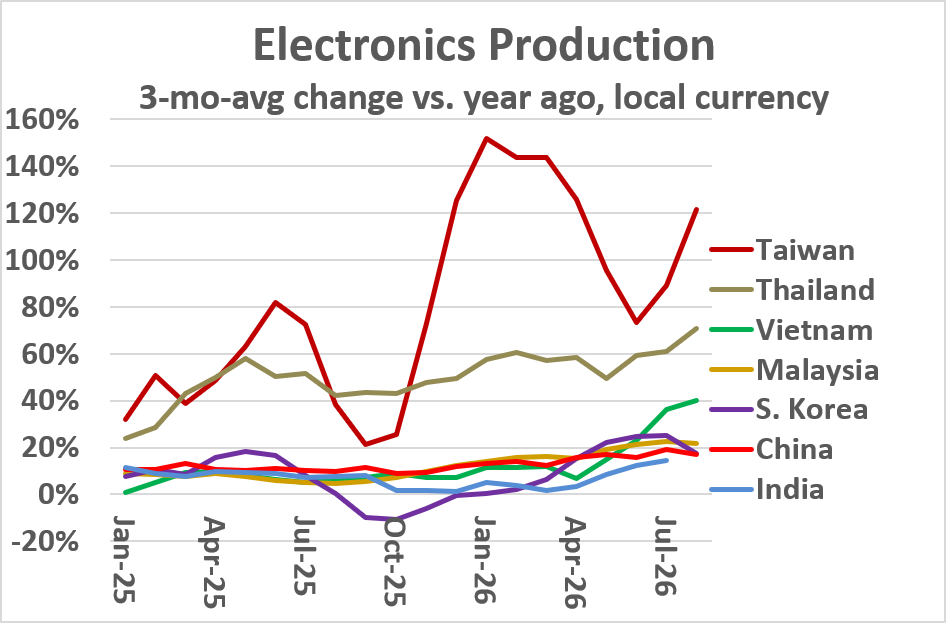
- Spring to Mid-2026 (The Asian Manufacturing Surge): Driven by surging global orders for Nvidia-powered AI modules, Taiwanese electronics production doubled, maintaining three-month-average growth rates exceeding 100% for the vast majority of the year. Simultaneously, secondary manufacturing hubs across Southeast Asia—including Thailand, Vietnam, and Malaysia—experienced rapid production scaling.
- Q3 2026 (The Consumer Crunch): By the third quarter of 2026, the compounding effects of AI infrastructure consumption triggered a severe memory crunch. IDC figures revealed that memory component costs had surged 350% compared to the same period in 2025. This component starvation immediately crippled mainstream hardware shipments, leading to double-digit percentage drops in global PC and smartphone deliveries.
- August–October 2026 (Stabilized Industrial Growth): Data compiled through late 2026 demonstrates that while consumer markets contract, overall industrial output remains resilient. U.S. three-month-average electronics production growth reached 8.1% by August 2026. Japan completely reversed its early-year slump to record a 17.6% increase by August, and the EU 27 rebounded to 16.9% growth by July 2026.
Supporting Data and Regional Metrics
The sheer scale of the 2026 electronics production boom is laid bare by economic and manufacturing indices across North America, Europe, and Asia.
Western Recovery and Stabilization
- United States: The three-month-average change in electronics production versus the previous year hit 8.1% in August 2026. This sustained a steady, uninterrupted acceleration trend that first took root in October 2025.
- Japan: Demonstrating one of the most dramatic turnarounds of the year, Japanese electronics production swung from a 1.5% contraction in January 2026 to a staggering 17.6% year-over-year increase by August 2026.
- European Union (EU 27): European manufacturing showed comparable resilience, bouncing back from a steep 10.5% decline in January 2026 to record 16.9% growth by July 2026.
The Asian Powerhouse and Supply Chain Hubs
Asia remains the undisputed epicentre of global hardware manufacturing, though performance metrics highlight a stark division between AI-focused assembly and traditional consumer device fabrication:
- Taiwan: Taiwan’s electronics sector recorded phenomenal figures throughout 2026, sustaining three-month-average growth rates exceeding 100% for most of the year. This massive expansion was anchored by Taiwan Semiconductor Manufacturing Company (TSMC), which mass-produces advanced integrated circuits (ICs), alongside domestic partners specializing in assembling these ICs into complex, high-margin AI modules.
- Thailand & Vietnam: Capitalizing on electronics supply chain diversification, Thailand posted a 71% year-over-year production increase in August 2026. Vietnam followed closely with a robust 40% growth rate.
- Malaysia, South Korea, & China: Traditional manufacturing powerhouses also saw solid gains. Malaysia recorded 22% growth in August 2026, South Korea achieved an 18% increase, and China—despite domestic economic headwinds—posted a 17% rise.
- India: Continuing its ascent as a mobile and electronics manufacturing alternative, India’s production index rose by 14% as of July 2026.
The Consumer Hardware Downturn
In stark contrast to industrial production metrics, data compiled by the International Data Corporation (IDC) illustrates a severe contraction in personal computing and mobile communications hardware:
- PC Shipments: Global PC shipments in the third quarter of 2026 plummeted by 20% compared to the same period in 2025. IDC projects a total annual decline of 11.3% for the full year of 2026.
- Smartphone Deliveries: Smartphone shipments fared even worse, registering a 22% year-over-year decline in Q3 2026, with an anticipated annual drop of 13.9% across the board.
- The Root Cause (Memory Inflation): According to market analyses, this hardware slump is not a reflection of collapsing consumer demand, but rather a direct symptom of severe supply constraints. IDC reports that memory costs (encompassing both DRAM and flash memory) spiked by a punishing 350% in Q3 2026 compared to the previous year, as hyper-scalers and AI server builders bought up available wafer capacity.
Official Responses and Market Analysis
Industry analysts and market research bodies have responded to the 2026 manufacturing landscape with warnings regarding the sustainability of current supply chain dynamics.
Representatives from Semiconductor Intelligence noted that while the macroeconomic picture for electronics manufacturing appears overwhelmingly positive on paper, the underlying composition of this growth is dangerously lopsided. The extraordinary capital expenditures poured into artificial intelligence data centers have effectively cannibalized silicon and component allocation that would otherwise support the consumer PC and smartphone sectors.
IDC market analysts emphasized that memory manufacturers are pivoting aggressively toward high-margin enterprise products—such as High Bandwidth Memory (HBM3e and HBM4) required for next-generation AI accelerators—at the direct expense of legacy consumer-grade DRAM and NAND flash lines. This strategic shift has left PC and smartphone OEMs in a difficult bind: they are forced to either accept compressed profit margins by absorbing component price hikes or raise retail prices, which inevitably dampens consumer demand.
Furthermore, supply chain logistics experts point out that while Southeast Asian manufacturing hubs like Thailand, Vietnam, and Malaysia are thriving, their growth is increasingly tied to the export of high-end server racks, networking equipment, and specialized AI module sub-assemblies rather than consumer electronics.
Implications for the Global Electronics Industry
The structural shifts observed in 2026 carry profound, long-term implications for the global technology ecosystem:
- Margin Compression for Consumer OEMs: Major PC and mobile brands face a protracted period of financial pressure. As long as artificial intelligence hyper-scalers continue to outbid consumer brands for advanced memory and semiconductor packaging capacity, consumer hardware vendors will struggle with volume growth. Unless memory manufacturers bring new fabrication plants (fabs) online faster than currently projected, high component pricing may become the new baseline for consumer electronics.
- Geographic Realignment of Manufacturing: The heavy concentration of AI module assembly in Taiwan and surrounding Southeast Asian nations underscores the continuing vulnerability of the global tech supply chain to localized disruptions. At the same time, the impressive growth rates in India, Vietnam, and Thailand validate ongoing efforts by multinational corporations to de-risk their supply chains away from single-nation dependencies.
- The Evolution of Capital Expenditure (CapEx): Semiconductor foundries and outsourced semiconductor assembly and test (OSAT) providers are experiencing a historic reallocation of capital. Investment is overwhelmingly flowing into advanced packaging (such as chip-on-wafer-on-substrate or CoWoS), extreme ultraviolet (EUV) lithography, and high-speed interconnects. Consequently, traditional consumer silicon nodes may experience under-investment, potentially leading to structurally higher component costs for everyday electronics for years to come.
- A Redefinition of "Industry Growth": Traditionally, global electronics production indices moved in tandem with consumer spending cycles on PCs, laptops, and smartphones. The events of 2026 signal a permanent decoupling of these metrics. Moving forward, a booming electronics production index no longer guarantees a healthy consumer hardware market; instead, it serves primarily as a barometer for enterprise-level data center expansion and the global artificial intelligence arms race.