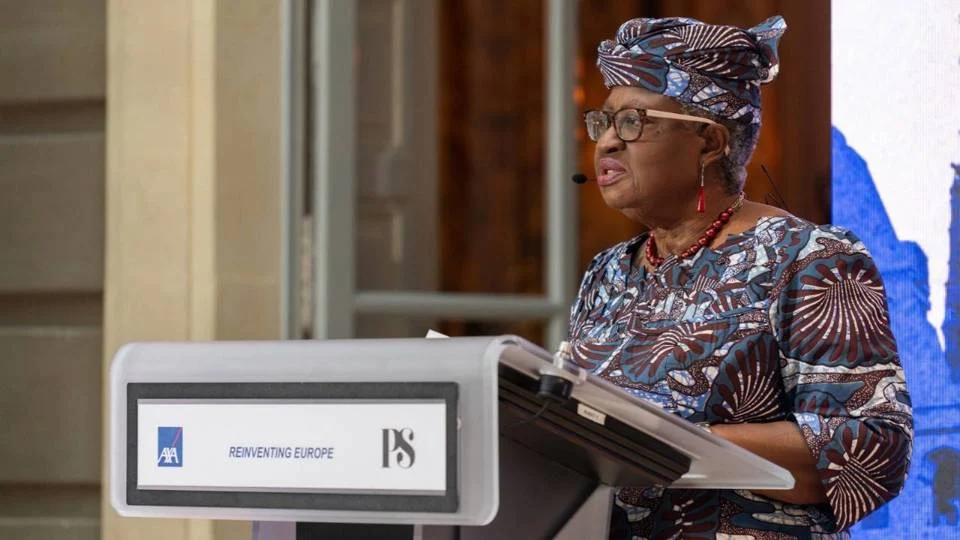
BRUSSELS / GENEVA — In a wide-ranging and forward-looking keynote address delivered during the high-profile Project Syndicate event Reinventing Europe, World Trade Organization (WTO) Director-General Ngozi Okonjo-Iweala challenged prevailing narratives of terminal European decline. Urging policymakers, economists, and industry leaders to shift away from alarmism, Okonjo-Iweala emphasized that the true path to European reinvention lies not in dismantling existing frameworks out of panic, but in systematically recognizing, preserving, and building upon foundational institutional strengths.
Addressing an elite audience of global thinkers and economic strategists, the WTO chief argued that while Europe faces undeniable external pressures—ranging from fierce technological competition between the United States and China to volatile geopolitical fault lines—its core economic machinery remains remarkably robust. Her remarks served as both a cautionary tale against knee-jerk protectionism and an optimistic blueprint for fostering external competitiveness through measured reform, strategic partnerships, and a revitalized economic bridge with the African continent.
Main Facts
The central thesis of Ngozi Okonjo-Iweala’s keynote address centers on the paradox of "reinvention." When societies and economies seek to transform themselves, they frequently commit the critical error of overlooking what already functions exceptionally well.
- Resilience of the Global Trading System: Contrary to widespread declarations that globalization is dead and that multilateral trade institutions are obsolete, the global trading system has demonstrated astonishing resilience in the face of compounding shocks, including the COVID-19 pandemic, supply chain disruptions, energy crises, and major regional conflicts.
- Europe’s Undervalued Strengths: While Europe lacks a consumer-facing digital monopoly or mega-tech conglomerate on the scale of Silicon Valley giants or Chinese state-backed tech titans, the European Union remains a dominant global trade powerhouse. Furthermore, it continues to lead the world in fundamental science, academic research, industrial depth, and regulatory standard-setting.
- The Danger of Panic: Okonjo-Iweala explicitly warned against policymaking driven by existential dread. Acting from a sense of panic risks destabilizing open markets, eroding multilateral norms, and triggering defensive, zero-sum economic policies that ultimately undermine long-term growth.
- The Africa Opportunity: A cornerstone of the Director-General’s prescription for European economic revitalization is the deepening of trade and investment ties with Africa—a rapidly industrializing continent boasting a young demographic, vast critical mineral reserves, and expanding consumer markets.
Chronology: The Context of Europe’s Economic Search for Identity
To fully understand the weight of Okonjo-Iweala’s interventions at the Reinventing Europe forum, it is vital to trace the historical and economic sequence of events that has brought the European Union to its current crossroads.
2008–2016: The Poly-Crisis Era
Europe’s modern struggle with competitiveness began in earnest with the 2008 Global Financial Crisis, which rapidly morphed into the Eurozone Sovereign Debt Crisis. During this period, deep structural divergences between Northern and Southern member states exposed vulnerabilities in the monetary union. Simultaneously, the rise of the platform economy and cloud computing revealed a widening tech gap between the US, China, and Europe.
2018–2020: The Trade War and Pandemic Shocks
As protectionist currents gained momentum globally—marked by US-China trade tensions—Europe found itself squeezed between two economic superpowers. The subsequent outbreak of the COVID-19 pandemic in 2020 laid bare Europe’s heavy reliance on external supply chains for medical goods, semiconductors, and energy, prompting intense debates over "strategic autonomy."
2022–2023: The Energy Shock and the Draghi Wake-Up Call
The outbreak of the war in Ukraine in 2022 severed Europe’s access to cheap Russian natural gas, triggering an energy price shock that severely damaged energy-intensive European industries, particularly in Germany. This crisis catalyzed a profound introspection, culminating in high-level policy reviews regarding European industrial policy. This period was heavily defined by the preparation of former European Central Bank President Mario Draghi’s landmark report on European competitiveness, published in late 2024, which warned that the EU faced a slow economic agony unless it dramatically boosted productivity, innovation, and investment.
2024–2026: The Pivot Toward Pragmatism and Global Partnership
By 2026, the European discourse shifted from unvarnished pessimism to a search for pragmatic execution. It was within this dynamic climate that Okonjo-Iweala delivered her address, urging European leaders to look beyond internal regulatory tinkering and forge authentic, mutually beneficial economic corridors with the Global South—most notably Africa.
Supporting Data: Europe’s Economic Standing in Figures
An analysis of macroeconomic indicators underscores the nuance of Okonjo-Iweala’s arguments. While Europe lags in venture capital deployment and commercialized consumer tech, its structural footprint in global commerce remains massive.
- Global Trade Share: The European Union remains the world’s largest trading bloc when combining intra- and extra-EU trade, accounting for roughly 15% of total global merchandise and services trade.
- Research and Development (R&D): European institutions and universities consistently capture a disproportionate share of global citations in high-impact scientific research. Horizon Europe, the EU’s flagship funding program for research and innovation, operates with a budget of €95.5 billion for the 2021–2027 period.
- The Demographic and Economic Weight of Africa: By 2050, Africa’s population is projected to reach 2.5 billion, with over 60% of its population under the age of 25. The African Continental Free Trade Area (AfCFTA), operationalized in recent years, creates a single market of 1.3 billion people with a combined GDP of approximately $3.4 trillion, representing an unprecedented frontier for European investment, green transition partnerships, and sustainable trade.
- Foreign Direct Investment (FDI): Europe remains the world’s leading destination and source of foreign direct investment, anchoring global capital flows despite tightening monetary conditions globally.
Official Responses and Reactions
Ngozi Okonjo-Iweala’s keynote address drew immediate praise, debate, and analysis from international trade officials, European policymakers, and economic analysts.
Proponents of the WTO Chief’s View:
Moderate and reform-minded European trade officials welcomed her emphasis on institutional resilience. Speaking on condition of anonymity, a senior European Commission trade official noted:
"Director-General Okonjo-Iweala is entirely correct to caution us against panic-driven policymaking. In our eagerness to match the industrial subsidies of the United States and the state-directed capitalism of China, Europe must not throw out the rulebook that made us prosperous. Our strength lies in open, rules-based trade, transparent regulatory standards, and deep alliances."
The Competitiveness Hawks:
Conversely, advocates for aggressive industrial intervention—often aligned with the findings of the Draghi report—argued that patience and preservation are insufficient to close the productivity gap with Washington and Beijing. Representatives from prominent European industrial associations pointed out that high energy costs and complex regulatory burdens continue to drive capital away from the continent.
"While we agree that Europe must not panic, we cannot afford complacency," remarked a spokesperson for BusinessEurope. "Preserving what works is important, but unless Europe drastically cuts red tape, unifies its capital markets, and aggressively scales up innovation, our industrial base will continue to experience slow attrition."
Perspectives from the Global South:
African trade delegations and development economists warmly received Okonjo-Iweala’s focus on Europe-Africa economic integration. African Union trade representatives noted that a true partnership based on value-addition manufacturing within Africa—rather than the traditional extraction of raw materials—would unlock unprecedented shared prosperity for both continents.
Implications for the Future of European and Global Trade
The policy implications of Okonjo-Iweala’s address at Reinventing Europe extend far beyond the immediate conference halls of Brussels. They signal a crucial philosophical fork in the road for Western economic strategy.
1. Re-evaluating Industrial Policy vs. Multilateralism
Europe is currently caught in a tension between maintaining its historic commitment to WTO-anchored multilateralism and deploying aggressive domestic subsidies to protect strategic industries (such as semiconductors, clean tech, and electric vehicles). Okonjo-Iweala’s intervention serves as a timely reminder that protectionist spirals ultimately harm export-oriented economies like those in Europe. Policymakers must walk a tightrope: enhancing strategic security without degenerating into destructive trade wars with allies and developing nations.
2. Capitalizing on the Demographic and Resource Complementarity with Africa
Perhaps the most actionable takeaway from the keynote is the imperative to re-orient European external economic policy toward Africa. Europe’s aging population and demand for critical raw materials (such as lithium, cobalt, and rare earths) neatly complement Africa’s youthful workforce, surging entrepreneurial energy, and rich natural endowments. Moving beyond traditional aid relationships toward equal, investment-heavy trade partnerships will be vital for Europe’s long-term resource security and economic relevance.
3. Preserving the "European Model" of Science and Regulation
Rather than attempting to replicate the hyper-commercialized, winner-take-all venture capital ecosystem of the US or the state-directed tech monopolies of China, Europe is being urged to lean into its unique comparative advantage: high standards of consumer protection, robust fundamental scientific research, ethical artificial intelligence governance, and sustainable manufacturing practices. By framing these standards not as bureaucratic hurdles, but as premium global public goods, Europe can command high-value market share without abandoning its core social and political values.
Conclusion
Ngozi Okonjo-Iweala’s address at the Reinventing Europe event cuts through the noise of contemporary economic doomsaying. By reminding global stakeholders that the international trading system and the European economy possess deep, enduring structural pillars of strength, she offers a powerful antidote to defeatism.
For Europe, the path forward does not require tearing down its institutional architecture in a panic. Instead, it demands calm, deliberate, and measured reforms—coupled with an outward-looking strategic vision that embraces new frontiers of partnership, most notably across the Mediterranean with Africa. As the global economy navigates an increasingly fractured geopolitical landscape, Okonjo-Iweala’s message remains clear: resilience is preserved not through isolation or fear, but through confidence, cooperation, and a steadfast commitment to open, rules-based trade.