By Industry News Service
Published: August 2026
Main Facts
As the artificial intelligence (AI) boom places unprecedented demands on global digital infrastructure, Emerson has officially launched its DeltaV Automation Platform for Data Centers. This comprehensive, scalable automation portfolio is specifically engineered to monitor, manage, and optimize the critical infrastructure required to support high-density AI workloads.
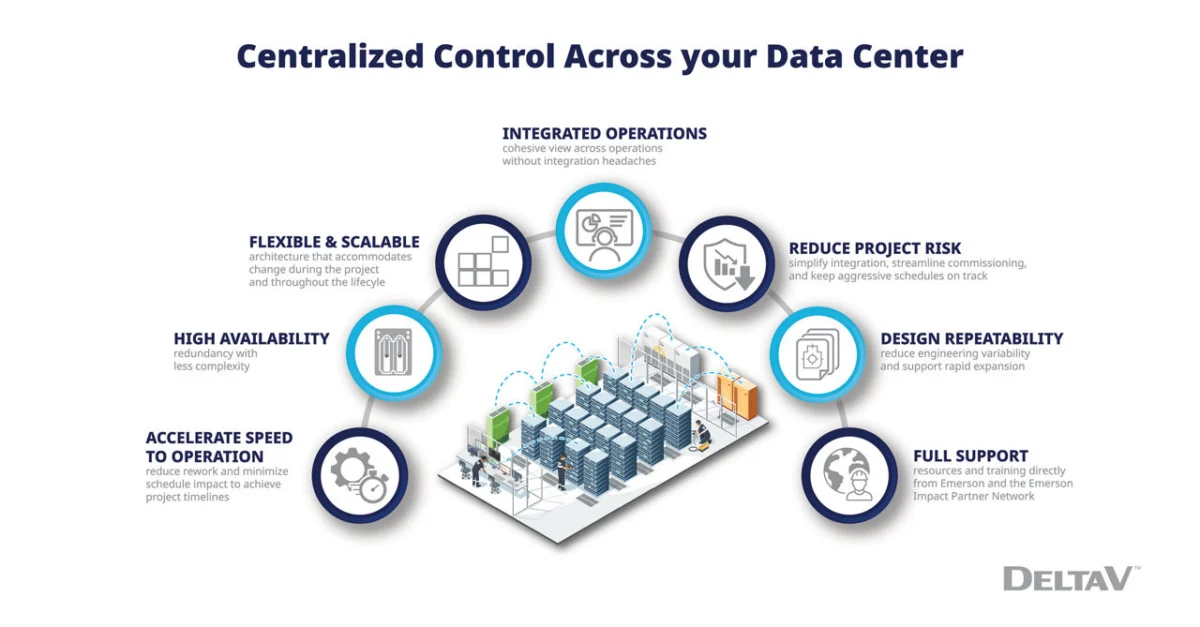
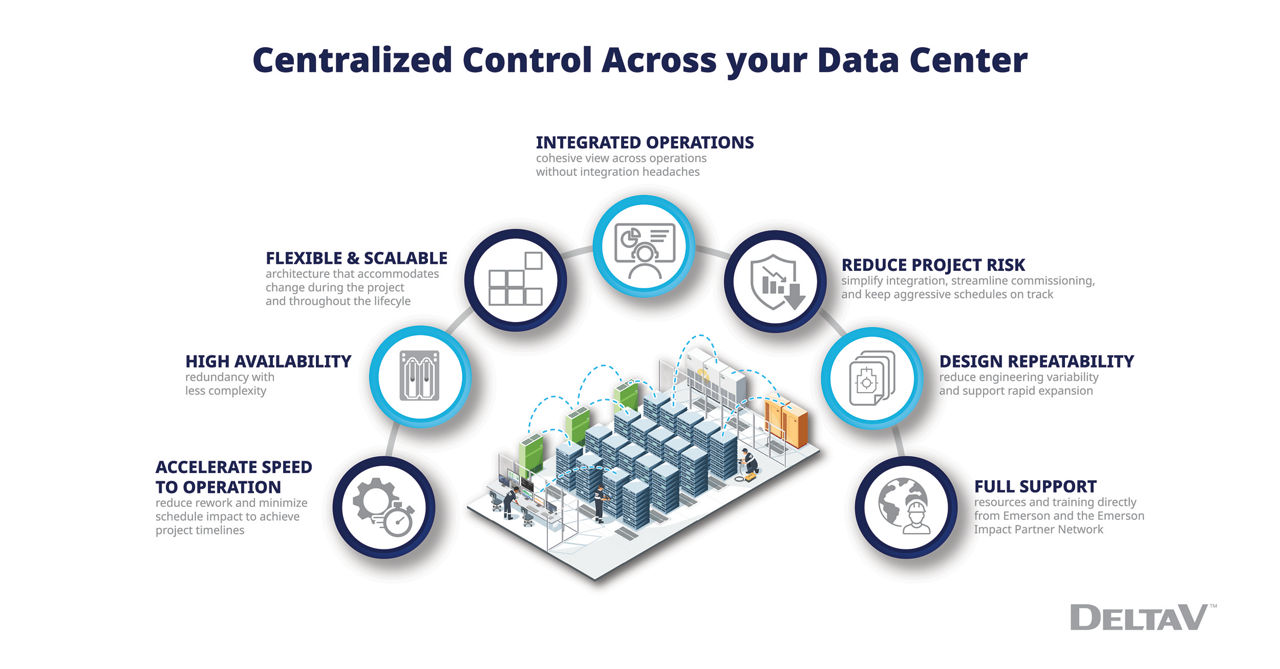
By unifying thermal, mechanical, and electrical subsystems under a single, cohesive automation architecture, the DeltaV platform tackles the growing complexity of modern data center management. At its core, the solution integrates Emerson’s flagship DeltaV Distributed Control System (DCS) with advanced DeltaV Programmable Logic Controllers (PLCs). This hardware-software synergy establishes a synchronized ecosystem capable of real-time process control, context-specific AI engineering support, and seamless integration with third-party AI optimization models.
The platform arrives at a critical juncture for the industry. Traditional data center design and deployment models are struggling to keep pace with the hyper-growth of generative AI, large language models (LLMs), and high-performance computing (HPC) clusters. Emerson’s new portfolio aims to replace fragmented point solutions with an integrated automation approach, significantly reducing engineering hours, streamlining commissioning, and ensuring long-term operational reliability.
Chronology: The Evolution of Data Center Automation
To understand the significance of Emerson’s latest release, it is essential to trace how the data center landscape has evolved over the past decade, culminating in today’s AI-centric infrastructure crisis.
1. The Era of Traditional Enterprise and Cloud Computing (2010–2019)
For much of the 2010s, data centers primarily served enterprise IT, SaaS providers, and early hyper-scale cloud networks. Workloads were relatively predictable, and power densities hovered around 5 to 10 kilowatts (kW) per rack. Infrastructure management relied on disparate, siloed systems: Building Management Systems (BMS) handled HVAC and environmental controls, while separate Power Management Systems (PMS) monitored electrical switchgear and uninterruptible power supplies (UPS). Coordination between these subsystems was largely manual, handled through scheduled maintenance and human operator intervention.
2. The Hyper-Scale Explosion and Early AI Pilots (2020–2023)
The rapid expansion of cloud computing, coupled with the nascent stages of machine learning and deep learning, pushed rack densities upward toward 20 to 30 kW. Operators began facing challenges with thermal management, leading to the widespread adoption of hot/cold aisle containment and early liquid-cooling trials. However, automation remained fragmented. Engineering teams frequently pieced together multi-vendor hardware and software solutions, resulting in extended commissioning times, integration bottlenecks, and vulnerable operational handoffs between electrical, mechanical, and software contractors.
3. The Generative AI Gold Rush and the Compression of Timelines (2024–2025)
The public debut of advanced generative AI models triggered a massive surge in data center construction. Rack densities skyrocketed past 50, 70, and even 100 kW as facilities deployed dense arrays of specialized AI accelerators and graphics processing units (GPUs). This exponential leap in power consumption created extreme thermal management hurdles, rendering traditional air cooling inadequate and forcing a rapid industry-wide pivot to direct-to-chip liquid cooling and advanced immersion technologies. Consequently, project timelines compressed drastically. Developers faced immense pressure to bring multi-megawatt facilities online in record time, exposing the severe inefficiencies of manual subsystem coordination and legacy point-solution architectures.
4. The Unified Automation Paradigm (2026 and Beyond)
Recognizing that legacy control methods could no longer support the velocity and complexity of AI infrastructure, Emerson consolidated decades of industrial automation expertise into the DeltaV Automation Platform for Data Centers. By bringing industrial-grade reliability, unified DCS/PLC frameworks, and embedded AI tools to the data center space, Emerson has established a new benchmark for how mission-critical facilities are designed, commissioned, and operated.
Supporting Data: The Technical Anatomy of the AI Infrastructure Crisis
The urgency behind Emerson’s DeltaV platform is rooted in hard data regarding the physical and operational realities of modern AI workloads.
Power Density and Thermal Realities
Traditional enterprise servers generate manageable heat loads that can be effectively cooled using traditional Computer Room Air Handler (CRAH) units. In contrast, modern AI clusters packed with high-end accelerators draw immense electrical currents and dissipate unprecedented amounts of thermal energy.
- The Wattage Leap: Standard server racks averaging 7–10 kW have been replaced by AI pods demanding 40 kW to upwards of 100 kW per rack.
- Cooling Transformation: At these thermal densities, air cooling alone is physically incapable of preventing hardware throttling or thermal runaway. Facilities must transition to hybrid air-and-liquid or 100% liquid-cooling infrastructures, requiring hyper-precise synchronization between coolant distribution units (CDUs), chillers, pumps, and server-level heat exchangers.
Project Execution and Supply Chain Pressures
Data center development is a high-stakes, capital-intensive endeavor where delays cost millions of dollars in lost revenue and deferred cloud contracts.
- Coordination Complexity: Modern data center projects involve a sprawling network of stakeholders—including civil engineers, electrical contractors, mechanical designers, system integrators, and software developers.
- The Integration Bottleneck: In traditional setups, each subsystem (generators, switchgear, HVAC, fire suppression) arrives with its own proprietary control logic and interface. Integrating these islands of automation typically consumes months of site testing and troubleshooting. By utilizing a unified architecture from day one, operators can bypass extensive custom programming, cutting integration efforts significantly and accelerating time-to-market.
Official Responses and Industry Perspectives
Industry leaders and technical experts have responded enthusiastically to the launch of the DeltaV platform, viewing it as a natural bridge between heavy industrial automation and mission-critical digital infrastructure.
"AI-related data center growth is fundamentally reshaping our industry," notes a leading infrastructure analyst. "Project timelines that used to span three to five years are now being squeezed into 18-to-24-month windows. When you combine those compressed schedules with the extreme thermal realities of high-density AI clusters, manual coordination is no longer a viable option. Operators need industrial-grade reliability from the ground up."
Emerson’s engineering leadership emphasizes that the DeltaV platform was designed specifically to eliminate the traditional boundaries between operational technology (OT) and IT environments.
- Bridging DCS and PLCs: By integrating the DeltaV distributed control system with specialized DeltaV programmable logic controllers, the platform ensures that critical safety, electrical distribution, and environmental control loops operate with deterministic precision.
- Embedded AI for Workflows: Rather than treating AI as merely a workload hosted inside the data center, Emerson has embedded context-specific AI tools within the control platform itself. These tools assist engineering teams during the design phase, automate routine tuning processes during commissioning, and interface smoothly with external machine learning models designed to optimize facility-wide Power Usage Effectiveness (PUE) and Water Usage Effectiveness (WUE).
Implications for the Future of Data Center Operations
The introduction of the DeltaV Automation Platform for Data Centers carries profound implications for the design, construction, and long-term management of digital infrastructure.
1. Shift from Reactive Maintenance to Autonomous Operations
For decades, data center management has leaned heavily on reactive responses to alarms or predictive maintenance schedules based on static run-hours. The integration of advanced DCS/PLC architectures equipped with AI optimization models paves the way for truly autonomous operations. Future facilities will dynamically adjust chiller speeds, valve positions, and electrical load balancing in real time, responding instantaneously to fluctuations in AI compute loads without human intervention.
2. Standardized Commissioning and Risk Mitigation
Commissioning a multi-megawatt data center is notoriously fraught with risk. Integrated automation platforms minimize human error during the testing phase by providing pre-engineered, validated control libraries for standard data center equipment (e.g., generators, ATS units, cooling towers). This consistency ensures that a facility behaves predictably during stress tests, power dips, and emergency failover scenarios.
3. Sustainability and Resource Conservation
With great computing power comes immense energy consumption. As global scrutiny on data center carbon footprints and water usage intensifies, operators are under intense pressure to minimize environmental impact. Unified automation platforms provide the granular visibility and closed-loop control necessary to optimize energy efficiency down to the individual server rack level. By dynamically matching cooling output to exact thermal loads, facilities can drastically reduce wasted energy and water, aligning hyper-scale AI growth with corporate sustainability mandates.
4. A New Standard for Engineering Workflows
Engineering teams facing labor shortages and tight talent pools will benefit heavily from the platform’s context-specific AI workflow tools. By automating repetitive configuration tasks and providing intuitive diagnostic capabilities, Emerson’s platform empowers leaner engineering teams to commission and manage larger, more complex facilities with greater confidence and accuracy.
Conclusion
As the artificial intelligence revolution continues to accelerate, the physical infrastructure supporting it must evolve with equal velocity. Emerson’s DeltaV Automation Platform for Data Centers represents a pivotal shift away from fragmented, manual subsystem integration toward a unified, intelligent, and scalable control paradigm. By bridging industrial control rigor with advanced AI-driven optimization, Emerson is helping data center operators meet the grueling demands of modern computing while laying the groundwork for the fully autonomous data centers of tomorrow.