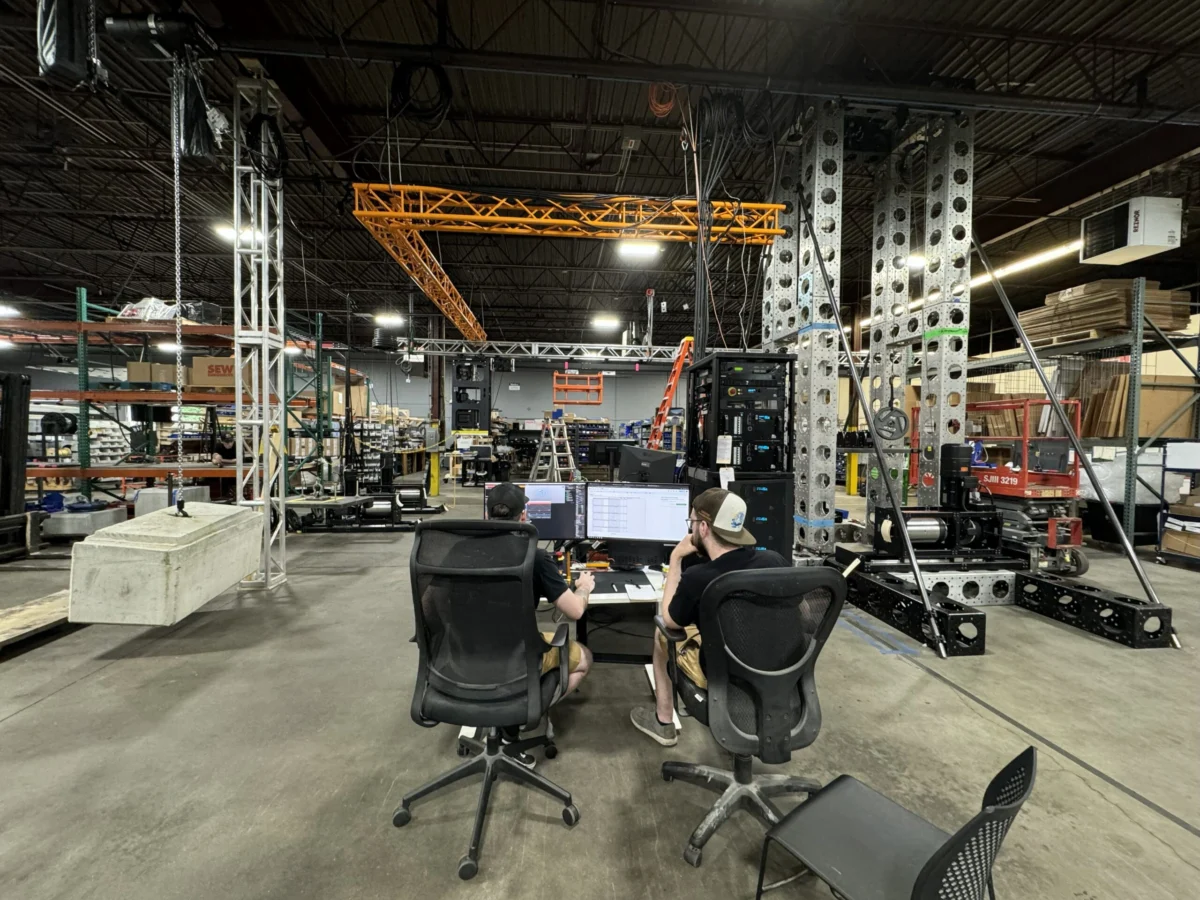
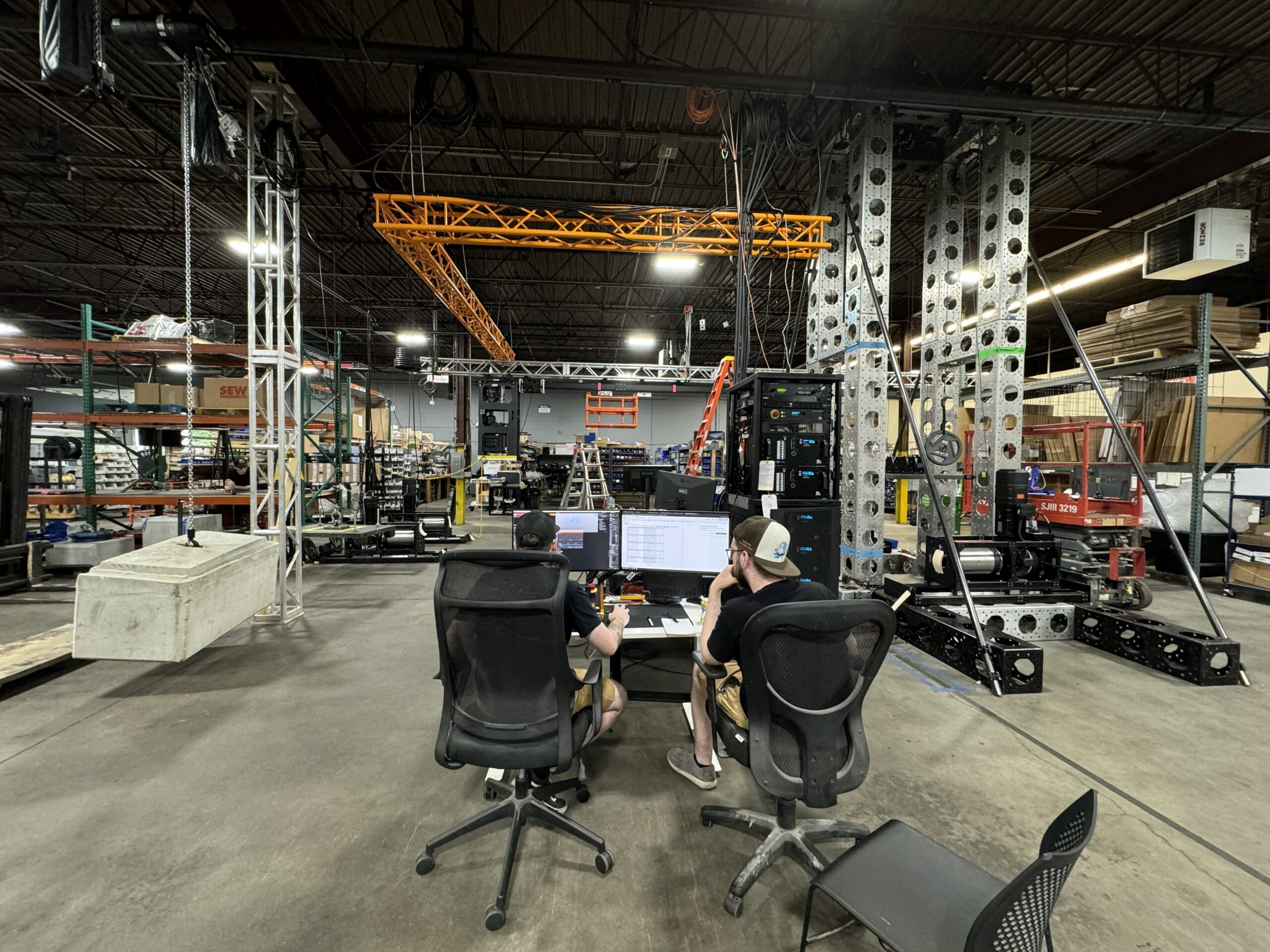
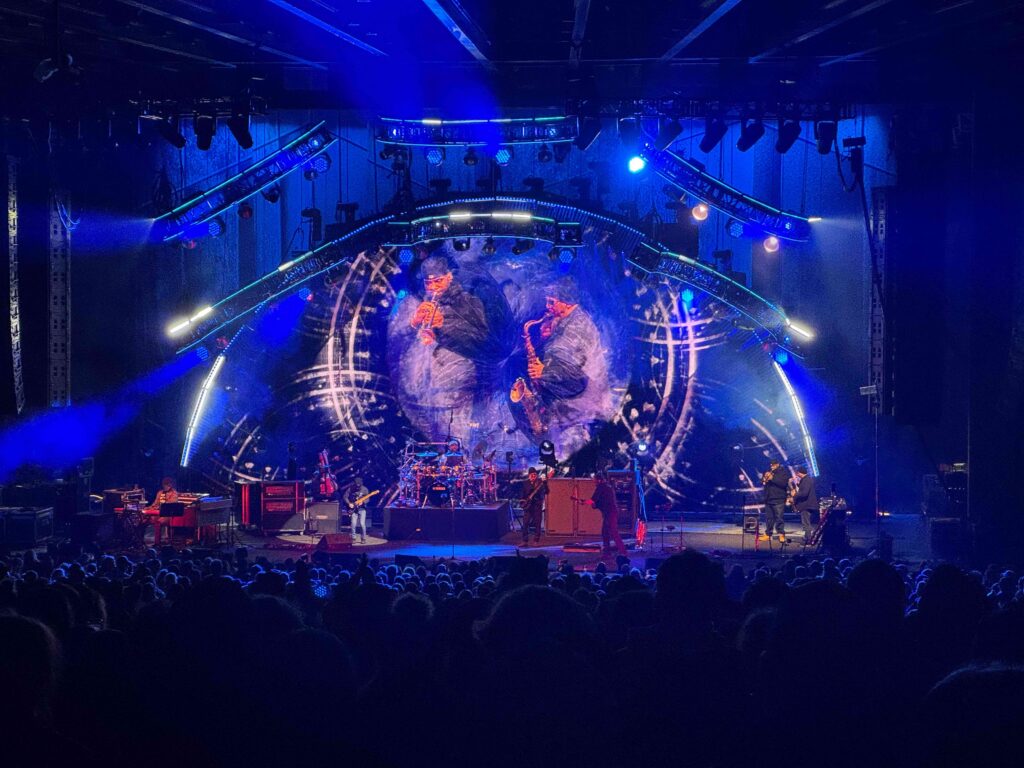
Modern theatergoers, concert enthusiasts, and arena spectators often take for granted the seamless choreography unfolding right before their eyes. Giant LED walls glide effortlessly across massive stages, heavy scenic backdrops transform in fractions of a second, and performers seemingly defy gravity, flying gracefully through the air with pinpoint precision. Behind these visually stunning theatrical feats is a complex web of motion control engineering.
At the forefront of this niche yet intensely demanding industry is Creative Conners, a specialized designer and manufacturer of stage automation machinery, standardized control hardware, and intuitive software. By prioritizing safety, reliability, and approachability, the company has successfully bridged the gap between high-end touring spectacles—such as those by Cirque du Soleil and the Dave Matthews Band—and modest regional theater productions or high school musicals staging Les Misérables.
However, maintaining this versatile balance requires continuous technological evolution. Facing aging hardware, supply chain disruptions, and the rigid constraints of legacy control integrated circuits (ICs), Creative Conners recently undertook a massive overhaul of its core motion control platform. By integrating Performance Motion Devices’ (PMD) Magellan MC58113 motion control IC, the company not only overcame technical limitations but also drastically accelerated its software development lifecycle, ensuring its stage automation systems remain among the safest and most capable in the entertainment industry.
1. Main Facts: The Intersection of Hardware, Software, and Show Business
The scale and scope of stage automation present a unique engineering challenge. Unlike industrial factory automation, where a robotic arm repeats the exact same trajectory millions of times within a sterile environment, theatrical automation must adapt to variable environments, shifting load weights, tight performance schedules, and rigorous safety demands.
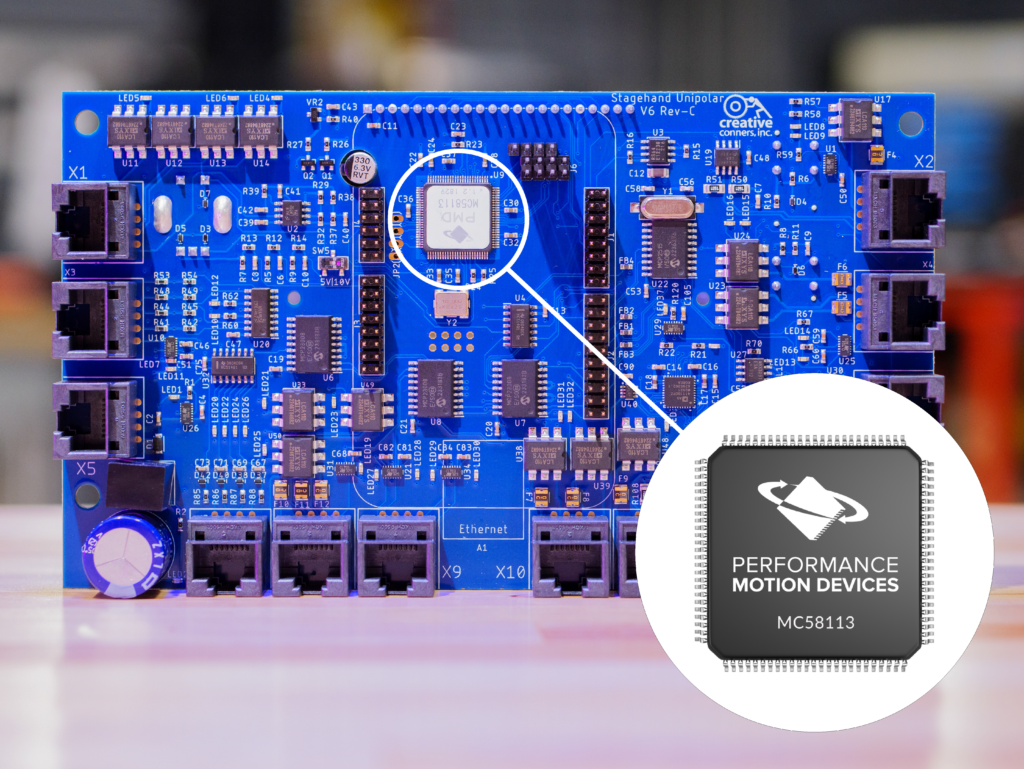
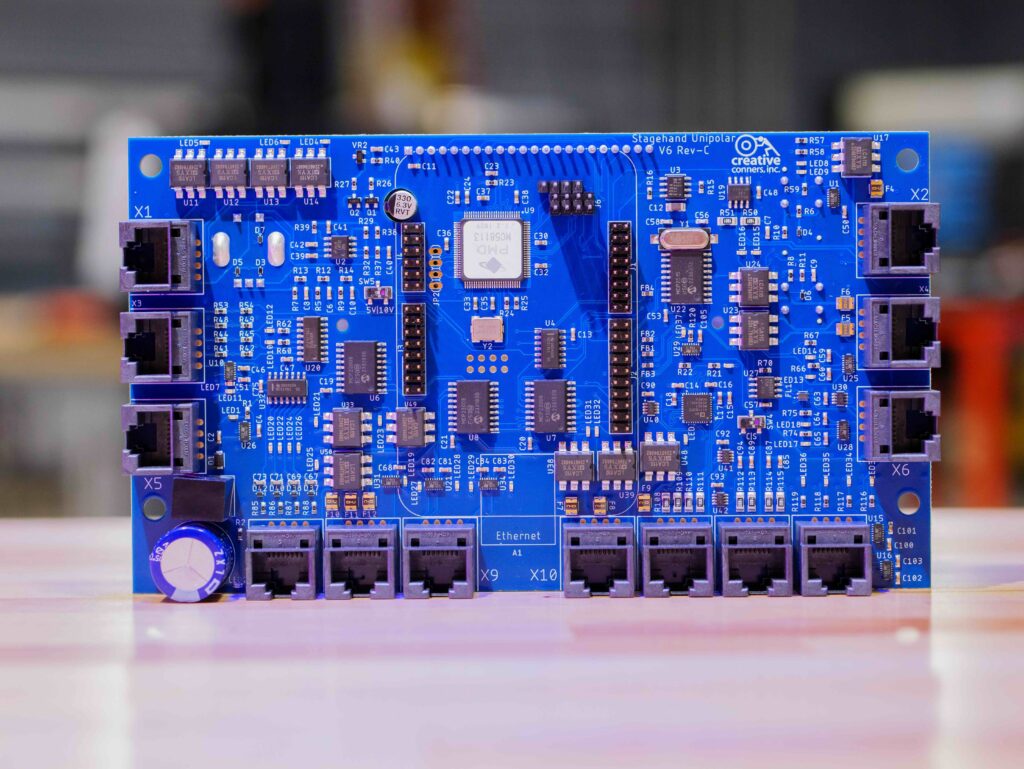
At the heart of nearly every Creative Conners system is a standardized control box known as the Stagehand. While the physical machinery (such as winches, lifts, and tracks) may be custom-built for a specific production, the Stagehand controller remains largely uniform across applications.
The Role of the Stagehand: The Stagehand acts as the bridge between variable-frequency drives (VFDs), encoders, safety interlocks, and the execution layer of Creative Conners’ proprietary Spike Mark software.
Cue Execution: Spike Mark generates the cues that dictate where elements move, how fast they travel, pause durations, and how multiple stage elements coordinate. Once a cue is triggered, the Stagehand locally executes these commands in real time.
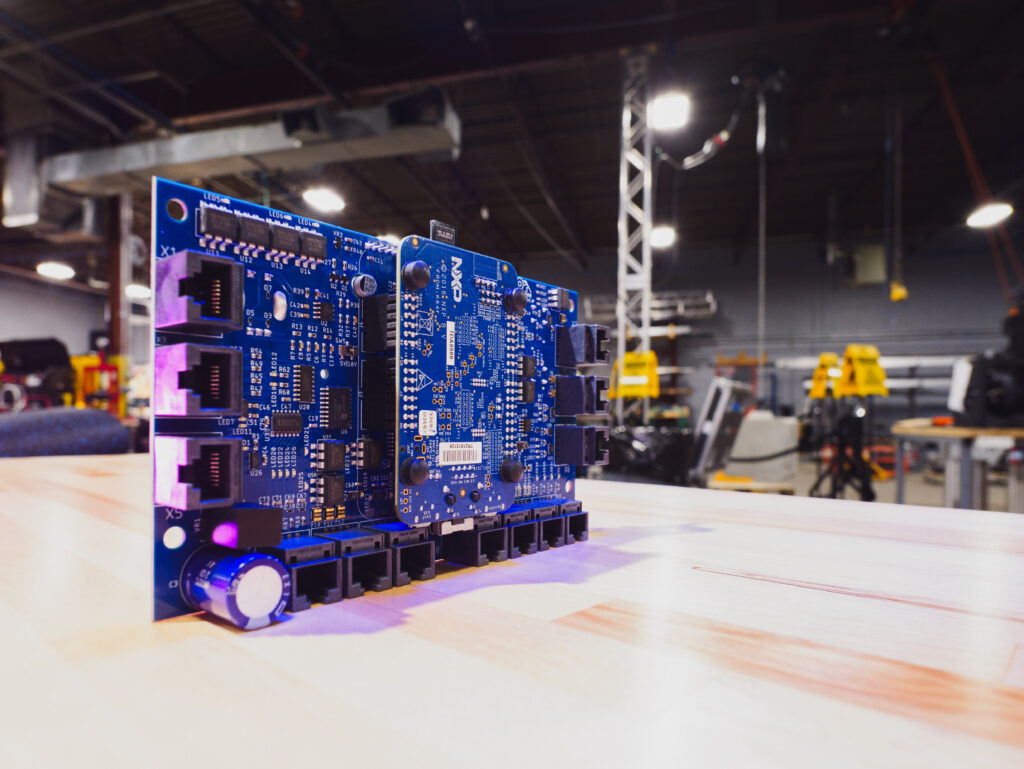
The Component Upgrade: To keep pace with modern theatrical demands, Creative Conners redesigned its Stagehand control Printed Circuit Board (PCB), swapping out legacy Texas Instruments (TI) chips for PMD’s Magellan MC58113 motion control IC, coupled with a local microprocessor and human-machine interface (HMI) display.
This hardware shift unlocked critical features—such as asymmetric acceleration, absolute encoder support, and bidirectional analog signals—that directly elevate the safety, fluidity, and precision of modern stagecraft.
2. Chronology: Overcoming Obsolescence and Engineering the Transition
To understand why the integration of the PMD Magellan MC58113 was such a pivotal milestone for Creative Conners, it is necessary to examine the chronological progression of their control architecture, the hurdles they faced, and how the partnership blossomed.
The Era of Legacy Systems
For years, Creative Conners relied on legacy motion control chips supplied by Texas Instruments. While these components served the company well during its early growth phases, they eventually hit a technological ceiling. As theatrical designs grew more ambitious, the limitations of these older ICs became glaringly apparent.
Chief among these limitations was the inability to control acceleration and deceleration profiles independently. Christian Basse, Senior Controls Engineer at Creative Conners, noted the frustration this caused:
"On the old IC, we were locked to symmetric accel/decel. Whatever you loaded for the acceleration you had to use for the deceleration."
This constraint clashed with the dramatic artistry of theater. Production teams often require machinery to get moving rapidly to maintain tight scene transition windows, yet demand a smooth, deliberate, and visually pleasing stop to prevent jarring movements that could compromise safety or break theatrical illusion. Furthermore, the older architecture did not permit acceleration parameters to be changed on the fly—a fatal flaw when designing performer-flying effects where motion characteristics must shift dynamically mid-cue.
The Supply Chain Breaking Point
Beyond functional limitations, procurement challenges added urgency to the redesign. Aging motion controllers became increasingly difficult to source, a vulnerability severely exacerbated by global pandemic-era supply chain disruptions. Creative Conners needed a reliable, high-performance, and readily available motion control solution that aligned with its modular design philosophy.
Selection and Rapid Deployment
After evaluating several alternatives in the motion control marketplace, the engineering team selected PMD’s Magellan MC58113 motion control IC. The implementation phase was remarkably smooth, aided by unexpected synergies between the two engineering teams.
When Creative Conners encountered an application requiring higher encoder resolution than standard implementations allowed, PMD did not just offer a workaround; they collaborated directly with the theater automation firm, delivering a custom firmware update in roughly a week. This agile response enabled Creative Conners to roll out its next-generation Stagehand control boards swiftly and efficiently.
3. Supporting Data & Technical Capabilities: What the MC58113 Brings to the Stage
The integration of the Magellan MC58113 introduced several profound technical advantages that directly address the pain points of theatrical motion control.
Asymmetric Acceleration and Deceleration
With the MC58113, Creative Conners finally liberated its control systems from symmetric profile constraints. Stage designers can now program quick initial bursts of acceleration to clear scene transitions efficiently, followed by highly refined, cushioned deceleration curves that bring massive structures to a whisper-quiet halt.
Absolute Encoder Support and Safety Scenarios
One of the most critical safety enhancements unlocked by the new IC is its robust support for absolute encoders. In traditional relative or incremental encoder setups, losing power means the system loses its positional reference point, often requiring tedious manual re-homing procedures.
With absolute encoders paired with the MC58113, position tracking is retained even when the machine and controls are entirely unpowered. Basse emphasizes the life-saving nature of this feature during emergency protocols:
"If it’s going to move without the machine and the controls being powered, you’re not going to lose the position. This is critical in rescue scenarios, where a performer may need to be manually lowered using mechanical brakes while the controller is powered off. When power is restored, the system still knows exactly where it is."
While absolute encoders are optional for basic setups, they have become indispensable for permanent venue installations and high-end acrobatic rigging where safety margins must be absolute.
Bidirectional Analog Signals for Hydraulics
Certain specialized stage effects rely on hydraulic actuators rather than standard electric motors. These valves interpret negative voltage as reverse motion and positive voltage as forward motion via a $pm$10-V speed signal generated by an external Digital-to-Analog Converter (DAC).
When Creative Conners previously experimented with newer TI controllers, they temporarily lost this bidirectional signaling capability. Migrating to the PMD controller allowed them to seamlessly integrate an external DAC once more, restoring full bidirectional support and ensuring the company never had to turn down complex, specialized hydraulic stage designs.
Motion Tracing, Tuning, and C-Motion API
Precision in theater is not merely about smooth motion; it is about absolute synchronization. If a descending wall and a rising platform must meet at an exact coordinate within a 50-millisecond window, there is no room for error. The MC58113 features highly tunable position filters and built-in tracing and monitoring tools, giving engineers deep visibility into motion behavior over time to diagnose anomalies and optimize performance.
Additionally, PMD’s C-Motion C/C++ software library drastically streamlined firmware development. Instead of forcing engineers to write low-level serial communication routines and message-packing protocols from scratch, PMD provided a robust, command-driven API. Basse noted:
"That saved so much time and has been invaluable to us."
4. Official Responses & Industry Perspectives
The transition to PMD technology has fundamentally shifted how Creative Conners approaches product development and customer delivery. By shifting the burden of low-level motion control plumbing to PMD’s pre-tested, highly reliable silicon and software layers, Creative Conners’ lean engineering team can redirect its focus toward what matters most: high-level functionality, intuitive user interfaces, and artistic enablement.
Reflecting on the company’s philosophy, Christian Basse summarized their vertically integrated business model:
"We design and manufacture the machines and controls and then write the software."
This end-to-end control ensures that whether a system is rented by a high school drama club for a weekend or installed permanently for a multi-year Las Vegas residency, the underlying dependability remains identical. The collaboration with Performance Motion Devices has reinforced this philosophy, proving that industrial-grade precision hardware can be successfully tailored to the fast-paced, imaginative world of entertainment.
5. Future Implications: Smart Machines and Next-Gen Servo Integration
Having successfully modernized the Stagehand control PCB with the Magellan MC58113, Creative Conners is already looking toward the horizon of stage automation engineering.
The company is actively exploring PMD’s multi-axis motion controllers to enable even tighter, more complex multi-axis synchronization. Furthermore, they are eyeing advanced integrated servo solutions, specifically PMD’s ION/CME N-Series intelligent drives.
One particular variant in the N-Series lineup boasting a 1000-W power output has captured the engineering team’s imagination. Adopting an integrated, higher-power drive architecture would allow Creative Conners to engineer a revolutionary new generation of "smart machines." In these future systems, drive and control electronics could be mounted directly onto the machinery itself, radically trimming down umbilical cable clutter, reducing overall system size and weight, and simultaneously increasing lifting capacity and operational speeds.
As theater productions continue to push the boundaries of physical spectacle, the synergy between robust motion control silicon and creative engineering will remain the invisible engine turning theatrical dreams into reality. Through its partnership with Performance Motion Devices, Creative Conners is well-positioned to keep the curtains rising safely, smoothly, and brilliantly for decades to come.