The landscape of industrial manufacturing is undergoing a seismic shift, driven by the persistent trio of labor shortages, the demand for high-mix/low-volume production, and the constant pressure to optimize floor space. As manufacturers scramble to maintain quality while increasing throughput, TRUMPF—a global leader in manufacturing technology—has unveiled a transformative solution: the TruLaser Weld 3000.
Debuting at FABTECH 2026, the TruLaser Weld 3000 is not merely an incremental upgrade; it is a fundamental rethinking of how robotic laser welding can be deployed in the modern workshop. By integrating sophisticated artificial intelligence into the programming workflow, TRUMPF has addressed the industry’s most significant bottleneck: the time and expertise required to set up automated welding systems.
Main Facts: A New Paradigm for Robotic Welding
The TruLaser Weld 3000 is a compact, turn-key robotic laser welding cell designed to provide high-quality, repeatable results in environments where space is at a premium and product variants are high.

At its core, the system utilizes AI-assisted programming to slash setup times by up to 50 percent compared to conventional methods. The system supports both direct-at-the-machine programming and offline programming via TRUMPF’s proprietary TruTops Weld software, allowing production managers to prepare future jobs without interrupting current machine operation.
Key Technical Specifications:
- Dimensions: A footprint of approximately 11.98 x 11.98 feet, making it 24 percent smaller than its predecessor, the TruLaser Weld 5000.
- Reach: Equipped with a KUKA Iontec robot providing an 82.68-inch reach, enabling it to process large, pallet-sized components.
- Capability: Compatible with stainless steel and structural steel (up to 0.31 inches) and aluminum (up to 0.24 inches).
- Laser Power: Configurable at three or four kilowatts.
The Chronology of Development
The journey to the TruLaser Weld 3000 began with a deep analysis of user feedback from the small-to-medium enterprise (SME) sector. Over the past three years, TRUMPF engineers focused on identifying why many manufacturers, despite recognizing the benefits of automation, remained hesitant to adopt robotic welding.
- Phase I (2023–2024): Identification of the "programming gap." Research indicated that the primary deterrent for SMEs was the reliance on highly specialized, expensive labor to program robots for varying, short-run batches.
- Phase II (2024–2025): Development of the "TeachLine" suite. The focus shifted from merely building a faster robot to building a "smarter" interface. This period saw the integration of AI models capable of recognizing weld geometries and automatically adjusting for minor deviations.
- Phase III (2026): Optimization of hardware. Recognizing that smaller shops struggled with equipment size, the engineering team miniaturized the welding optics by 40 percent, significantly expanding the robot’s ability to reach into deep cavities and complex housings.
- Phase IV (October 2026): Official unveiling at FABTECH 2026, marking the transition of AI-assisted welding from a theoretical laboratory concept to a production-ready reality.
Supporting Data: Efficiency Through Intelligence
The core innovation of the TruLaser Weld 3000 is the synergy between the TeachLine Touch and TeachLine AI features.

Streamlining the Workflow
In traditional robotic welding, a technician must manually "teach" the robot every point of a weld path. If a component is slightly bent or positioned incorrectly, the entire program may fail, leading to costly downtime. The TruLaser Weld 3000 changes this.
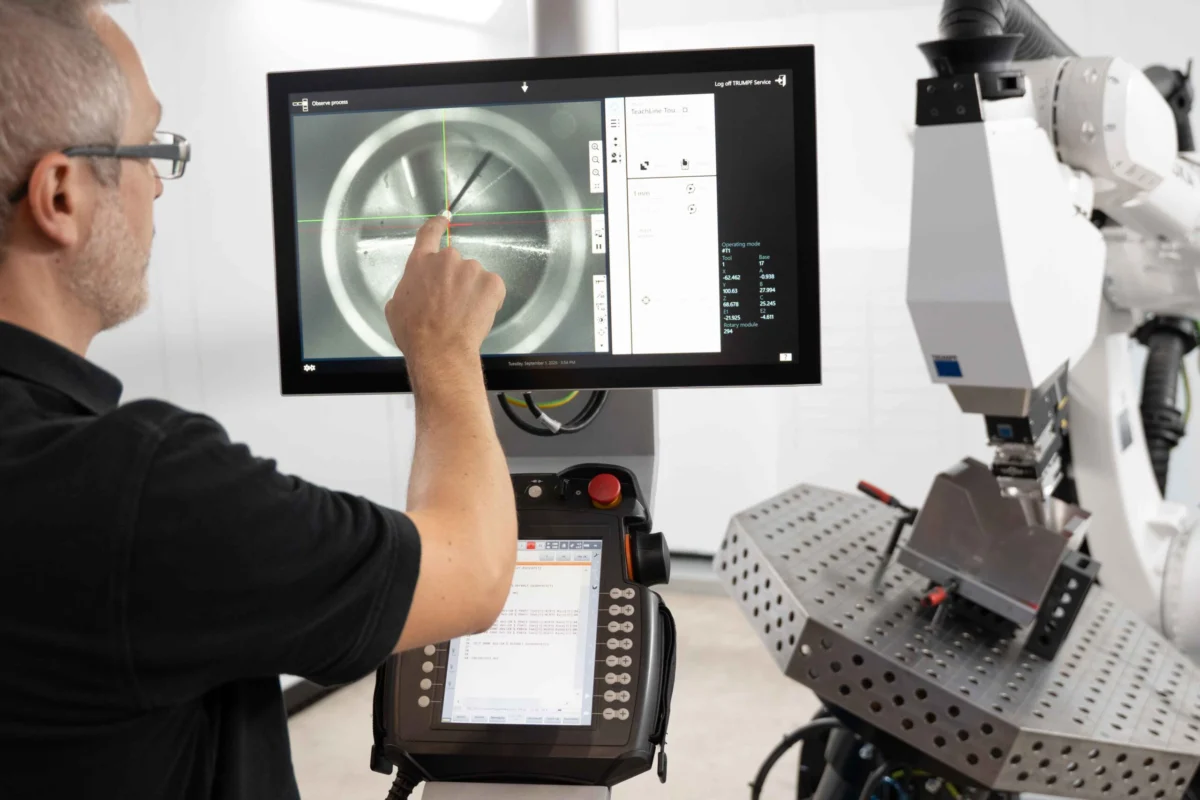
- TeachLine Touch: Allows users to manually correct minor weld point deviations by simply tapping the machine’s touchscreen. This intuitive interface democratizes operation, allowing less experienced staff to manage high-precision tasks.
- TeachLine AI: This is the force multiplier. The AI engine autonomously detects deviations in the component configuration and adjusts the robot’s trajectory in real-time. By removing the need for manual fine-tuning of every weld point, the system reduces the time from CAD-import to "first part good" by half.
Advanced Process Stability
Beyond programming, the machine utilizes established TRUMPF technologies to guarantee quality:
- BrightLine Scan: Uses a high-frequency scanner to broaden the weld seam, increasing the connecting area and, consequently, the mechanical strength of the bond in fillet and overlap welds.
- BrightLine Weld: Dynamically distributes laser power between the inner and outer core, drastically reducing spatter—a critical requirement for industries where post-process cleanup is not viable.
- FusionLine: Enables the use of filler wire for larger gaps (up to 0.06 inches), ensuring that even components with suboptimal fit-up can be salvaged through automation.
Official Responses and Strategic Vision
Robin Stuhler, Head of Product Management for Welding at TRUMPF Inc., frames the launch as a strategic response to the shifting demographics of the workforce. "The TruLaser Weld 3000 provides competitive advantages, particularly for companies that manufacture high-quality sheet metal assemblies and housings in small batches with a wide variety of variants," Stuhler noted during the product announcement.

"We are not just selling a laser; we are selling a solution to the instability of the current labor market. By lowering the barrier to entry, we enable companies to maintain stable processes and short cycle times without needing a PhD in robotics."
TRUMPF’s vision is clearly rooted in the concept of "Digital Connectivity." By integrating the welding cell into the broader digital ecosystem of the modern factory, TRUMPF ensures that the machine is not an island, but a node in a larger, data-driven production network.
Implications: The Future of Metal Fabrication
The implications of the TruLaser Weld 3000 are profound for several key sectors:

1. The Democratization of Automation
For years, robotic welding was the domain of automotive OEMs and massive Tier-1 suppliers. The compact footprint and AI-assisted setup of the TruLaser Weld 3000 bring this capability to the "job shop." Small manufacturers of medical equipment, kitchen appliances, and data center housing can now compete with larger entities by offering the same level of consistency and throughput.
2. Solving the Spatial Constraints
Many job shops are located in urban environments where real estate is expensive. A 24 percent reduction in footprint compared to previous models is not just a technical spec; it is a business model enabler. It allows factories to increase their capacity without the need for facility expansion or relocation.
3. Addressing the Skilled Labor Crisis
The industry is currently facing an aging workforce. The "TeachLine AI" feature means that the knowledge of a veteran welder is effectively "baked into" the machine. This allows shops to cross-train existing personnel—who may have basic manufacturing knowledge but no experience with robotics—to operate the laser cell. This shift helps bridge the gap between the scarcity of expert welders and the increasing complexity of manufacturing demand.

4. A New Era of Quality Control
By reducing spatter and increasing the strength of welds through technology like BrightLine Scan, the TruLaser Weld 3000 drastically reduces the need for manual rework. In the manufacturing world, rework is the silent profit-killer. By achieving "right-first-time" production, the system directly impacts the bottom line, allowing manufacturers to allocate labor to higher-value tasks.
Conclusion
As we look toward the remainder of the decade, the TruLaser Weld 3000 serves as a case study for the integration of artificial intelligence into traditional heavy industry. It is a reminder that the goal of Industry 4.0 is not to replace the human element, but to augment it with tools that remove the drudgery and technical complexity of repetitive tasks.
By combining the robustness of laser technology with the agility of AI, TRUMPF has provided a blueprint for how manufacturers can navigate the volatility of the 2020s. Whether it is in the precision-driven world of medical devices or the robust requirements of structural engineering, the TruLaser Weld 3000 is poised to become a staple in the high-mix, high-flexibility production floor. As the industry gathers at FABTECH 2026, the message is clear: the future of welding is not just faster—it is significantly smarter.