In the industrial landscape, the standard emergency drill often concludes with a ritualistic sigh of relief. A sign-in sheet is signed, an evacuation time is recorded, and the facility manager marks the event as "completed." But for safety professionals, this binary approach—compliance versus non-compliance—is increasingly viewed as a dangerous illusion. A drill that ends with a completed form but fails to identify operational friction points is not a success; it is a missed opportunity to uncover the exact moments where a real-world emergency could turn catastrophic.
The true value of an emergency drill lies not in the event itself, but in the performance data it yields. By shifting the focus from simple participation metrics to granular, behavioral readiness indicators, plant leaders can expose the "readiness gaps" that hide in plain sight, ensuring that when the alarm sounds, the response is instinctive, controlled, and precise.
Main Facts: The Shift from Compliance to Performance
Modern industrial safety standards, as echoed by the Occupational Health and Safety Administration (OSHA), mandate that emergency action plans must be site-specific. However, many facilities treat these plans as static documents.
The fundamental problem with current drill reporting is that it focuses on administrative "vanity metrics"—date, time, number of participants, and total evacuation duration. While these data points satisfy basic regulatory audits, they provide zero insight into the quality of the response. Did the staff recognize the alarm? Did they choose the safest path, or did they follow the crowd into a potential bottleneck? Was the accountability process truly verified, or was it a "guesstimate"?
To achieve true operational readiness, leadership must pivot toward readiness metrics. These indicators measure observable behavior under simulated stress. A useful metric is defined by a simple formula: Expected Action + Observation Point + Acceptable Standard + Correction Owner. This framework transforms safety from a vague policy into an evidence-based operational discipline.
Chronology of an Effective Drill Program
A robust drill program is not a singular event; it is a cycle of continuous improvement. The lifecycle of an effective drill follows a distinct, iterative progression:
- Pre-Drill Design (Planning): Define the scenario based on specific risk factors. Identify high-risk areas where previous drills have shown hesitation.
- Calibration (Observation Setup): Position observers at critical bottlenecks (stairwells, turnstiles, and muster points) rather than just at the assembly area.
- Execution (Simulation): Initiate the alarm under "real" plant conditions—incorporating ambient noise, shift changes, or even limited visibility to simulate a true emergency.
- Debrief (Data Collection): Immediately gather performance data from observers. Compare actual behavior against the "Expected Action" standard.
- Root Cause Analysis (Correction): Assign ownership for every "vulnerable" or "failed" metric.
- Verification (Closure): Implement the fix and schedule a spot-check or follow-up drill to validate that the behavior has demonstrably improved.
Supporting Data: Eight Critical Metrics for Readiness
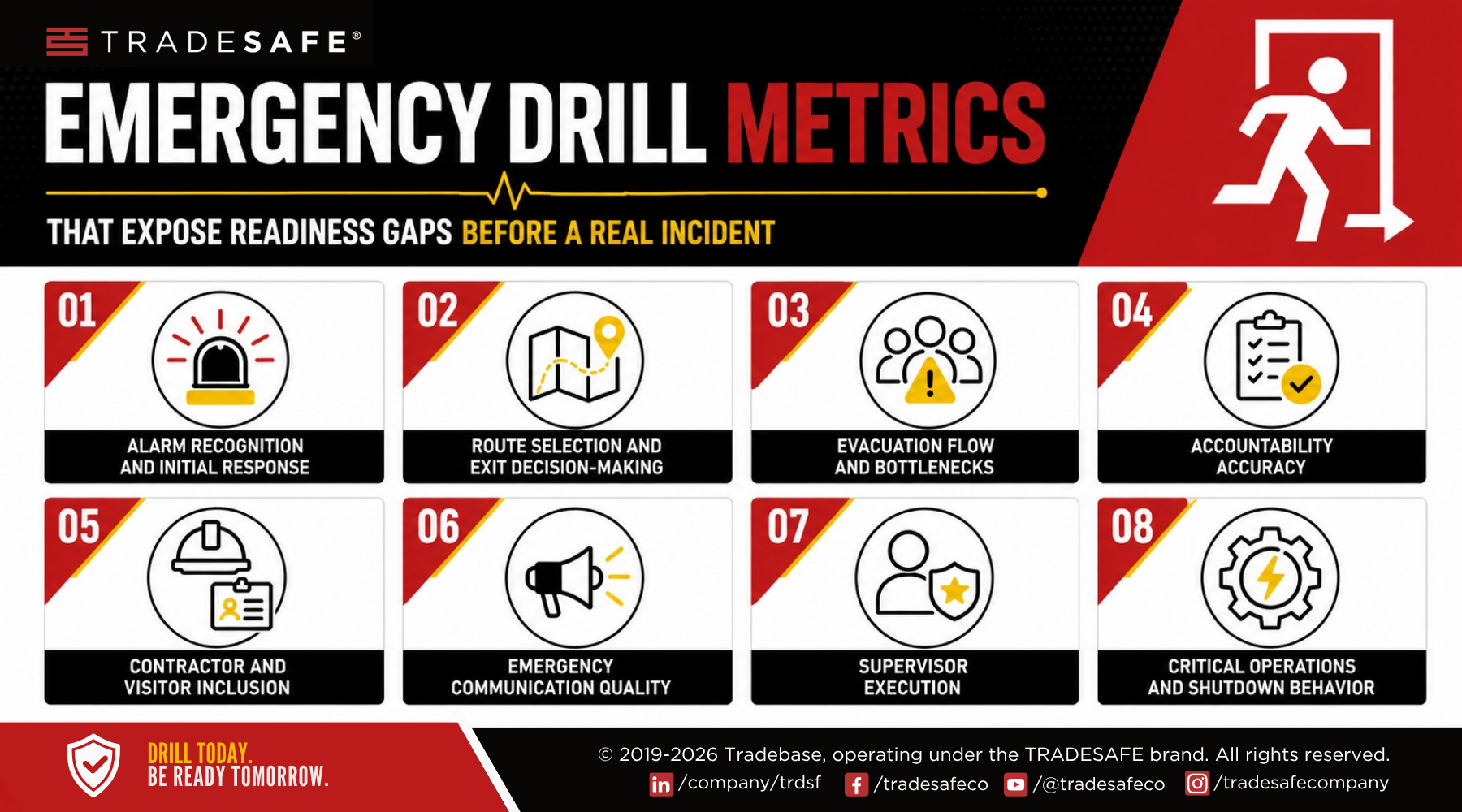
To move beyond basic compliance, organizations should audit the following eight categories during every drill:
1. Alarm Recognition and Initial Response
The first point of failure is often the alarm itself. In a noisy maintenance shop or an outdoor tank farm, an alarm might be drowned out or misidentified. The standard should be clear: employees must begin the correct protective action within a set timeframe (e.g., 30 seconds) without waiting for supervisor prompting.
2. Route Selection and Decision-Making
Evacuation speed is secondary to evacuation safety. If a primary route is blocked by a simulated hazard, do employees automatically shift to the correct alternate route, or do they wait for instructions? Observers must monitor intersections to ensure that individual decision-making remains sharp.
3. Evacuation Flow and Bottlenecks
A facility may clear in seven minutes, but if those seven minutes were spent standing in a queue at a narrow gate or a badge-access turnstile, the site is vulnerable. Bottlenecks turn controlled evacuations into dangerous crushes during actual events.
4. Accountability Accuracy
Accountability is not complete until it is verified. A headcount is merely a number; a true accountability process reconciles every individual against current rosters, including temporary workers and visitors.
5. Contractor and Visitor Inclusion
Contractors represent a unique risk profile. They are often unfamiliar with the facility layout and may be working in isolated, high-risk areas. Drills must include the active verification of contractor locations and their integration into the muster process.

6. Emergency Communication Quality
Communication is only successful if the message is received, understood, and acted upon. Effective communication is specific and location-based. It avoids vague directives and provides actionable information: "Evacuate through North Exit A; do not use the South Corridor."
7. Supervisor Execution
Supervisors are the lynchpins of an orderly response. They control the pace, handle the sweeps, and manage the flow. If a supervisor hesitates, the workforce follows. Scoring supervisor performance is essential for identifying leadership gaps.
8. Critical Operations and Shutdown Behavior
Critical shutdown procedures (e.g., closing valves or securing energy) must be strictly governed. Employees must know exactly when to stop a task and abandon the equipment. Any task that requires improvisation during an emergency is a task that needs to be redesigned or simplified.
Official Responses and Regulatory Guidance
The Federal Emergency Management Agency (FEMA) emphasizes the use of "After-Action Reporting" (AAR). This methodology, while traditionally used for large-scale disasters, is highly effective for industrial plants. FEMA’s guidance suggests that every drill should result in a clear, documented Improvement Plan (IP).
Similarly, OSHA’s regulations on emergency action plans highlight that an effective plan is not one that is filed away, but one that is practiced and refined. OSHA stresses the importance of site-specific training. For instance, an alarm system must be perceivable above the ambient noise of the specific work environment—a regulatory requirement that can only be verified through the "real-world" testing of a drill.
Implications for Safety Culture
The shift to data-driven drills has profound implications for a facility’s safety culture. When leadership moves from "checking the box" to "measuring the gap," it signals that safety is a high-stakes operational priority, not just an administrative requirement.
Addressing the "Red" Findings
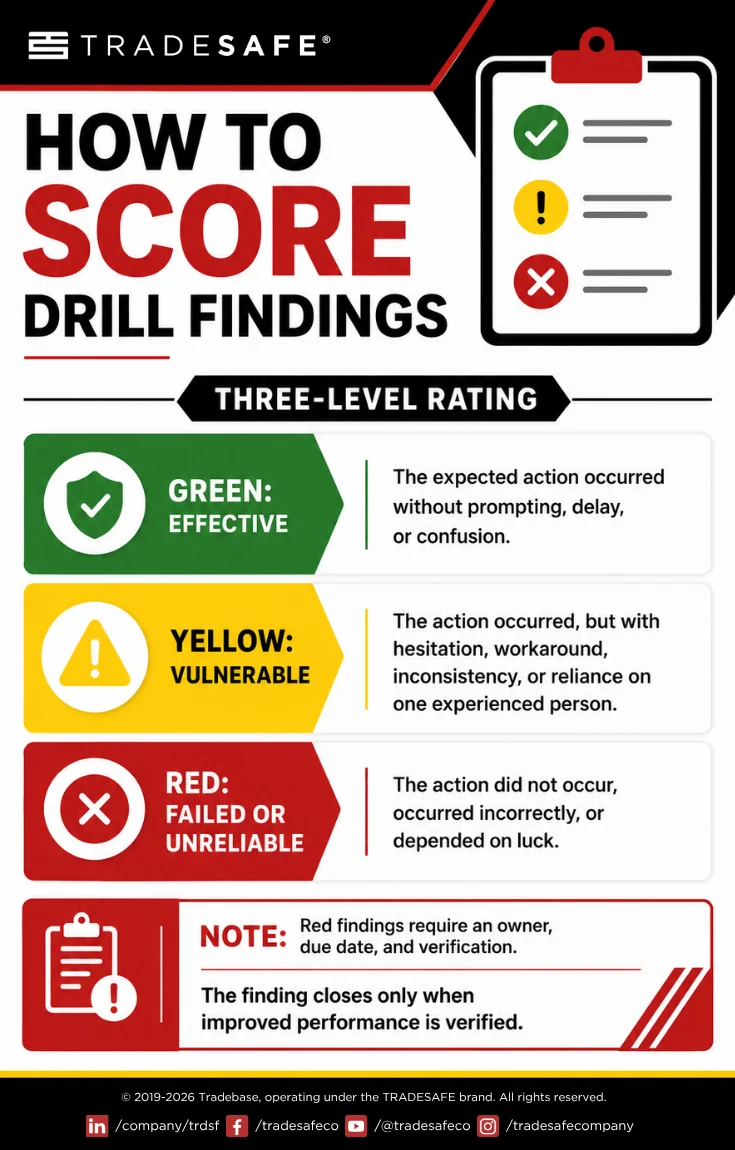
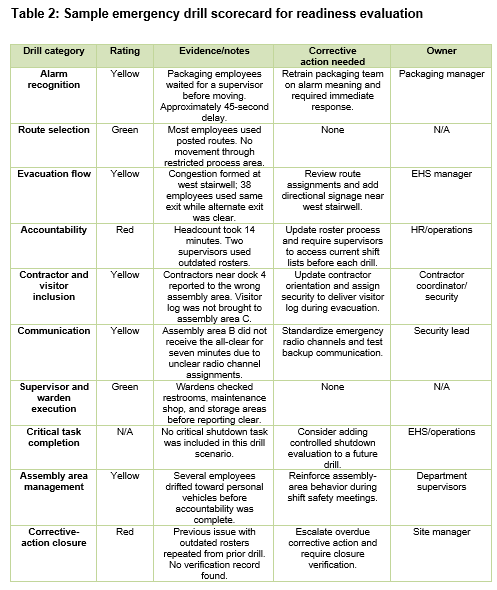
When a drill reveals a "Red" finding—a critical failure—the response must be precise. Simply telling employees to "do better next time" is a recipe for failure. A true corrective action involves:
- Defining the Owner: Who is responsible for fixing the process?
- Determining the Method: How will we ensure this doesn’t happen again? (e.g., updating signage, changing software, or re-training specific teams).
- Setting a Deadline: When will the fix be operational?
- Verification: How will we prove it worked? (e.g., a follow-up spot check).
By treating every drill as a diagnostic tool, management gains a clearer view of the plant’s actual vulnerability. This transparency fosters accountability at all levels, from the shop floor to the executive suite.
Conclusion: The Path Forward
Emergency drills are not valuable because they satisfy an annual schedule. They are valuable because they reveal the exact points where a real-world incident would become slower, less controlled, or more dangerous.
A high-performance drill program treats the entire facility as a living system. It acknowledges that human beings, under stress, rely on patterns and training. By measuring recognition, route selection, supervision, and communication, leaders can build a culture that does not just respond to emergencies—it anticipates them.
Ultimately, the goal is to reach a state where the drill is no longer a performance, but a refined, automated response. When a plant can demonstrate that its emergency action plan works—not just in theory, but under the specific, physical constraints of its people, noise levels, and equipment—it has achieved the only standard that truly matters: the safety of its workforce. The next time the alarm sounds, the data gathered from previous drills will be the difference between a controlled evacuation and a chaotic, high-risk situation. It is time for industrial leaders to stop counting heads and start counting the critical behaviors that save lives.