PEARL HARBOR, Hawaii — In modern warfare and contested logistics, the greatest threat to operational readiness is often not enemy fire, but the grueling wait for a replacement part. Traditional military supply chains rely on sprawling, vulnerable networks of centralized manufacturing hubs, cargo aircraft, and maritime transport ships. If a critical component fails on a frontline vessel or an isolated base, troops may wait weeks—or even months—for a replacement to navigate through bottlenecks, customs, and transport lines.
That paradigm is beginning to shift. During the multinational Rim of the Pacific (RIMPAC) 2026 exercise, military technologists proved that the future of logistics may lie not in stocking massive warehouses, but in manufacturing parts at the point of need.
A mobile, containerized advanced manufacturing system developed by Snowbird Technologies successfully produced structural 316L stainless steel components aboard the amphibious assault ship USS Essex while underway. The milestone deployment points to a transformative horizon for naval operations, offering a glimpse of a future where warships can print and machine their own replacement hardware on the high seas.
Main Facts: The Technology and the Mission
The recent demonstration centered on the deployment of Snowbird Technologies’ SAMM Tech (Stand-Alone Mobile Manufacturing Technology) platform. Integrated into a ruggedized, transportable container, the system is designed to withstand the harsh conditions of maritime and field environments while delivering industrial-grade manufacturing capabilities.
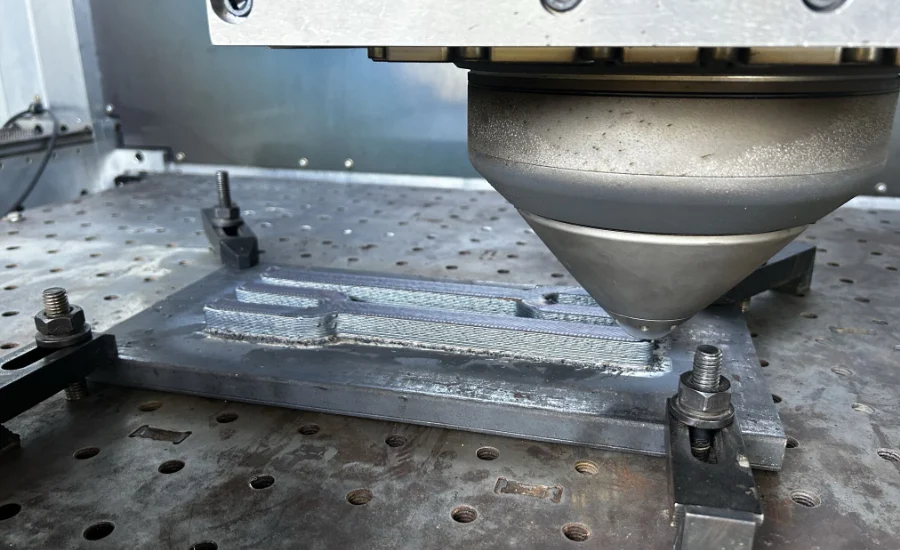
At the technological heart of the SAMM Tech platform is Meltio’s Engine Blue system, which utilizes laser-wire directed energy deposition (DED)—a form of metal additive manufacturing. Unlike powder-bed 3D printing systems, which can pose safety and containment challenges in rolling seas or confined spaces, wire-laser DED uses commercially available metal wire feedstock. This method is exceptionally clean, highly efficient, and capable of depositing metal at high rates to build "near-net-shape" components.

Crucially, the system does not stop at printing. Once the metal component is built via additive manufacturing, an integrated CNC (Computer Numerical Control) machining center takes over. This dual-capability setup allows the system to print a part and subsequently mill it to final, precision tolerances, complete with the required surface finishes, entirely within the self-contained unit.
During the RIMPAC 2026 exercise, this capability transitioned from theoretical naval architecture concepts into operational reality. The system was first loaded onto the USS Essex, operating continuously as the amphibious assault ship transited from San Diego to Hawaii. Following the maritime transit, the containerized unit was offloaded and transferred to Schofield Barracks, where it seamlessly continued to produce mission-critical metal components for participating international forces.
Chronology of the Deployment
The path to proving expeditionary manufacturing at RIMPAC 2026 involved a carefully orchestrated sequence of testing, transit, and land-based operations:
- Pre-Exercise Integration: Snowbird Technologies and naval researchers integrated the Meltio Engine Blue DED system and the CNC milling center into the ruggedized SAMM Tech container, ensuring the hardware could withstand the vibrations, pitch, and roll of a moving warship.
- Phase 1: At-Sea Transit (San Diego to Hawaii): The containerized manufacturing system was embarked upon the USS Essex. While underway across the Pacific Ocean, operators executed live print jobs, successfully fabricating 316L stainless steel components in real-time aboard a rolling naval vessel.
- Phase 2: Port Arrival and Offloading: Upon arriving in the Hawaiian operational theater, the system was successfully disembarked from the USS Essex, demonstrating its expeditionary nature and ease of transfer from sea to shore.
- Phase 3: Land-Based Deployment at Schofield Barracks: The unit was redeployed to Schofield Barracks. Throughout the remainder of the RIMPAC exercise, the mobile facility accepted digital part requests transmitted across a distributed military network and rapidly manufactured the requested hardware for various participating commands.
Supporting Data and the CAMRE Initiative
The deployment was not merely a corporate demonstration; it was a rigorous scientific experiment managed under the auspices of the Naval Postgraduate School’s Consortium for Advanced Manufacturing Research and Education (CAMRE).
CAMRE’s distributed manufacturing experiment aims to quantitatively evaluate how deployable, on-demand manufacturing can fundamentally alter the defense logistics calculus. In contested environments—where sea lanes and air corridors may be heavily targeted or disrupted by adversaries—traditional supply lines are inherently fragile. By distributing manufacturing capabilities directly to the tactical edge, the military seeks to achieve several key performance metrics:

- Lead-Time Reduction: Cutting component delivery times from weeks or months down to hours.
- Inventory Footprint Minimization: Reducing the need to stock thousands of specialized, low-turnover spare parts on every vessel.
- Network Agility: Demonstrating that digital Computer-Aided Design (CAD) files can be securely transmitted from centralized engineering commands to deployed tactical units anywhere in the world.
- Material Versatility: Proving that marine-grade alloys—specifically 316L stainless steel, known for its high corrosion resistance in saltwater environments—can be reliably processed in dynamic physical environments.
Official Responses and Industry Perspectives
Military leaders and manufacturing executives alike have heralded the successful RIMPAC trials as a watershed moment for expeditionary engineering.
"Military logistics have historically operated on a ‘just-in-case’ model that requires massive inventory pipelines," noted representatives close to the CAMRE project. "Deployable advanced manufacturing shifts us toward a ‘just-in-time, where-needed’ philosophy. If a ship can make its own brackets, valves, or fittings while underway, it remains mission-capable instead of heading back to port for repairs."
Snowbird Technologies emphasized that the core achievement of the deployment was the elimination of environmental barriers. Traditional manufacturing equipment is notoriously sensitive to dust, humidity, motion, and temperature fluctuations. By housing the DED and CNC milling technologies inside a ruggedized, climate-controlled container, the company has proven that precision manufacturing can follow troops into the field rather than remaining tethered to stationary factories in the continental United States.
Meltio executives pointed out that the choice of wire-laser DED was critical to the success of the mission. Wire feedstock is safer to handle, easier to store, and significantly cheaper than reactive metal powders, making it an ideal choice for deployment aboard naval vessels where safety protocols regarding hazardous materials are exceptionally stringent.
Strategic Implications for Global Defense
The successful integration of the SAMM Tech platform during RIMPAC 2026 carries profound implications for the future of global military strategy and industrial manufacturing:

1. Resiliency in Contested Logistics
In future conflicts against near-peer adversaries, secure supply lines cannot be guaranteed. Cyberattacks on logistics networks, anti-ship missiles, and contested airspace threaten traditional cargo routes. Distributed manufacturing ensures that even if a force is temporarily cut off from mainland supply chains, it can sustain its own operations by fabricating replacement parts locally.
2. Evolution of the Defense Industrial Base
The success of containerized manufacturing blurs the line between the factory floor and the battlefield. Defense contractors will increasingly need to design components with digital fabrication in mind, ensuring that secure CAD files can be instantly transmitted and printed on-demand globally. This places a premium on digital data security, intellectual property management, and standardized additive manufacturing parameters across allied militaries.
3. Commercial Spin-Offs and Remote Industries
While the immediate application of this technology is military, the commercial implications are vast. Industries operating in remote, harsh environments—such as offshore oil and gas drilling, deep-sea exploration, mining operations in rugged terrains, and aerospace outposts—face logistical challenges identical to those of the military. The ability to drop a self-contained metal printing and machining factory into a remote site promises to revolutionize maintenance cycles across the commercial sector.
Looking Ahead
As the data from the RIMPAC 2026 CAMRE experiment is fully analyzed, naval logists and industrial engineers will look toward the next phase of deployment: scaling the technology, expanding the catalog of certified printable alloys, and integrating artificial intelligence to further automate quality assurance.
What was once science fiction—fabricating critical steel hardware on a warship crossing the Pacific—is now an operational reality. As deployable advanced manufacturing continues to mature, the front lines of tomorrow may never be far from their own industrial base.