







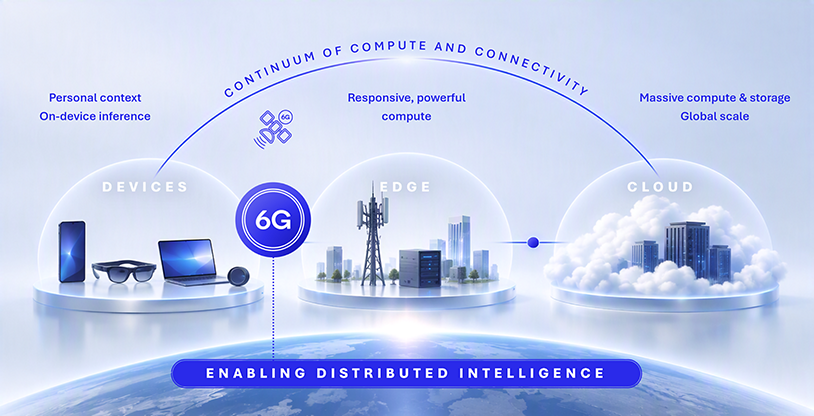
As the telecommunications industry sets its sights on 2026 for the initial foundation of 6G, the primary design philosophy has shifted. It is no longer about predicting the specific killer applications of the 2030s; it is about building a system so fundamentally adaptable that it can rise to meet challenges we cannot yet foresee. As AI becomes the central nervous system of our digital world, distributing intelligence across devices, the edge, and the cloud, the network must evolve from a rigid transport pipe into a dynamic, context-aware ecosystem.
Main Facts: The Shift Toward Distributed Intelligence
The core premise of 6G design is the "compute continuum." In the current 5G landscape, an AI-driven interaction—such as a mobile assistant coordinating camera inputs, real-time voice synthesis, and cloud-based data retrieval—is often treated as a monolithic task. To the user, it is a single request; to the network, however, it is a chaotic burst of varying traffic profiles.
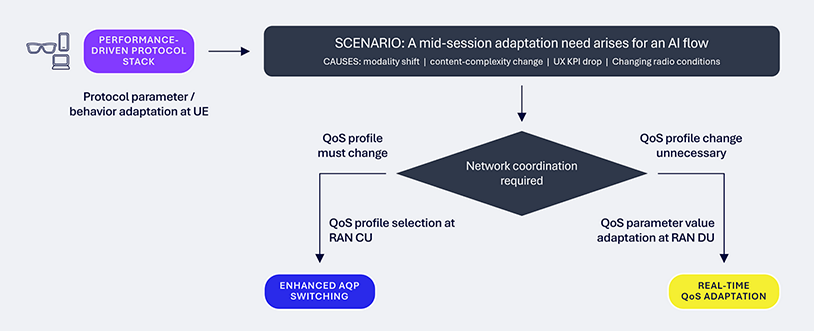
Currently, mobile operators face a dilemma: they must either reserve peak resources continuously, which is inefficient and costly, or risk performance degradation during traffic spikes. 6G aims to solve this by moving away from static Quality of Service (QoS) models. Instead of forcing every application provider to integrate with complex network APIs, 6G will utilize "adaptive intelligence." By empowering devices to communicate their immediate requirements and allowing the network to shift resources in real-time, 6G creates a symbiotic relationship between the hardware at the edge and the infrastructure of the core.

Chronology: From 5G Foundations to 6G Futures
To understand the trajectory of 6G, one must look at the evolution of connectivity:
- Pre-2024: The era of basic 5G, where connectivity was largely "best effort" with limited, static QoS classes.
- 2024–2025: The rise of Edge AI and early agentic applications. The industry begins to realize that current network architectures are struggling to balance the latency requirements of distributed AI.
- 2026 (The Inflection Point): The launch of the initial 6G framework. Standards bodies, including 3GPP, begin codifying mechanisms for "Alternative QoS Profiles" (AQPs).
- 2027–2030: The maturation phase. Commercial 6G deployments begin, introducing performance-driven protocol stacks that allow for dynamic, real-time radio resource adjustment.
- 2030 and Beyond: The "Systemic Adaptation" era, where AI agents autonomously manage their own network requirements, and 6G infrastructure adapts to these needs without manual intervention.
Supporting Data: Understanding AI Traffic Profiles
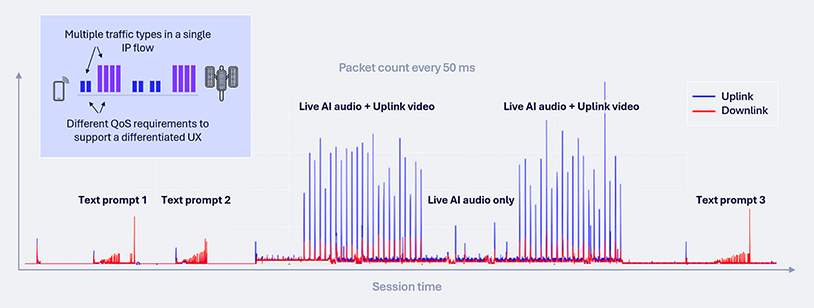
The challenge of 6G is not just speed; it is the sheer unpredictability of AI traffic. AI applications do not follow the standard "download/upload" patterns of traditional web browsing.
- Multimodality: A single AI session may oscillate between text (low data), audio (medium latency sensitivity), and high-resolution video/sensor fusion (high bandwidth).
- Latency Inversion: While current systems focus on throughput, future AI models will be bottlenecked by "time to first token." As compute speeds increase, network delay becomes the primary factor in perceived intelligence.
- Physical AI Constraints: Robotics and industrial AI introduce safety-critical requirements that mandate extreme reliability, often requiring the network to prioritize control signals over massive data transfers.
Data from early 6G testbeds suggests that traditional IP-flow filtering is insufficient. By implementing dynamic AQP switching, networks can handle these shifts without the overhead of re-establishing sessions, potentially reducing handover latency by 40–60% compared to current 5G architectures.
Official Perspectives: The Industry Mandate
Industry leaders are unanimous: 6G must be "configurable by design." Qualcomm, a leading voice in these developments, has frequently highlighted that the objective is to decouple network policy from specific application requirements.
"The goal is not to predict the next big app," says a representative from the 3GPP standards group. "The goal is to provide the ‘knobs and dials’—the hooks—that allow a device to inform the network of its state, and for the network to respond within a pre-authorized policy framework. This keeps the operator in control while giving the device the agility it needs to perform in the field."
The consensus is that operators are wary of "open-loop" systems where devices dictate resource allocation, which could lead to network instability. Instead, the industry is moving toward "bounded flexibility." The network defines the playground (policy, authorization, and charging rules), and the device is permitted to move within those boundaries to optimize its own performance.
Implications: The Multi-Layer Adaptation Framework
The transition to 6G will have profound implications for both network operators and end-users.
For Operators: Efficiency Through Intelligence
Operators will no longer need to over-provision their networks for the "worst-case" scenario. By utilizing dynamic QoS, they can pack more users onto the same spectrum without degrading the experience. This "resource optimization" is the key to monetizing 6G. If a robot in a factory needs a burst of high-priority bandwidth for a safety maneuver, the network can temporarily reallocate that capacity from a background update task, then immediately revert once the safety maneuver is complete.
For Developers: A Universal Interface
Developers will benefit from a more "application-aware" network. Rather than worrying about the underlying radio protocols, they can interact with the network through standardized performance envelopes. The network will handle the complexity of the radio access network (RAN) scheduling, providing a consistent "service tier" that adapts to the device’s needs.
For the End-User: The "Invisible" Network
The ultimate goal of 6G is to make the network invisible. Whether the user is wearing an XR headset, controlling a drone, or using an agentic AI assistant, the feeling should be one of immediate, seamless performance. By shifting the protocol stack to be performance-driven, 6G ensures that the network is always working in the background to minimize latency and maximize reliability, regardless of the device’s current location or the congestion level of the local cell.
Conclusion: Designing for the Unknown
As we stand on the precipice of the 6G era, the most important design choice is the rejection of rigid standardization. History has shown that by the time a G-standard is fully deployed, the applications driving it have already changed.
By building a system that leverages device context—buffer states, radio conditions, and application requirements—we are effectively creating a "living" network. 6G will not be a static deployment that becomes obsolete in a decade. Through software-defined policy and a multi-layer adaptation framework, 6G will be the first generation of wireless technology designed to grow alongside the AI systems it supports. The answer to the challenges of the future starts in 2026, not with a specific technology, but with the commitment to building a network that can, quite literally, think for itself.