




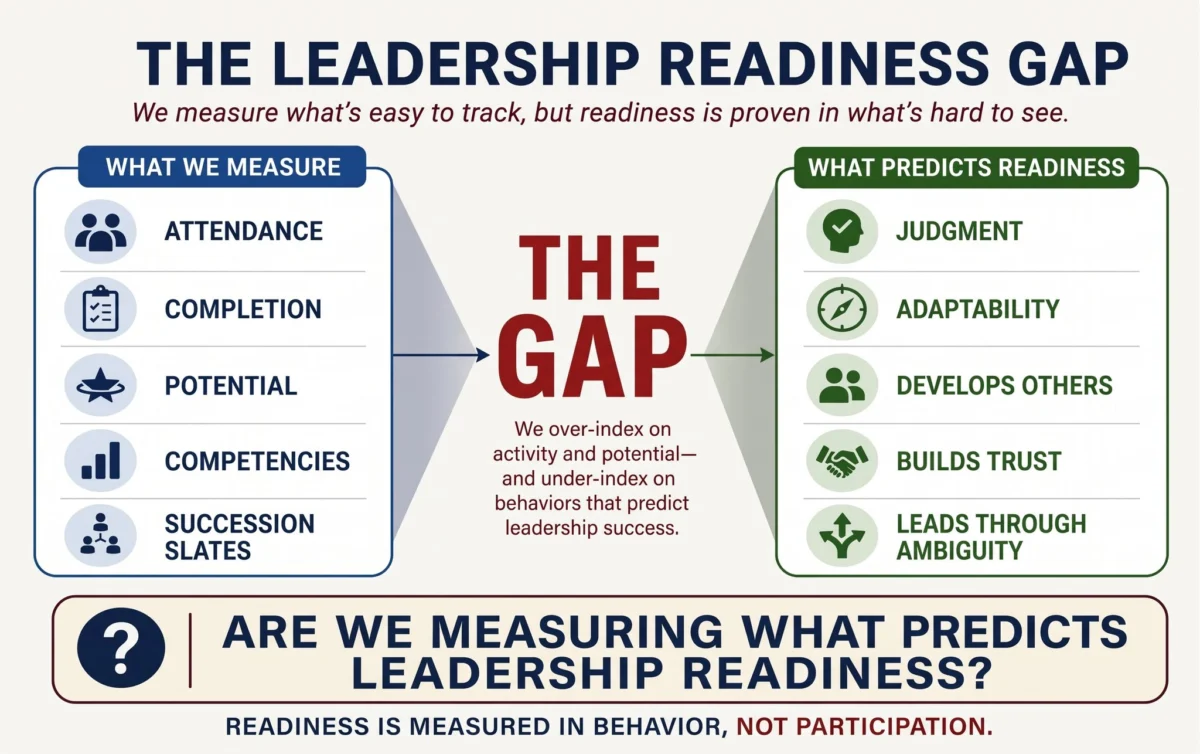
In the high-stakes world of corporate succession planning, there is a recurring, often silent, crisis. Organizations dedicate thousands of hours and substantial capital to identifying "high-potential" talent, mapping out career trajectories, and enrolling rising stars in prestigious leadership development programs. Yet, when a critical role suddenly becomes vacant, the atmosphere in the boardroom often shifts from confidence to apprehension. The central question changes from the comfortable, speculative "Who’s next?" to the stark, urgent reality of "Who’s actually ready?"
This transition represents more than a semantic shift; it highlights a fundamental flaw in modern talent management. Many organizations are not suffering from a lack of talent, but from a persistent leadership readiness gap. While they have become adept at identifying promise, they have remained alarmingly passive when it comes to engineering the specific readiness required for the complex challenges of the modern enterprise.
The State of the Pipeline: Data and Disconnects
The struggle to cultivate a dependable leadership pipeline is not an isolated phenomenon; it is a global systemic failure. According to DDI’s Global Leadership Forecast 2025, a staggering 80 percent of organizations report a lack of confidence in their leadership pipelines. This data point serves as a sobering indictment of current HR and L&D strategies.
If corporations are investing record amounts in leadership development, why does the bench remain so thin? The answer lies in the distinction between potential—a projection of what someone might become—and readiness—the tangible, demonstrated capability to lead in a specific context. The current reliance on theoretical assessments and "check-the-box" training programs has created a false sense of security. Organizations are measuring the input (how many people attended a seminar) rather than the output (how that leader behaves during a crisis).
Understanding the Readiness Gap: A Chronology of Failure
To understand how this gap forms, one must look at the typical lifecycle of a high-potential employee.
Phase 1: Identification (The Pedestal Stage)
The organization identifies an individual based on past performance, technical expertise, and ambition. They are labeled "high potential." At this stage, they are often given accolades, fast-tracked for promotions, and invited to elite internal workshops.
Phase 2: The Developmental Illusion
The employee undergoes training designed to build leadership competencies. However, this training often occurs in a vacuum, detached from the actual, messy, and ambiguous realities of their daily work environment.
Phase 3: The Promotion Threshold
A vacancy opens. The organization, relying on the "high-potential" tag, promotes the individual.
Phase 4: The Crucible of Reality
The new role exposes the gap. The individual—formerly a star performer—struggles to transition from a "doer" to a "leader." They find themselves unable to influence across functions, paralyzed by ambiguity, or failing to empower their team. The organization, caught off guard, views the failure as an individual shortcoming rather than a failure of the developmental system.
Three Structural Shifts in Thinking
Closing the readiness gap requires a radical departure from traditional talent management. Organizations must implement three core shifts to move from theoretical potential to practical readiness.
1. Shifting from Potential to Demonstrated Readiness
Potential is a hypothesis; readiness is a proven fact. As one experienced practitioner noted, the most dangerous risk is confusing the two. When an individual is promoted based solely on their past success as an individual contributor, they are often set up for failure.
True readiness must be contextual. A leader may be perfectly prepared to manage a stable, established department but completely unequipped to lead an organization through a digital transformation or a period of financial distress. To mitigate this, organizations must ask: "What does this person need to experience, practice, and demonstrate before they step into this role?" This requires creating "stress-test" environments where leaders can prove their judgment under pressure long before they hold the title.
2. From Isolated Programs to Integrated Systems
Leadership development is too often treated as a series of events. A seminar on emotional intelligence or a workshop on strategic thinking is helpful, but it is not a system. Readiness is built through a cyclical, rigorous process:
- Identify: Recognize the gaps identified by the succession plan.
- Develop: Provide targeted, real-world experiences.
- Observe: Watch how the leader navigates these challenges.
- Feedback/Reassess: Provide brutal, honest feedback and adjust the development plan accordingly.
By building a system that treats leadership development as a continuous loop of "lived performance" rather than a curriculum, companies ensure that leaders are not just learning theories, but internalizing the behaviors required for the next level.
3. Measuring Impact, Not Just Activity
The final, and perhaps most difficult, shift involves measurement. For too long, L&D functions have been measured by metrics that offer the illusion of progress: attendance rates, total training hours, and employee satisfaction scores.
To transform the culture, leadership development teams must move toward a model of: Activity → Capability → Behavior → Impact.
The question every L&D department must ask is: "What value is being added?" If a leadership program does not change how a leader communicates, how they handle a difficult conversation, or how they build their team, it is merely creative activity. Evidence of readiness should look like measurable changes in team engagement, increased speed in decision-making, and the successful navigation of complex, cross-functional challenges.
Implications for the Future of Work
The implications of this shift are profound for the C-suite and HR leadership.
First, the definition of accountability must change. When a promotion fails, the tendency is to blame the leader. However, if a leader was identified as "high potential" and the organization failed to provide the necessary developmental experiences to bridge their readiness gap, the system is at fault. Boards and executive teams must start auditing their talent development systems with the same scrutiny they apply to financial reports.
Second, the role of the mentor and the manager becomes paramount. Readiness is not something that can be achieved through digital modules alone. It requires the active, daily involvement of current leaders who are willing to delegate, observe, and provide the hard, honest feedback that builds character and judgment.
Finally, organizations must embrace the discomfort of "not-yet." There is no shame in acknowledging that a high-potential leader is not yet ready for a specific role. In fact, identifying that gap early is a sign of a healthy, mature organization. It allows for the time and targeted investment needed to prepare the leader, rather than forcing them into a role where they are likely to fail and burn out.
Conclusion: Building for What Comes Next
Leadership readiness is not a destination; it is an ongoing, daily practice. It is the result of intentional, rigorous, and evidence-based development.
The next time an organization sits down to discuss its succession pipeline, the conversation should not begin with a list of names. It should begin with a list of challenges. What are the obstacles the organization will face in the next three to five years? Who has demonstrated the specific, granular skills needed to navigate those obstacles? And what evidence do we have to support that conclusion?
By shifting our focus from the "who" to the "how," we stop managing for the sake of appearances and start building for the future. The organizations that succeed in the coming decade will be those that realize the most important question isn’t "Who’s next?" but "Who is prepared for what comes next?"—and who have the data, the systems, and the courage to prove it.