





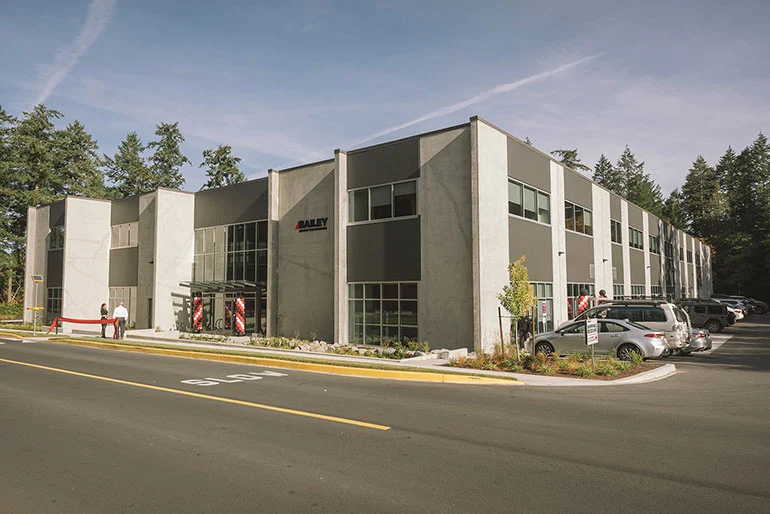
VICTORIA, British Columbia – On October 8, Bailey International officially ushered in a new era for its electronics division with the grand opening of its expansive, 30,000-square-foot headquarters in Victoria. This strategic relocation marks a significant milestone for the global manufacturer, consolidating its electronics operations under one roof to accelerate innovation, enhance operational efficiency, and provide a unified hub for the development of its sophisticated joysticks, handles, and electronic control systems.
The move represents more than just a change of address; it is a physical manifestation of Bailey International’s commitment to its workforce and its growing customer base across the construction, agriculture, and transportation sectors. By bringing diverse departments—from research and development to customer support—into a single collaborative environment, the company is positioning itself to lead in the increasingly complex world of industrial automation and control technology.
Main Facts: A New Hub for Innovation
The new facility, located at #100 – 4480 Markham Street, Victoria, BC, is designed to serve as the heartbeat of Bailey’s electronics division. Spanning over 30,000 square feet, the building is equipped to handle the end-to-end lifecycle of the company’s product line.
Bailey International has built its reputation on the precision engineering of joysticks and electronic controls that define how operators interact with heavy machinery. As modern equipment becomes increasingly digitized, the demand for more intuitive, ergonomic, and reliable control interfaces has surged. This new facility provides the laboratory space, testing environments, and administrative infrastructure necessary to meet that demand.
The grand opening event, held on a crisp autumn day in October, featured a ceremonial ribbon-cutting followed by guided tours for employees, local stakeholders, and industry partners. The event highlighted the modern, open-concept design of the headquarters, which is intended to break down the silos often found in industrial manufacturing environments.
Chronology: The Journey to Completion
The transition to the new Victoria headquarters was a model of project management precision. The construction phase was a tightly orchestrated endeavor, spanning exactly 109 working days.
- Project Initiation (January 26, 2026): The build-out project commenced in late January, with a clear mandate to create a space that would foster cross-functional synergy.
- Execution Phase (February–June 2026): Over the next five months, crews worked diligently to transform the raw space into a high-tech facility. The intensity of the work is underscored by the labor statistics: each construction crew member logged approximately 872 hours of work to ensure the facility met Bailey’s rigorous standards.
- Project Completion (June 30, 2026): The interior build-out was finalized on time, allowing for the strategic migration of teams and equipment.
- Operational Integration (July–September 2026): During the summer months, the company focused on calibrating its production lines, setting up R&D testing rigs, and ensuring that all logistical channels were fully functional.
- Grand Opening (October 8, 2026): The official unveiling marked the culmination of months of logistical planning and collaborative effort.
Supporting Data: Why Consolidation Matters
In the world of industrial manufacturing, the "silo effect" can be a major barrier to innovation. When design engineers are physically separated from production teams or customer support representatives, feedback loops are delayed.
By consolidating the electronics division, Bailey International is tackling three primary operational goals:
- Reduced Latency in Development: With R&D and manufacturing teams in proximity, the iterative process—taking a concept from a CAD model to a functional prototype—is significantly shortened.
- Enhanced Supply Chain Visibility: A unified headquarters allows for more cohesive oversight of the supply chain, particularly for the high-end electronic components that define Bailey’s product quality.
- Customer-Centric Support: By centralizing the support team, the company can provide faster, more informed answers to technical queries from OEM (Original Equipment Manufacturer) partners.
The 30,000-square-foot footprint is not merely "large"; it is strategically partitioned to support specialized functions. This includes climate-controlled testing bays, dedicated assembly lines for high-precision handles, and collaborative "war rooms" where project managers can interface with engineers in real time.
Official Responses: Voices from the Front Lines
The sentiment among the leadership team is one of profound pride and forward-looking optimism.
Darren Lockyer, VP of Electronics at Bailey International, emphasized the human element of the move. "Bringing the electronics team together in one headquarters strengthens how we serve our customers and support our people," Lockyer stated during the opening ceremony. "As part of Bailey, we’re proud to keep investing and building for the future right here in our community. This is a commitment to the talent we have and the talent we hope to attract in the British Columbia region."
For those tasked with the physical realization of the project, the move was a testament to team culture. Neda Bagheri, Project Manager for Bailey, who oversaw the construction from inception to completion, reflected on the process: "This new headquarters build-out was such a meaningful experience, and I’m really grateful to be part of a team that supports each other and keeps things moving forward. It’s been one of those projects that reminds you how much can happen when the right people work together."
The perspective from the engineering department is equally enthusiastic. Nicholas Whyte, New Product Development Manager, sees the facility as a catalyst for technological advancement. "We see real potential to improve operator experience, efficiency and safety while simplifying product configuration and supply chains," Whyte noted. "We’re currently looking for OEM partners to help us test and validate where this technology can deliver the most value."
Implications: The Future of Bailey International
The opening of this facility is a signal to the broader industrial sector that Bailey International is prepared to compete at the highest level of the digital-industrial revolution.
Advancing Human-Machine Interface (HMI)
As the construction and agriculture industries trend toward increased automation and autonomous operation, the "operator experience" has become a competitive differentiator. Bailey’s focus on ergonomic, intelligent controls is perfectly timed. With this new headquarters, the company is expected to ramp up its R&D into haptic feedback, customizable electronic mapping, and IoT-integrated controls that report real-time diagnostic data to fleet managers.
Economic Impact and Local Presence
By cementing its presence in Victoria, Bailey International reaffirms its role as a key contributor to the local economy. The facility requires a specialized workforce, ranging from electrical engineers and software developers to logistics coordinators and quality assurance technicians. This concentration of expertise turns the Victoria site into a regional hub for industrial electronics, potentially attracting further investment and talent to the area.
Strengthening OEM Partnerships
The invitation extended by Nicholas Whyte to OEM partners is particularly telling. It suggests that Bailey is moving beyond a "component supplier" model to a "strategic innovation partner" model. By inviting partners to co-test and validate new technologies within the walls of the new headquarters, Bailey is effectively co-creating the next generation of machinery controls.
Conclusion
The October 8 grand opening is more than a footnote in the history of Bailey International—it is a strategic pivot point. As the company settles into its new home at 4480 Markham Street, it does so with the structural, intellectual, and physical capacity to scale its operations to meet the demands of a modern, digitized world.
With the team now united under one roof, the potential for creative friction, rapid problem-solving, and cutting-edge design has never been higher. As Bailey continues to refine its joysticks and electronic control systems, the industry will be watching closely to see how this newfound synergy manifests in the products that keep the world’s heavy machinery moving.
For more information on the company’s latest developments and their electronics portfolio, visit www.baileyintl.com/electronics.