






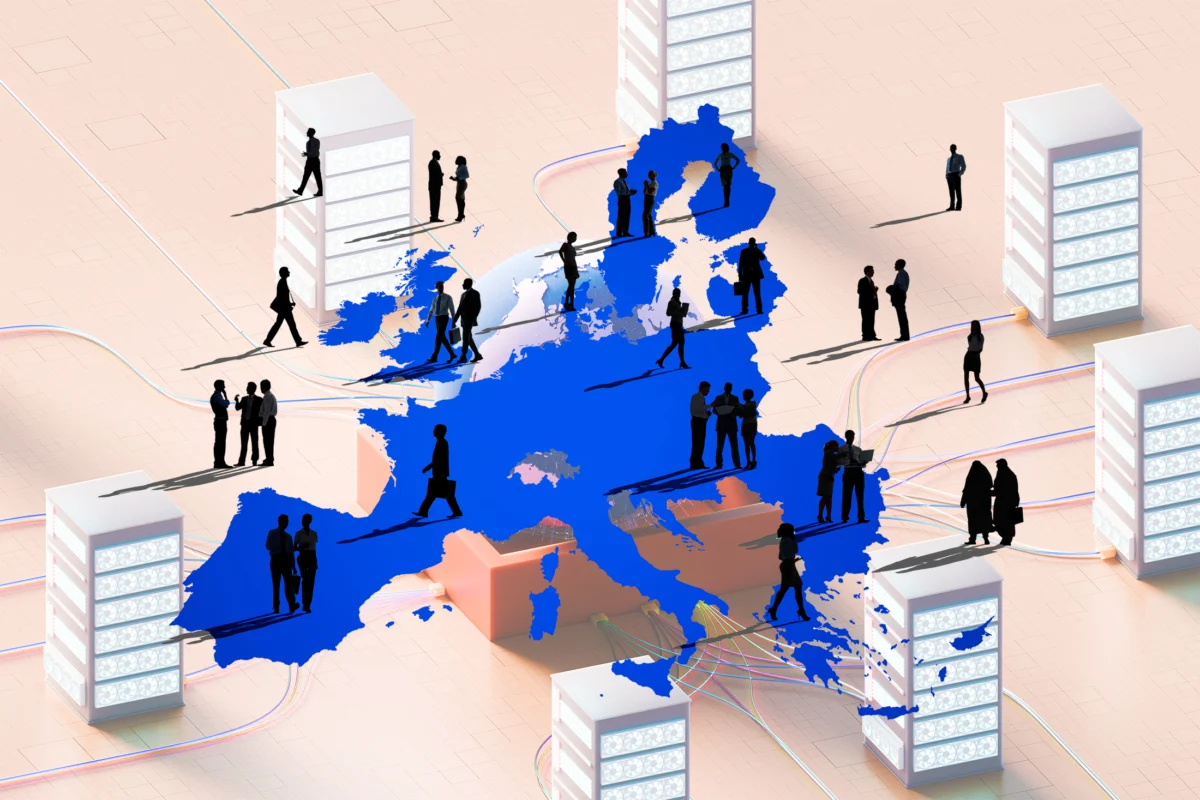
Europe possesses an enviable foundation for the artificial intelligence revolution: world-class technical universities, a deep reservoir of mathematical talent, and a culture of rigorous research. Yet, the continent finds itself in a precarious position. Despite churning out elite AI researchers and engineers, Europe is witnessing a steady "brain drain," as its most promising innovators pack their bags for the United States.
The reasons for this migration are no longer shrouded in mystery. They are grounded in hard, undeniable data. As an AI engineer building the multi-agent chatbot platform ChatMakr in France—and having spent years navigating the labyrinthine world of innovation financing for Parisian tech founders—I have seen the structural fractures that drive our best and brightest to Silicon Valley.
The Core Disconnect: A Capital and Customer Problem
The common narrative suggests that Europe lacks the talent to compete with the U.S. This is fundamentally false. Mapping of global AI professionals indicates that Europe boasts roughly 30% more AI talent per capita than the United States. The deficit is not in human capital; it is in financial capital and customer density.
The Funding Chasm
The fiscal year 2026 provided a sobering reality check on this disparity. According to AI Weekly, U.S. venture capital deployed $412.7 billion in the first half of the year alone, with a staggering $355.9 billion—nearly 86%—flowing directly into AI companies. By contrast, Europe’s entire AI venture haul for the same period was approximately $42 billion, a mere 8% of the global total.
This is not merely a matter of quantity; it is a matter of velocity and risk appetite. American venture firms, fueled by the Y Combinator model and a robust secondary market, provide rapid, high-stakes equity financing. They expect explosive growth and provide the networking infrastructure to achieve it. In Europe, the ecosystem is fragmented, reliant on public subsidies, and characterized by a risk-averse mentality that stifles the "blitzscaling" required to dominate the global AI landscape.
The "U.S. Pivot" Pattern
Even when European startups find early success, they often find themselves forced to restructure for the American market. Klarna, the Swedish fintech giant, serves as a cautionary tale: it was forced to rebuild its core product from the ground up to gain traction in the U.S., eventually seeing its American revenue grow by 58% year-over-year.
The acquisition of Hugging Face by Nvidia for $12.93 billion in September 2026 is often cited as a European success story. While it is a monumental exit for its French founders, the company was founded in New York City in 2016. The capital gravity of the U.S. is so strong that even European-born founders recognize they must relocate to the U.S. to reach their full potential. Exceptions like the Swedish startup Lovable, which achieved a $6.6 billion valuation without a U.S. headquarters, are increasingly rare anomalies in a landscape of forced migration.
The Tax Cost: Navigating the French Regulatory Labyrinth
Funding is only half the battle. For founders based in high-tax jurisdictions like France, success itself can become a liability. France currently holds one of the highest tax-to-GDP ratios in the OECD, at 43.5%.
The "exit tax" is the primary deterrent for scaling entrepreneurs. If a founder has been a French tax resident for six of the previous ten years and holds significant shares—specifically, those exceeding €800,000 in value or representing 50% of profit rights—the act of moving their tax residence abroad triggers immediate taxation on unrealized gains. A founder sitting on millions in paper wealth can face a life-altering six- or seven-figure tax bill simply for moving to a market where their company can better compete. This policy essentially creates a "golden handcuff" scenario, discouraging founders from moving to the U.S. until they have already been stripped of the agility required to compete globally.
The Structural Mismatch: Grants vs. Growth
While European governments have attempted to bridge the gap with public funding, these mechanisms often fall short of market-based VC.
In France, programs like Bpifrance’s Prêt d’Amorçage offer modest capital infusions (€50,000 to €300,000). On the broader European stage, the EIC Accelerator offers grants of up to €2.5 million, and Germany’s ZIM program provides substantial R&D subsidies. While these programs preserve founder equity, they lack the "smart money" component. They are burdened by heavy administrative overhead, stringent documentation requirements, and a lack of the aggressive, network-driven guidance that accompanies American VC funding.
Furthermore, tax incentives like the Crédit d’Impôt Recherche (30% tax credit on R&D) and the IP Box (10% preferential regime for IP income) are generous on paper but difficult to navigate in practice. Many founders, wary of the complex compliance and potential for future tax audits, under-claim or abandon these programs entirely.
Mistral’s Strategic Pivot: Beyond the Frontier Race
On September 8, 2026, the European AI ecosystem received a glimmer of hope when Mistral raised €3 billion in a Series D round led by Samsung, valuing the company at over €21 billion. This stands as the largest equity funding round in European tech history.
However, a deeper look at Mistral’s strategy reveals a shift away from the "frontier model" race. As of late 2026, models like DeepSeek V4 Pro and Qwen 3.6-27B have surpassed Mistral in coding benchmarks like SWE-bench. Mistral has responded by pivoting toward sovereign infrastructure, compute capacity, and acting as a neutral platform for third-party models.
Their decision to integrate the Chinese-built GLM-5.2 model onto their platform signifies a broader realization: if you cannot win the race for the absolute "smartest" model, you can win by controlling the infrastructure layer. By becoming the "neocloud" for Europe, Mistral is betting that sovereignty and regional compliance will eventually trump raw, unchecked model performance.
Implications for the Future of European AI
The path forward for Europe is clear, yet difficult to execute.
- Capital Reform: Europe must move away from its over-reliance on government-backed grants and toward a more integrated, pan-European venture capital market that mirrors the speed and risk-tolerance of the American model.
- Regulatory Simplification: The "exit tax" must be re-evaluated. If Europe wishes to keep its founders, it cannot penalize them for seeking larger markets. Harmonizing tax incentives to ensure they are accessible to early-stage startups—rather than just established players—is critical.
- Sovereign Infrastructure: The Mistral model of prioritizing infrastructure and data sovereignty provides a viable alternative to the OpenAI/Anthropic duopoly. By positioning itself as the guardian of regional data, Europe can leverage its strict GDPR environment as a competitive advantage rather than a regulatory burden.
The Hugging Face outcome proves that Europe can build category-defining entities. The challenge for the next decade is not to replicate the U.S. model, but to provide a competitive environment where talent does not feel compelled to leave the continent to see its vision realized. Europe has the researchers; now, it must build the home for the companies they are desperate to create. If we fail to act, we will continue to act as an incubator for the American AI giants, watching our best minds build the future of the world from the offices of San Francisco, while our own digital sovereignty remains a secondary concern.