Sponsored by InfluxData
For decades, the automotive manufacturing floor has been the domain of the "data historian." From the rhythmic thrum of stamping presses to the precise, programmed arcs of robotic weld cells, these systems have faithfully archived the heartbeat of the assembly line. Yet, as the industry pivots toward Industry 4.0, the rise of the Electric Vehicle (EV), and the demand for hyper-granular predictive maintenance, these legacy systems are hitting a wall.
Modern vehicle assembly lines generate data at a velocity and volume that traditional historians were never engineered to handle. Today, manufacturers face a "trilemma": per-tag licensing costs that make every new sensor a budgetary hurdle, proprietary architectures that isolate quality data in impenetrable plant-level silos, and batch-export workflows that stifle the real-time analytics required for true predictive maintenance.
The temptation to "rip and replace" is high, but in the automotive sector, the stakes are existential. A single line stoppage can cause a cascade effect, leading to missed takt times, severe Just-in-Time (JIT) penalties, and, in the worst-case scenarios, the shutdown of downstream OEM assembly plants within hours.
A new 22-page technical guide from InfluxData offers a strategic alternative: augmenting the historian rather than replacing it. By introducing a time-series layer that functions in parallel with existing infrastructure, manufacturers can unlock next-generation data capabilities without risking a single second of production time.
The Evolution of the Automotive Data Stack: A Chronology of Constraint
To understand the current impasse, one must look at the evolution of automotive data.
The Era of Proprietary Silos (1990s–2010s)
In the late 20th century, the goal was simple: record data for compliance and post-mortem analysis. Historians were installed as standalone entities, connected to PLCs (Programmable Logic Controllers) via serial or early Ethernet protocols. They were built for stability, not for the high-cardinality, high-frequency data streams required by modern machine learning models.
The Sensor Explosion (2015–2020)
As IoT sensors became cheaper and more capable, the number of tags per robot or weld cell increased exponentially. Suddenly, the "per-tag" licensing model—a staple of traditional historian vendors—became a financial bottleneck. Engineering teams were forced to choose which data points were "worth" tracking, inherently limiting the depth of their quality control efforts.
The Modern Integration Crisis (2020–Present)
Today, the industry is struggling with the fragmentation of data. With the integration of disparate systems—such as Allen-Bradley PLCs, KUKA/FANUC robotics, and Atlas Copco torque tools—manufacturers are finding that their legacy historians are unable to unify data across the plant, let alone across a global enterprise. This has necessitated a move toward a unified, queryable layer, which is the core focus of the InfluxData modernization framework.
Strategic Approaches to Modernization
The InfluxData guide outlines two primary methodologies for upgrading the data architecture without disrupting the delicate balance of an IATF 16949-certified production line.
1. The Parallel Feed Model
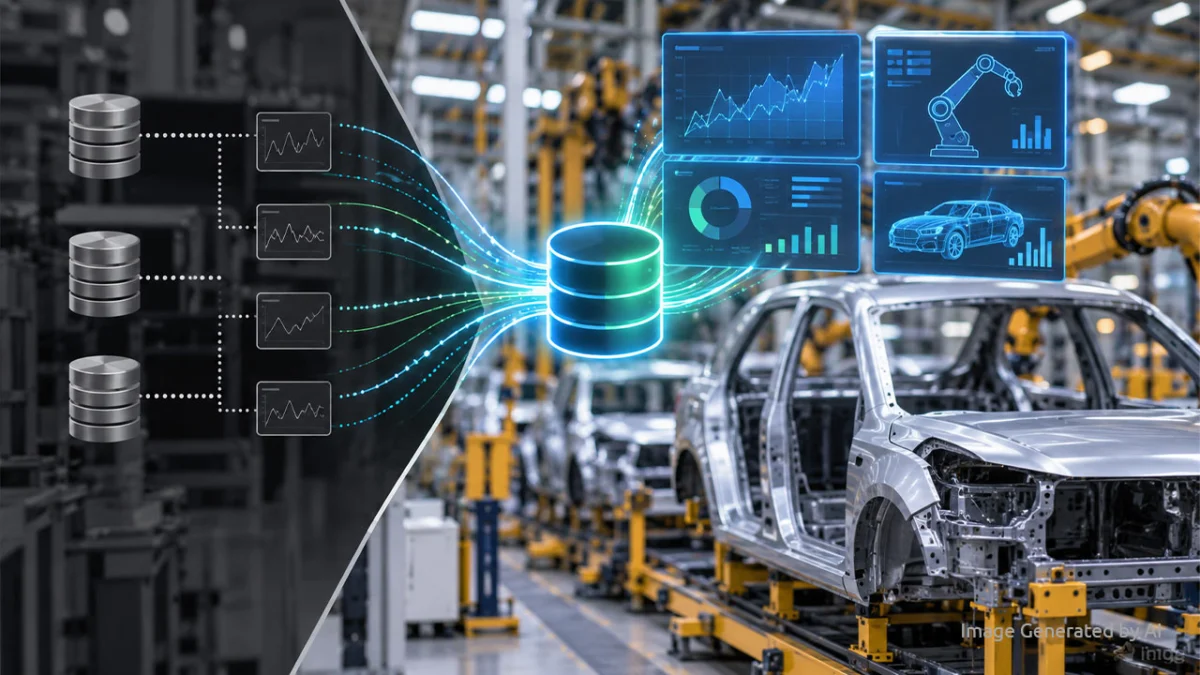
This approach utilizes Telegraf, an open-source, plugin-driven data collector. Because Telegraf supports hundreds of protocols—including OPC-UA, MQTT, and Modbus—it can "tap" into the stream of data moving from the production floor. By sending this data simultaneously to the existing historian and a modern InfluxDB instance, plants can experiment with new analytics, AI, and visualization tools without ever disconnecting the legacy system. If the new system encounters an issue, the legacy historian remains the single source of truth for the plant.
2. The Historian Consolidation Model
For enterprises managing dozens of facilities, the problem isn’t just capacity—it’s visibility. The consolidation model acts as an abstraction layer. By pulling data from multiple disconnected historians into a single, queryable InfluxDB instance, leadership can finally perform cross-plant benchmarking. This allows for global warranty investigations and enterprise-wide quality analysis that were previously impossible due to regional data silos.
Mapping the Automotive Data Flow
The guide provides a comprehensive map of the production floor, identifying the specific data points that define modern automotive manufacturing success:
- Stamping: Monitoring tonnage, die temperature, and high-frequency vibration to detect tool wear before a defect occurs.
- Body Shop: Tracking spot weld current and force, as well as joint-level data from KUKA and FANUC robots to optimize cycle times.
- Paint Shop: Managing critical environmental parameters like E-Coat tank levels, oven temperatures, and HVAC performance to ensure finish consistency.
- Final Assembly: Integrating data from smart tools like Atlas Copco torque guns, monitoring AGV routes for logistics optimization, and aggregating end-of-line dyno testing metrics.
Integration: Playing Well with Others
One of the most critical aspects of the modernization guide is its focus on interoperability. Rather than requiring a proprietary software stack, the suggested architecture acts as a "glue" for existing platforms:
- PTC ThingWorx: InfluxDB serves as the high-performance persistence layer, ensuring that even the most dense time-series data can be accessed instantly within the ThingWorx environment.
- Kepware: By streaming OPC data directly into InfluxDB 3, manufacturers can bridge the gap between legacy assets and modern analytics.
- Rockwell Automation: Through FactoryTalk Optix and View SE, Allen-Bradley PLC data is contextualized and indexed for rapid retrieval.
- Litmus Edge: This serves as the normalization engine, mapping disparate tags into a standardized asset context that is consistent across every facility in the global portfolio.
Implications: Natural Language and the Future of AI
Perhaps the most significant shift highlighted in the guide is the transition from SQL-heavy data management to Natural Language Access.
Through the InfluxDB MCP (Model Context Protocol) Server, engineers can now interact with production data using conversational AI. A plant manager can ask, "Show me the average weld current variance on line 4 compared to last Tuesday," and receive the answer immediately, without needing to write a single line of SQL code or understand the underlying schema. This democratizes data access, allowing those closest to the production line to make data-driven decisions in real-time.
Real-World Validation: Case Studies
The efficacy of this "augment-not-replace" strategy is proven by industry leaders who have already made the transition.
Toyo Tires: Scaling from 100 to 1,000 Machines
Toyo Tires serves as a masterclass in scalability. Starting with a pilot at a single facility in Serbia, they utilized the parallel feed model to monitor 100 machines. As they validated the results, they expanded the system to 1,000 machines across multiple international locations. By leveraging InfluxDB’s long-term storage and compression, they maintained 20 years of audit-ready data without sacrificing query performance.
Gotion: Powering the EV Revolution
As one of the world’s top-10 EV battery manufacturers, Gotion required a platform capable of handling the extreme data density involved in battery cell production. They chose InfluxDB specifically for its compression capabilities and its developer-friendly query language, which allowed their data science team to rapidly deploy machine learning models to detect anomalies in real-time.
American Axle & Manufacturing (AAM)
With a footprint spanning 85 facilities in 18 countries, AAM represents the pinnacle of complex, global manufacturing. By deploying an architecture built on InfluxDB, Telegraf, and Grafana, they have achieved a level of standardization that allows for enterprise-wide visibility, ensuring that quality standards are met consistently across every border.
Conclusion: A Roadmap for the Modern Engineer
The modernization of automotive manufacturing is no longer a question of "if," but "how." The constraints of legacy historians—licensing costs, data silos, and architectural rigidity—are fundamentally incompatible with the demands of an AI-driven future.
However, the industry’s risk-averse nature is well-founded. The guide provided by InfluxData serves as a critical bridge, offering a path that respects the necessity of uptime while embracing the power of modern time-series technology. For plant engineers, launch managers, and IT/OT architects, the message is clear: you don’t have to tear down the old to build the new. By layering modern, flexible, and scalable data infrastructure over existing systems, the automotive industry can continue to drive innovation without ever taking its foot off the pedal.
To download the full 22-page technical guide and explore the detailed architecture for your specific facility, visit the InfluxData resource center.