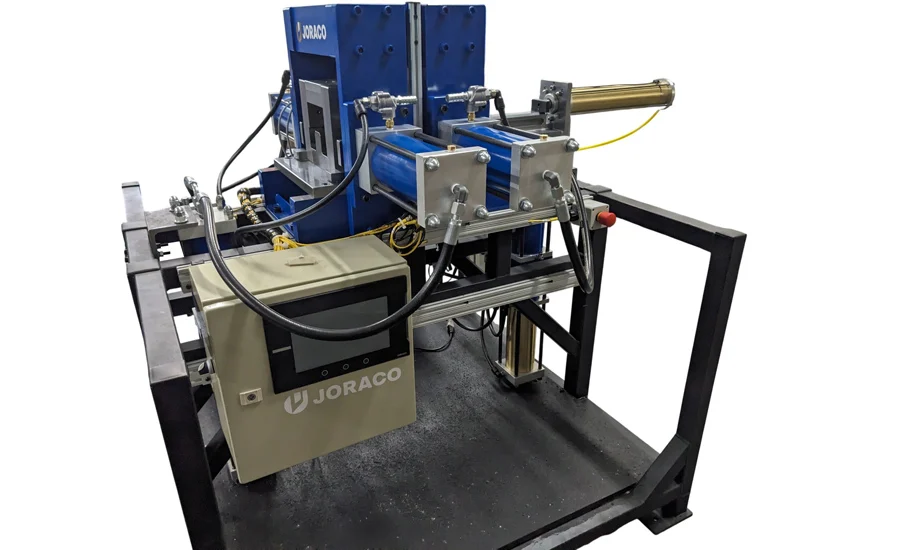
SMITHFIELD, RI — In an era where manufacturing efficiency and floorspace optimization dictate market leadership, AIM-Joraco has delivered a significant engineering achievement. The Rhode Island-based press and automation systems manufacturer has designed and built a highly specialized, custom workcell engineered to punch four holes simultaneously into stamped metal components.
The project, commissioned by an undisclosed industrial manufacturing client, underscores a growing industry demand for hybrid automation systems capable of seamlessly bridging the operational gap between robotic gantry integration and manual human oversight. By combining advanced hydropneumatic technology, structural simulation, and mobile ergonomics, the new system redefines precision and flexibility in high-throughput metal-forming environments.
Main Facts: The Anatomy of the AIM-Joraco Custom Workcell
At its core, the newly developed system is a triumph of application-specific engineering. The project brief challenged AIM-Joraco’s engineering team to design an automated solution capable of transferring stamped metal parts in and out of a press while executing high-precision punching operations.
Key specifications and features of the custom workcell include:
- Simultaneous Multi-Hole Punching: The machine utilizes custom piercing dies configured horizontally to produce four distinct slots across both sides of a stamped metal component in a single, unified stroke.
- Hybrid Accessibility: The system is explicitly designed to accommodate both automated gantry systems and human operators, ensuring maximum versatility on the factory floor.
- Mobility: Built upon a custom, 24-inch-wide mobile stand, the workcell features the structural integrity of a stationary press with the flexibility to relocate between different production line locations as manufacturing needs shift.
- Remote Piston Technology: A primary engineering innovation involves the use of remote pistons, allowing the piercing operation to be successfully executed using just two full-length hydropneumatic cylinders.
- Integrated Workflow: The workcell is designed for end-to-end integration, interfacing directly with an inbound feed system on the front end and an outbound conveyor system on the back end.
Chronology: From Concept to Commissioning
The realization of this complex manufacturing solution followed a rigorous, multi-stage engineering timeline characterized by close collaboration between AIM-Joraco and the client’s internal engineering division.
Phase 1: Collaborative Conceptualization and Requirements Review
The project commenced with deep-dive technical consultations. AIM-Joraco engineers met directly with the client’s manufacturing team to evaluate the physical and operational parameters of the production line. Critical factors reviewed during this initial phase included:
- Precise part orientation requirements.
- Loading and unloading logistics.
- Ergonomic accessibility for human operators.
- Clearances required for overhead automated gantries.
- Synchronization capabilities with upstream feeding mechanisms and downstream conveyor lines.
Phase 2: Structural Simulation and Iterative Design
Once the baseline concept was approved, AIM-Joraco deployed advanced computer-aided engineering (CAE) tools. Through intensive stress simulations and iterative digital prototyping, the engineering team optimized the machine’s structural supports. This phase was critical in ensuring that the chassis could withstand the high-tonnage forces of repetitive punching without micro-flexing, while still incorporating modular access points to allow for the partial disassembly of the tooling area during routine maintenance and die changeovers.
Phase 3: Mechanical Fabrication and Piston Integration
With digital models validated, fabrication shifted to the shop floor. Technicians constructed the mobile stand and installed dedicated mounting points for two multistage hydropneumatic cylinders. Concurrently, specialized horizontal piercing dies were fabricated.
A major technical hurdle overcome during this phase was maintaining absolute alignment when operating more than 7 inches away from the cylinder piston. Heavy-duty structural supports were engineered to tie the punches and dies directly into the tool area, neutralizing deflection risks and ensuring flawless execution.
Supporting Data & Engineering Innovation
The success of the AIM-Joraco workcell hinges on several sophisticated mechanical and hydraulic principles that solve long-standing challenges in metal fabrication.
Hydropneumatic Efficiency and Remote Piston Technology
Traditional stamping presses often require complex, multi-cylinder arrays or expensive hydraulic power units to execute multi-directional or offset piercing operations. AIM-Joraco streamlined this approach by leveraging remote piston technology.
By utilizing just two full-length hydropneumatic cylinders paired with remote actuation, the system delivers the immense force required for piercing thick-gauge stamped metal while significantly reducing mechanical complexity, energy consumption, and potential points of failure.
Overcoming Deflection at Distance
In conventional press design, performing an operation 7 inches away from the driving piston introduces severe bending moments and alignment risks that can result in tool wear, galling, or catastrophic punch failure. AIM-Joraco countered this by integrating heavy-duty structural tie-ins directly within the tool zone. This architecture ensures that the structural load is absorbed by a robust frame rather than the tooling components themselves, guaranteeing repeatable, micron-level alignment over hundreds of thousands of duty cycles.
Mobility Meets Rigidity
Factory floors are dynamic environments. Fixed automation cells often trap manufacturers into rigid floor layouts that are difficult to modify when retooling for new product lines. By mounting the multi-tonne hydropneumatic press system on a reinforced, 24-inch-wide mobile platform, AIM-Joraco provided the client with plug-and-play adaptability. The base features secure locking mechanisms to anchor the unit during high-speed production, yet allows for rapid decoupling and relocation when production schedules demand re-routing.
Official Responses and Industry Perspectives
While individual client identities remain confidential for proprietary reasons, industry analysts and manufacturing experts have weighed in on the broader significance of AIM-Joraco’s custom implementation.
"The modern manufacturing landscape no longer rewards one-size-fits-all solutions," noted an independent industrial automation consultant. "Facilities are dealing with fluctuating labor availability, complex mixed-model assembly lines, and tighter footprints. When a press manufacturer like AIM-Joraco can successfully marry high-force hydropneumatics with mobility and dual human-gantry accessibility, it signals a maturation in how custom workcells are conceptualized."
Internal engineering stakeholders at AIM-Joraco emphasize that this project is indicative of their broader corporate philosophy: prioritizing custom-tailored mechanical agility over off-the-shelf compromises. By working hand-in-hand with customer engineering teams from the napkin sketch to the final factory floor sign-off, AIM-Joraco continues to carve out a distinct niche in the competitive metal-forming and assembly machinery sector.
Broader Implications for the Assembly and Manufacturing Sector
The successful deployment of this custom workcell carries several important takeaways for the broader manufacturing community:
1. The Acceleration of Hybrid Workcells
As lights-out manufacturing and fully automated robotics continue to expand, absolute automation is not always practical or cost-effective for every station on a line. The inclusion of "human-in-the-loop" design considerations alongside automated gantry compatibility ensures that plants can seamlessly transition between manual interventions (such as prototype runs or maintenance checks) and fully automated lights-out production without re-engineering the workstation.
2. Space Optimization and Floor Agility
With commercial real estate and factory floor space commanding high overhead costs, traditional bolted-down, single-purpose presses are increasingly viewed as liabilities. Mobile, multi-functional workcells like the one developed by AIM-Joraco point the way toward modular factories where individual workcells can be wheeled into position, connected to plant air and electrical drops, and integrated into active lines within hours.
3. Engineering Customization as a Competitive Edge
Standard catalog machinery will always hold a place in high-volume, low-variety sectors. However, for companies producing complex, highly differentiated stamped components, bespoke engineering is becoming a baseline requirement. The ability to simulate, prototype, and manufacture custom dies and remote-piston configurations rapidly separates tier-one equipment builders from transactional suppliers.
Conclusion
AIM-Joraco’s latest custom engineering feat demonstrates the profound impact of collaborative problem-solving in industrial manufacturing. By successfully tackling the geometric, structural, and operational hurdles of simultaneous multi-hole metal punching within a mobile, hybrid-access framework, the company has delivered an asset that enhances its client’s throughput, flexibility, and operational safety.
For manufacturers looking to explore similar custom press solutions, automated workcells, or to review AIM-Joraco’s extensive catalog of standard and engineered-to-order systems, further information is available directly through their official corporate portal at www.joraco.com.