





In the fast-moving world of renewable energy, "wave energy" has long been a term that invites skepticism. It is a sector littered with the ghosts of ambitious startups, failed prototypes, and grand visions that disintegrated the moment they met the unforgiving reality of the Atlantic Ocean. Recently, the conversation turned toward offshore data centers powered by wave energy—a concept that, while headline-grabbing, often lacks the rigorous engineering pedigree required for industrial viability.
However, a closer look at Sweden’s CorPower Ocean reveals a different narrative. Unlike the "render-first" startups that prioritize sleek marketing decks over hardware, CorPower has been in the trenches since 2012. With full-scale deployments in Portugal and a history of exporting electricity to the grid, the company has survived the brutal reality of large-scale marine environments. But being a "credible" engineering firm is only the first step. The real question is whether CorPower can overcome the "reference class" of marine machinery failures—corrosion, biofouling, seal degradation, and the crushing costs of offshore maintenance—that have historically rendered wave energy an economic impossibility.
The Origin Story: Borrowing from Biology
CorPower’s founding narrative deviates from the typical clean-tech origin myth. Its core technology was inspired by the work of Swedish cardiologist Stig Lundbäck, whose research into the pumping dynamics of the human heart informed the design of a compact wave-energy converter.
The philosophy is elegant: the device mimics the heart’s ability to tune and detune its motion, allowing it to capture maximum energy in ordinary seas while becoming "transparent" and protective during violent storms. While this bio-inspired approach suggests a level of intellectual sophistication often missing in the sector, it also triggers a classic industry red flag. Hardware startups originating from outside the marine domain often underestimate the "accumulated brutality" of the ocean. The ocean is not a patient circulatory system; it is a corrosive, high-pressure, grit-filled environment where even the cleverest mechanical design must eventually succumb to the laws of entropy and industrial logistics.
Chronology of Development: From Concept to Atlantic Deployment
CorPower has moved with a methodical pace that separates it from speculative competitors:
- 2012: CorPower Ocean is founded, rooted in the research of Stig Lundbäck.
- Initial Testing Phase: The company moves through iterative dry testing, utilizing hardware-in-the-loop (HIL) simulations to stress-test their "Cascade" power take-off (PTO) system.
- The Portugal Campaign: CorPower deploys its C4 device offshore. This marks a critical milestone: the machine is not just a concept, but a grid-connected asset that has successfully navigated the high-energy Atlantic sea states.
- Post-Deployment Analysis: Following the retrieval of the C4 unit, the company publicly reports on wear, biofouling, and corrosion. Crucially, they use this data to upgrade the tidal regulator, improve seal designs, and optimize their grease systems. This transparency is vital; it marks the transition from "heroic prototype" to "industrial development."
Engineering the Mechanical Interface: The "Motorcycle Shock" Challenge
At its heart, the CorPower device is a point-absorber—a floating buoy that moves vertically relative to a seabed-tethered structure. This motion is converted into electricity by a PTO system inside the buoy. The visual design is striking: two parallel, high-tension rods descend from the buoy, resembling the front-fork shock absorbers of a motorcycle.
This mechanical simplicity is both a strength and a potential failure point. The rods, seals, and scrapers must endure constant, cyclic loading in a saline, biologically active environment. Our analysis of the post-deployment reports confirms that the "mundane" risks—biofouling buildup, seal abrasion, and cathodic protection failure—were indeed the primary points of concern for the engineering team. While CorPower has addressed these with upgraded materials and grease systems, the long-term reliability of these exposed components remains the primary hurdle for commercial bankability.
Data and Economic Implications: The "Boring" Threshold
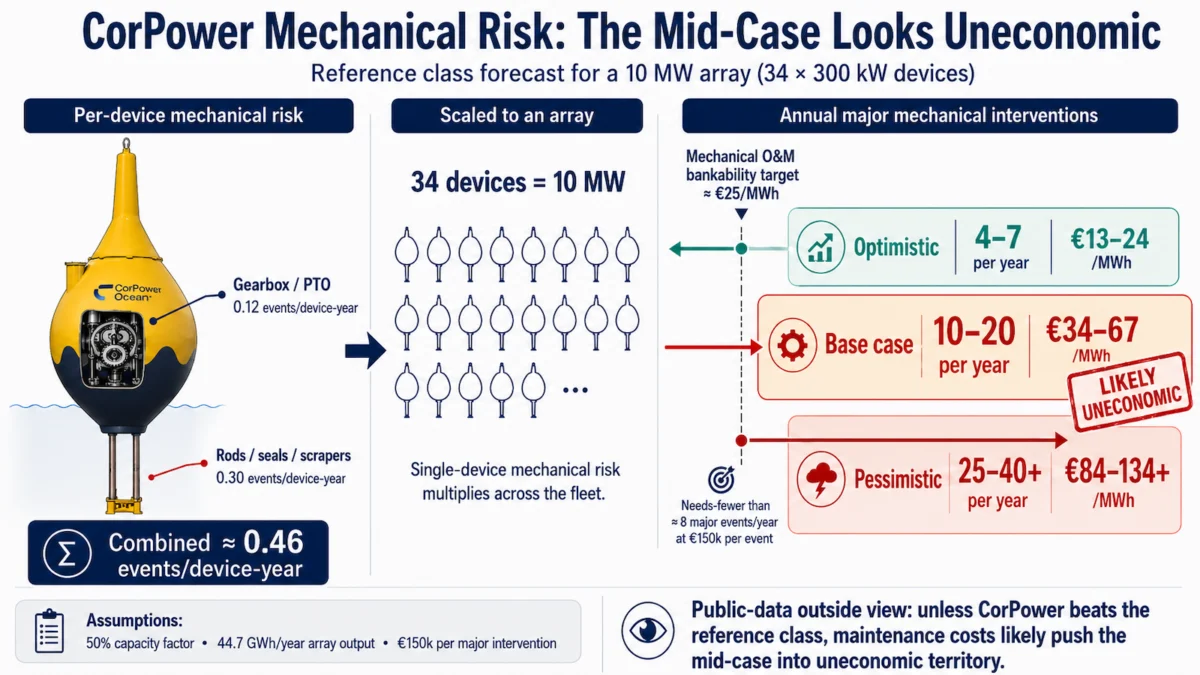
To understand the economic viability, one must look at the math of maintenance. A 10 MW array, comprised of approximately 34 CorPower units, requires a logistical infrastructure that can perform complex, offshore mechanical interventions.

If we apply a "reference class forecasting" approach—looking at similar marine mechanical systems—we can project an estimated failure rate of roughly 0.46 significant mechanical events per device-year. This implies that for a 34-device array, the operator could face 10 to 20 major interventions annually. At an estimated cost of €150,000 per intervention (accounting for vessel mobilization, weather-window delays, and lost generation), the maintenance burden alone could add between €34 and €67 per MWh to the Levelized Cost of Energy (LCOE).
This is a "maintenance treadmill." For CorPower to be bankable, it must prove that its systems can operate with significantly higher reliability than the industry average, pushing that event rate down to the 0.1 to 0.2 range.
The Competitive Landscape: Why Geography Matters
CorPower is currently operating in water depths of roughly 40 meters. In the modern energy market, this is prime real estate for fixed-bottom offshore wind. A single 20 MW wind turbine offers a level of scale and maintenance economy that 67 individual 300 kW wave-energy units simply cannot match.
For wave energy to carve out a permanent place in the energy transition, it must look toward niche applications where wind is either technically constrained or where the specific properties of wave energy—such as co-location with aquaculture, desalination, or remote island power—provide a unique value proposition. In the broad, competitive wholesale electricity market, wave energy remains at a severe disadvantage against the industrialized juggernaut of wind and solar.
Official Stance and Technical Transparency
CorPower Ocean’s leadership has consistently emphasized their "staged validation" approach. By publishing reports on their C4 deployment, they are intentionally inviting the scrutiny of the financial and engineering communities. They argue that the "Cascade Gearbox"—designed for over 100 million load cycles—is the answer to the fatigue issues that plagued their predecessors. They view the ocean not as an insurmountable enemy, but as a manageable environment where "staged learning" leads to incremental, yet vital, reliability gains.
Conclusion: The Long Road to "Boring"
Is CorPower a game-changer? It is certainly a serious player. It is not the "fantasy" infrastructure often peddled by speculative AI-focused energy firms. It possesses a genuine engineering backbone, a history of rigorous testing, and an honest engagement with the challenges of the marine environment.
However, bankability is not achieved through a single successful machine. It is achieved through the accumulation of "boring" records: thousands of days of uptime, predictable maintenance intervals, and dry, unremarkable financial reports. Until the mechanical retrieval rate of these units drops, and until the cost of maintaining a fleet of 34-plus units can be contained within a competitive MWh price, the technology remains in the "demonstrator" category.
For the investors and stakeholders watching CorPower, the roadmap is clear: the next phase must prioritize fleet-level performance over individual device heroism. The ocean will continue to provide the stress test; the only way to win is to make the technology so resilient that it eventually becomes the most boring, predictable part of the grid. Until then, wave energy remains a technology of great promise that is still, quite literally, fighting to stay afloat.