




The promise of next-generation geothermal energy has long been anchored by a singular, seductive narrative: that by moving away from volatile, mineral-rich hydrothermal reservoirs and toward closed-loop, subsurface radiator systems, we could turn geothermal energy into a repeatable, scalable manufacturing process. Eavor, the Calgary-based company at the vanguard of this movement, was once the standard-bearer for this ambition. However, recent disclosures regarding their flagship Geretsried project in Bavaria suggest that the gap between a compelling pitch deck and subsurface reality has widened into a chasm.
The project, which was hailed as a commercial lighthouse for deep-earth heat extraction, now faces a structural and strategic reckoning. Far from a routine update, the latest reports—corroborated by expert analysis from GeoExPro—indicate that Eavor is stepping back from its role as an operator. For a company whose value proposition was predicated on its unique ability to master the subsurface, this pivot looks less like a strategic evolution and more like a retreat from the very technical challenges it claimed to have solved.
Chronology of an Ambition: From Concept to Construction
To understand the current crisis, one must look at the trajectory of Geretsried. The project was never a small-scale laboratory experiment; it was a €368 million commercial demonstration, backed by a formidable coalition of capital, including a €91.6 million grant from the EU Innovation Fund, a €45 million EIB loan, and additional financing from major institutions like ING and Mizuho.
The design was elegant in its simplicity: drill four injector-producer well pairs, each featuring complex multilateral subsurface radiators. By circulating a working fluid through these sealed loops, Eavor intended to extract heat without the complications of hydraulic fracturing or the corrosive brines that plague conventional geothermal.
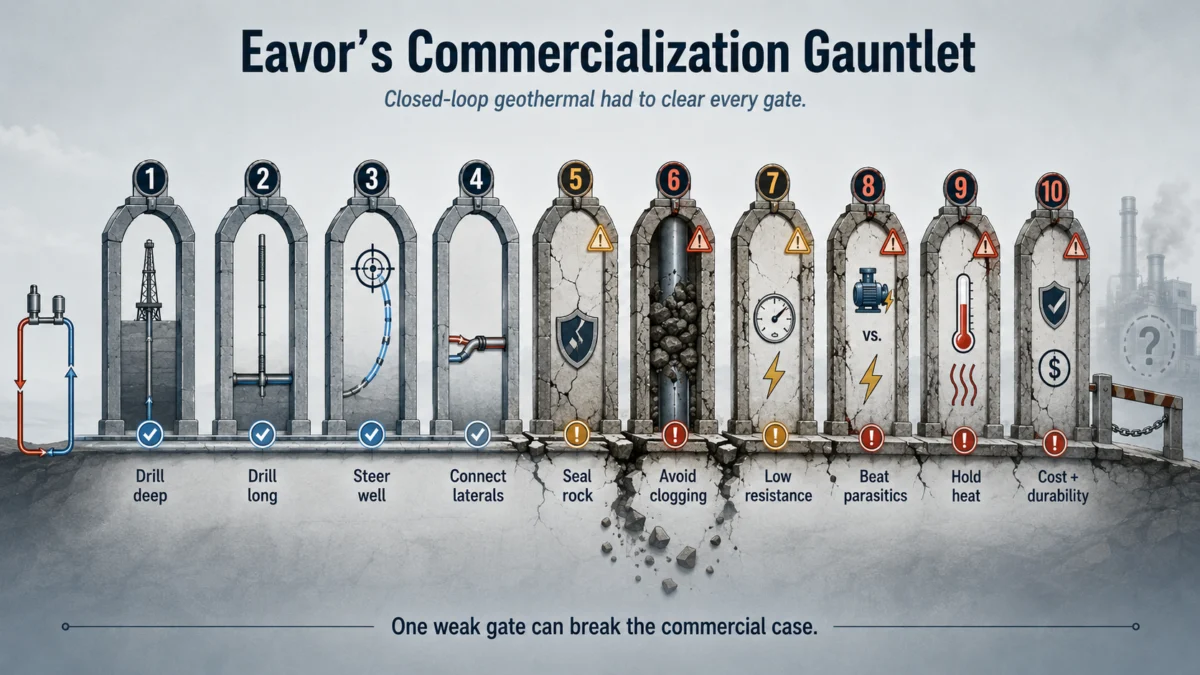
Construction began with high expectations, but the implementation hit systemic snags. According to project records, Eavor has only completed one of the four planned well pairs. Even within that single pair, the performance is discouraging: of the twelve planned horizontal loops, only six were completed, and only three or four contribute materially to the system. The remainder were effectively lost to blockages—specifically, rock fragments that could not be cleared—rendering those sections of the “radiator” useless.

Supporting Data: The Performance Gap
The disparity between the promised output and the current operational reality is stark. Geretsried was designed to deliver approximately 60 MW to 64 MW of thermal output, with a target of 8 MW of gross electricity production.
Current metrics from the site paint a different picture: the plant is producing between 0.5 MW and 1 MW of gross electricity. Given that the plant’s internal parasitic load—the energy required to keep the pumps and surface equipment running—is approximately 0.5 MW, the project is hovering at the threshold of being net-energy negative. This is not a minor deviation; it is an order-of-magnitude shortfall.
The technical hurdles are numerous:
- Drilling and Steering: Achieving the necessary lateral length and spacing in a high-heat environment requires extreme precision.
- Sealing and Flow Assurance: The core of the Eavor value proposition, "Rock-Pipe," relies on sealing the rock wall itself to create a durable, non-cased pipe. The failure to prevent clogging in the loops suggests this sealing technology—the company’s "crown jewel"—is struggling to function under field conditions.
- Mechanical Reliability: Maintaining a closed-loop system in a chemically active, high-pressure, and high-temperature environment for decades is a monumental engineering challenge that has yet to be met at this scale.
The Strategic Pivot: Technology Provider or Distressed Asset?
In light of these struggles, the company’s pivot toward a "technology licensing" model raises more questions than it answers. Typically, a firm shifts to a licensing model once it has successfully proven a reference plant and wishes to scale by allowing others to operate its intellectual property.
However, Geretsried is not a finished, high-performing asset. It is an incomplete, underperforming project that requires significant remediation, additional capital, and, most importantly, proof of technical viability. By stepping away from the operator role, Eavor is effectively distancing itself from the most difficult aspects of its own business: the drilling, the sealing, and the flow assurance.

If the technology works, why leave the heavy lifting to others? The market is currently left to wonder if the company is selling a "recipe" because the kitchen is on fire.
Implications for Investors and the Market
The current situation creates a "buyer problem." Any firm—be it a drilling contractor or an energy utility—that takes over the Geretsried site will view it not as a turnkey asset, but as a high-risk, distressed construction project. The party that steps in will demand substantial risk premiums. They will not be interested in subsidizing Eavor’s R&D; they will require time-and-materials contracts with ironclad liability protections.
Furthermore, the "moat" surrounding Eavor’s technology is proving to be shallower than investors may have realized. Much of the Eavor stack is standard industrial engineering: Organic Rankine Cycle (ORC) power generation, heat pumps, and standard horizontal drilling. The proprietary element—the sealing of the borehole—is an area of active interest for oil and gas firms and other subsurface industries. If Eavor’s specific method cannot be delivered repeatedly, the "moat" loses its defensive value.
The Negotiation Genius Perspective
Drawing on the principles of deal-making outlined in works like Negotiation Genius by Deepak Malhotra and Max Bazerman, the leverage in this scenario is shifting away from Eavor. Potential partners, such as Chubu Electric (an early investor), have a strong "Best Alternative to a Negotiated Agreement" (BATNA). They can afford to wait, learn from Eavor’s failures, and hire the necessary expertise from the open market.
If Eavor wishes to salvage its commercial standing, it must move toward a contingent contract structure. This would mean tying compensation directly to performance milestones:

- Successful completion of loop fields without blockage.
- Demonstrated net-positive thermal/electrical output.
- Sustained reliability over multiple seasons.
If the technology is as robust as the company claims, Eavor should welcome these performance-based terms. If, however, they insist on large, upfront licensing fees without taking responsibility for the project’s success, it acts as a negative signal to the market.
Conclusion: What Lies Ahead?
Eavor is at a critical juncture. The company has moved from being a pioneer of next-generation energy infrastructure to a firm struggling to manage its own intellectual property and the remnants of its primary demonstration project. While the human capital and the data gathered at Geretsried hold value, they are not a substitute for a functioning, bankable commercial system.
For geothermal energy to succeed, the industry needs to move past the hype of "revolutionary" pitch decks and focus on the unglamorous, iterative work of drilling and flow assurance. Eavor’s story is a reminder that the subsurface does not yield to ambition alone; it demands physical, repeatable proof. Until Eavor or its successors can show a stable, net-positive, and economically viable loop field, the "closed-loop" dream remains exactly that: a dream.
The coming months will determine whether Eavor survives as a niche IP firm or if it becomes a case study in the risks of overpromising on the complexities of the earth’s crust. For now, the path forward is narrow, and the burden of proof rests entirely on the company’s ability to deliver results where its current infrastructure has stalled.