By Rebecca Jeffrey
Published in Air Cargo News
Main Facts: The Reign of the 777 Freighter
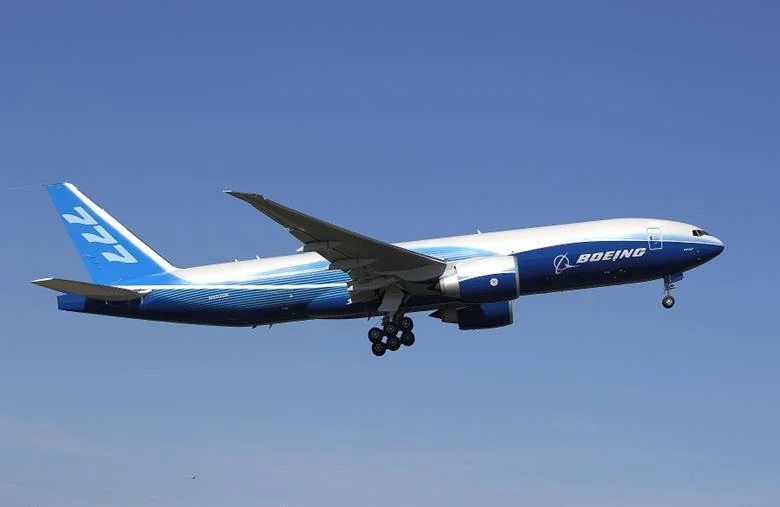
The landscape of global air logistics has shifted. According to definitive data released by American aerospace manufacturing giant Boeing, the Boeing 777 Freighter (777F) has officially surpassed all iterations of the legendary Boeing 747 freighter fleet to become the most widely operated cargo aircraft in the world today.
Having eclipsed the milestone of 330 active airplanes in service, the 777F now moves more global air cargo volume annually than any other individual freighter type. Powered by its unmatched range, fuel efficiency, and heavy-lift capabilities, the twin-engine widebody accounts for approximately 40% of total global freighter capacity.
This milestone marks a generational changing of the guard in the skies. For decades, the iconic four-engine Boeing 747 reigned supreme as the undisputed queen of the skies, carrying outsize cargo across oceans. Today, however, twin-engine efficiency and long-haul reliability have won the day. In 2025 alone, the global 777F fleet logged an astonishing 6,250 flight hours, averaging more than 17 hours of utilization per day. Furthermore, the aircraft dominates the ultra-long-haul sector, operating a remarkable 80% of all freighter flights exceeding 6,000 nautical miles (nmi).
Analysts estimate that the global trade value transported by the 777F fleet last year approached a staggering $4 trillion, underscoring the aircraft’s critical role in keeping international supply chains moving.
Chronology: The Journey to Market Dominance
The ascent of the 777F is the result of decades of engineering evolution, strategic market positioning, and regulatory milestones. Understanding how the aircraft claimed the top spot requires looking back at its development and the regulatory hurdles it cleared just recently to secure its future.
- Mid-2000s (Development & Launch): Recognizing a looming gap in the market as older tri-jets and aging 747-200/400 freighters approached retirement, Boeing developed the 777 Freighter based on the highly successful 777-200LR (Longer Range) passenger aircraft.
- February 2009 (First Delivery): Air France took delivery of the very first 777F, signaling a new era of high-capacity, long-haul cargo transport.
- December 2025 (Seeking Regulatory Extension): With strict new international emissions standards threatening to curtail the production and sale of older aircraft designs, Boeing officially filed a formal request with the US Federal Aviation Administration (FAA) for an emissions exemption. Boeing requested that the decision be finalized by May 1, 2026, to secure the aircraft’s near-term sales pipeline.
- September 2026 (FAA Grants Exemption): The FAA officially granted Boeing an emissions exemption for the 777F model. This regulatory victory threw a vital lifeline to the aircraft’s production longevity, ensuring Boeing could continue selling and delivering the aircraft beyond the end of 2027.
- Throughout 2026 (Current Production & Delivery Run): Boeing’s ongoing order and delivery metrics highlight robust demand. By late 2026, the manufacturer recorded six new 777F orders, 20 aircraft deliveries year-to-date, and a firm backlog of 38 unfilled orders. Cumulatively, total firm orders for the 777F and its upcoming sibling, the 777-8F, have now cleared the 450-aircraft mark.
Supporting Data: Fleet Metrics and Financial Footprint
A deeper dive into Boeing’s operational data illustrates the sheer scale of the 777F’s dominance in the modern air cargo ecosystem.

Key Performance Indicators (2025–2026 Dataset)
- Active Fleet Size: Over 330 aircraft currently in commercial service globally.
- Global Capacity Share: Generates roughly 40% of total worldwide air cargo capacity.
- Daily Utilization: Averaging upwards of 17 flight hours per day per airframe.
- Long-Haul Dominance: Handles 80% of all international cargo flights longer than 6,000 nautical miles.
- Economic Impact: Carried an estimated $4 trillion worth of global trade goods in the preceding year.
- Order Book Health: More than 450 combined firm orders for the 777F and 777-8F product lines, with 38 specific 777F units remaining in the backlog.
- Current Year Momentum: 20 aircraft delivered and six new net orders secured during 2026 alone.
The FAA exemption further cements this financial and operational pipeline. Under the terms of the regulatory approval, Boeing is legally permitted to sell up to 35 additional 777Fs that will remain fully eligible for a standard Certificate of Airworthiness past the 2027 threshold. This guarantees that major global cargo airlines—such as FedEx, Qatar Airways Cargo, DHL, and Emirates SkyCargo—can continue to seamlessly integrate the aircraft type into their long-term fleet strategies without immediate regulatory disruption.
Official Responses and Regulatory Context
The transition of the 777F to the world’s leading freighter has elicited strong reactions from industry stakeholders, regulators, and market analysts alike.
Boeing officials highlighted the historic nature of the milestone, noting in a corporate statement:
"The Boeing 777 Freighter fleet has overtaken the in-service fleet of 747 freighters of all types to become the most widely operated freighter in the world today."
The statement underscores a profound shift in cargo economics. While the Boeing 747 will forever hold a revered place in aviation history for pioneering mass air freight, its four engines have become economically and environmentally less viable compared to modern, twin-engine widebodies.
The regulatory battle over emissions standards also proved to be a nail-biter for the manufacturer and its customer base. When Boeing filed its exemption request in late 2025, environmental groups and competing interests scrutinized whether legacy engine architectures should receive extensions. However, the FAA ultimately sided with industry stability and technological transition timelines when it granted the exemption in September 2026.
By permitting the sale of 35 additional non-compliant-by-modern-standards airframes through the end of the decade, the FAA provided Boeing with the regulatory runway necessary to bridge the gap toward next-generation aircraft like the 777-8F, ensuring that supply chains do not face a sudden capacity crunch.

Implications: What This Means for the Future of Air Cargo
The coronation of the Boeing 777F as the world’s preeminent cargo aircraft carries far-reaching consequences for airlines, shippers, airports, and the broader global economy.
1. Standardization and Fleet Harmonization
For major international carriers, operating a unified widebody fleet simplifies maintenance, crew training, and spare parts inventory. Airlines that already operate passenger variants of the 777 find immense cost synergies in adding the 777F to their cargo divisions. Mechanics, pilots, and ground crews require minimal transition training, driving down overhead costs.
2. Redefining Long-Haul Trade Routes
Because the 777F controls 80% of routes exceeding 6,000 nautical miles, it has effectively shrunk the globe for high-value time-sensitive goods—ranging from pharmaceuticals and perishable foods to advanced electronics and automotive components. Its ability to fly point-to-point across continents without intermediate fuel stops reduces transit times and minimizes cargo handling risks.
3. The Bridge to Sustainable Aviation
While the 777F relies on proven GE90-115B engine technology, its efficiency relative to older four-engine freighters has historically lowered carbon emissions per ton-mile. The FAA exemption allows airlines to maximize the lifespan of these valuable assets while manufacturers continue to refine sustainable aviation fuels (SAF) compatibility and develop next-generation designs like the 777-8F.
4. Market Competition and Future Outlook
With over 450 total orders locked in for the 777F and 777-8F combined, Boeing has secured a formidable stronghold in the heavy freight sector. Competitors like Airbus with the A350F will continue to challenge Boeing’s dominance, but the entrenched network of 777F operators, coupled with the newly secured 35-plane production buffer, ensures that Boeing’s twin-engine workhorse will dictate the rhythm of international trade well into the 2030s.
As global supply chains continue to navigate economic fluctuations, geopolitical shifts, and evolving environmental mandates, the Boeing 777 Freighter stands firmly at the center of gravity for international commerce—proving that the future of air cargo belongs to efficiency, range, and reliability.