Introduction and Main Facts
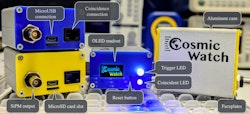
In an era where modern electronics engineering is heavily dominated by high-level software abstraction, pre-packaged software libraries, and plug-and-play modules, tangible physical hardware design occasionally takes a backseat. Yet, true innovation often relies on mastering the nuanced realities of raw analog input/output and specialized sensors. A brilliant embodiment of this engineering philosophy can be found at the University of Delaware, where Spencer Axani, an assistant professor in the Department of Physics and Astronomy, has engineered the CosmicWatch Detector v3X.
The CosmicWatch Detector v3X is a portable, low-power, open-source particle detector designed to track cosmic-ray muons—high-energy sub-atomic particles originating from deep space. Traditionally, detecting and analyzing muons required massive, highly complex, and prohibitively expensive experimental setups restricted to national laboratories and elite universities. Professor Axani’s iteration shatters these economic and physical barriers, delivering a fully functional, high-sensitivity muon telescope boasting a total bill-of-materials (BOM) cost of roughly $100. Operating on a meager 0.5 Watts of power, the device proves that world-class physics data acquisition is entirely achievable using off-the-shelf components, careful analog circuit design, and an innovative approach to signal processing.

Chronology of Development: Eight Years of Iteration
The journey of the CosmicWatch project is a testament to iterative engineering and academic dedication.
- The Genesis (circa 2018): Professor Axani initially conceived the CosmicWatch platform nearly eight years ago with the goal of making particle physics accessible to high schools, undergraduate labs, and citizen scientists. The earliest versions laid the groundwork for low-cost scintillation detection, but lacked the advanced telemetry, multi-sensor data logging, and optimized analog front ends found in modern iterations.
- Continuous Refinement: Over the subsequent years, Axani released multiple upgrades, progressively shrinking the form factor, reducing power consumption, and improving timing resolution. The architecture evolved from a basic educational tool into a rugged, deployable scientific instrument capable of operating in extreme environments.
- The Stratospheric Milestone (May 2026): Proving its mechanical and electrical resilience, a CosmicWatch v3X unit achieved a major milestone by launching on a high-altitude scientific balloon. The unit successfully ascended to an altitude of 100,000 feet, continuously logging high-fidelity cosmic-ray data throughout its punishing upward and downward journey through the stratosphere.
- Current Status: Today, thousands of units have been built worldwide. With the publication of its technical blueprint in The Journal of Instrumentation and open-source documentation hosted via GitHub and arXiv, the project has matured into a global community-driven scientific initiative.
Supporting Data and Technical Architecture
The ingenuity of the CosmicWatch v3X lies in its seamless integration of a custom analog front-end circuit, optical physics, and embedded digital processing.

1. The Scintillator and Optical Coupling
When high-energy cosmic rays collide with atmospheric atoms high above the Earth, they trigger secondary particle cascades rich in muons. These muons possess immense kinetic energy, allowing them to pierce the atmosphere and travel deep underground.
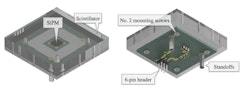
When a charged muon passes through the detector’s core—a 5 × 5 × 1-cm slab of plastic scintillator—it excites the constituent scintillant molecules. As these molecules return to their ground state, they emit photons isotopically along the path of the particle. These scintillation photons undergo internal reflection or are redirected by a surrounding jacket of reflective aluminum foil. A fraction of these photons successfully reaches an onsemi MicroFC 60035 C-Series silicon photomultiplier (SiPM) device, which is optically coupled to the scintillator via optical gel and a silicone pad. The SiPM converts the detected photon burst into a proportional electrical pulse.
2. The Analog Front End: Precision Over brute Force
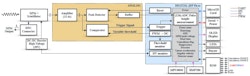
Rather than deploying an expensive, power-hungry, ultra-fast Analog-to-Digital Converter (ADC) combined with a high-speed software comparison loop, the design relies on a classic, highly efficient all-analog peak detector circuit.
- The Comparator: The SiPM signal is amplified and routed to a comparator, which instantly triggers data acquisition by stamping the event with an accurate hardware timestamp.
- The Analog Peak Detector: The signal also enters a classic analog peak detector built around an input operational amplifier, a low-loss capacitor, a Schottky diode, and an output buffer. This simple circuit holds a constant fraction of the pulse peak, allowing the Raspberry Pi Pico (RPi) microcontroller to measure the pulse amplitude precisely. The resulting ADC value corresponds directly to the number of incident photons.
- Coincidence Detection: To filter out ambient radiogenic background signals (such as localized gamma and beta radiation), the system utilizes a multi-unit coincidence detection framework. By configuring two spatially separated detectors to register events simultaneously within a strict microsecond time window, the system successfully rejects uncorrelated background noise, ensuring that only true cosmic-ray muons are logged.
3. Comprehensive Telemetry
Once triggered, the Raspberry Pi Pico records an extensive array of diagnostic and environmental parameters for every event:
- Event count and precise hardware timestamps
- 12-bit pulse amplitude and SiPM pulse height
- Ambient temperature and barometric pressure
- Linear acceleration and angular velocity
- Cumulative system dead time
- Coincidence flag status (confirming multi-detector validation)
Official Insights and Academic Reception
The academic and engineering communities have warmly embraced the CosmicWatch v3X, recognizing its dual value as a rigorous scientific instrument and an extraordinary educational pedagogical tool.
In their peer-reviewed paper titled "CosmicWatch: The Desktop Muon Detector (v3X)", published in The Journal of Instrumentation, Professor Axani and his collaborators detailed the rigorous testing methodologies that validate the unit’s performance against commercial-grade detectors costing orders of magnitude more.
Because academic journals often place such resources behind paywalls, Professor Axani ensured open science principles were upheld by publishing an open-access pre-print via arXiv. Furthermore, in an exemplary display of open-source stewardship, all hardware schematics, Bill of Materials (BOM) spreadsheets, Printed Circuit Board (PCB) gerber files, and firmware listings have been made publicly available on GitHub. This transparency allows high school physics classes, university research labs, and independent hardware hackers worldwide to fabricate, assemble, and deploy their own functional particle observatories for approximately $100.
Implications for Education, Research, and Engineering
The success of the CosmicWatch Detector v3X carries profound implications across multiple disciplines:
- Democratizing Big Physics: By lowering the cost threshold to $100, particle physics is no longer restricted to institutions with multi-million-dollar laboratory budgets. Classrooms across the globe can now conduct genuine astrophysical research, track cosmic ray fluxes, and replicate historical physics experiments (such as verifying Einstein’s theory of time dilation using atmospheric muons).
- A Triumph for Analog Engineering: In an industry increasingly populated by software engineers who treat hardware as a generic commodity, CosmicWatch serves as a powerful reminder of the irreplaceable value of foundational analog design. The clever use of operational amplifiers, Schottky diodes, and peak detectors over resource-heavy digital processing showcases how elegant analog solutions save power, reduce cost, and optimize performance.
- Inspiring Future Innovators: Projects like this reinforce the enduring romance of engineering—proving that deep curiosity, a foundational grasp of electronic signals, and hands-on circuit design can unlock the invisible sub-atomic universe right from a desktop.