As artificial intelligence moves rapidly from experimental novelty to core industrial infrastructure, the engineering sector finds itself at a critical inflection point. This week’s AI engineering brief examines how artificial intelligence is reshaping practical engineering workflows, addressing everything from the widening talent and skills gap to cutting-edge CAD automation, end-to-end product lifecycle management (PLM), and hyper-realistic factory digital twins.
While the appetite for innovation remains exceptionally high, organizations are increasingly grappling with the friction of implementation. The narrative is shifting away from simple text-based chatbots toward "agentic" systems capable of multi-step execution, deeply integrated software environments, and synchronized physical-digital ecosystems.
1. Main Facts: The Current State of AI in Engineering
The integration of artificial intelligence into engineering and manufacturing is no longer a speculative trend projected for the next decade; it is happening right now, often outpacing corporate policy and formal governance frameworks. However, this acceleration has brought structural challenges to the forefront.
- The AI Skills Bottleneck: According to a comprehensive survey of nearly 5,400 STEM professionals conducted by the Specialist Staffing Group and highlighted by ASME (American Society of Mechanical Engineers), optimism regarding new technology remains remarkably high—only 9% of U.S. respondents expressed pessimism about their organization’s technological adaptability. Yet, 32% of U.S. STEM professionals identified upgrading staff AI competencies as their single greatest organizational challenge.
- The Rise of "Shadow AI": Driven by the urgency to improve productivity, engineers are adopting AI tools independently. ASME data reveals that more than half of surveyed STEM professionals utilize unauthorized or unvetted AI tools on a weekly basis. Concurrently, 22% of engineering leaders worldwide report that controlling staff use of AI has become a major compliance and operational hurdle.
- Agentic AI Moves Into Production: A new MIT-backed research paper indicates that engineering and manufacturing sectors are increasingly deploying agentic AI—systems that go beyond static responses to actively plan steps, invoke software tools, interface with CAD/CAM platforms, and autonomously adapt based on real-time feedback.
- Autodesk Embraces Model Context Protocol (MCP): Autodesk has formally introduced Model Context Protocol (MCP) servers, creating a standardized architectural bridge that allows AI agents to directly interact with Autodesk tools, geometries, and data repositories without requiring manual data transcription.
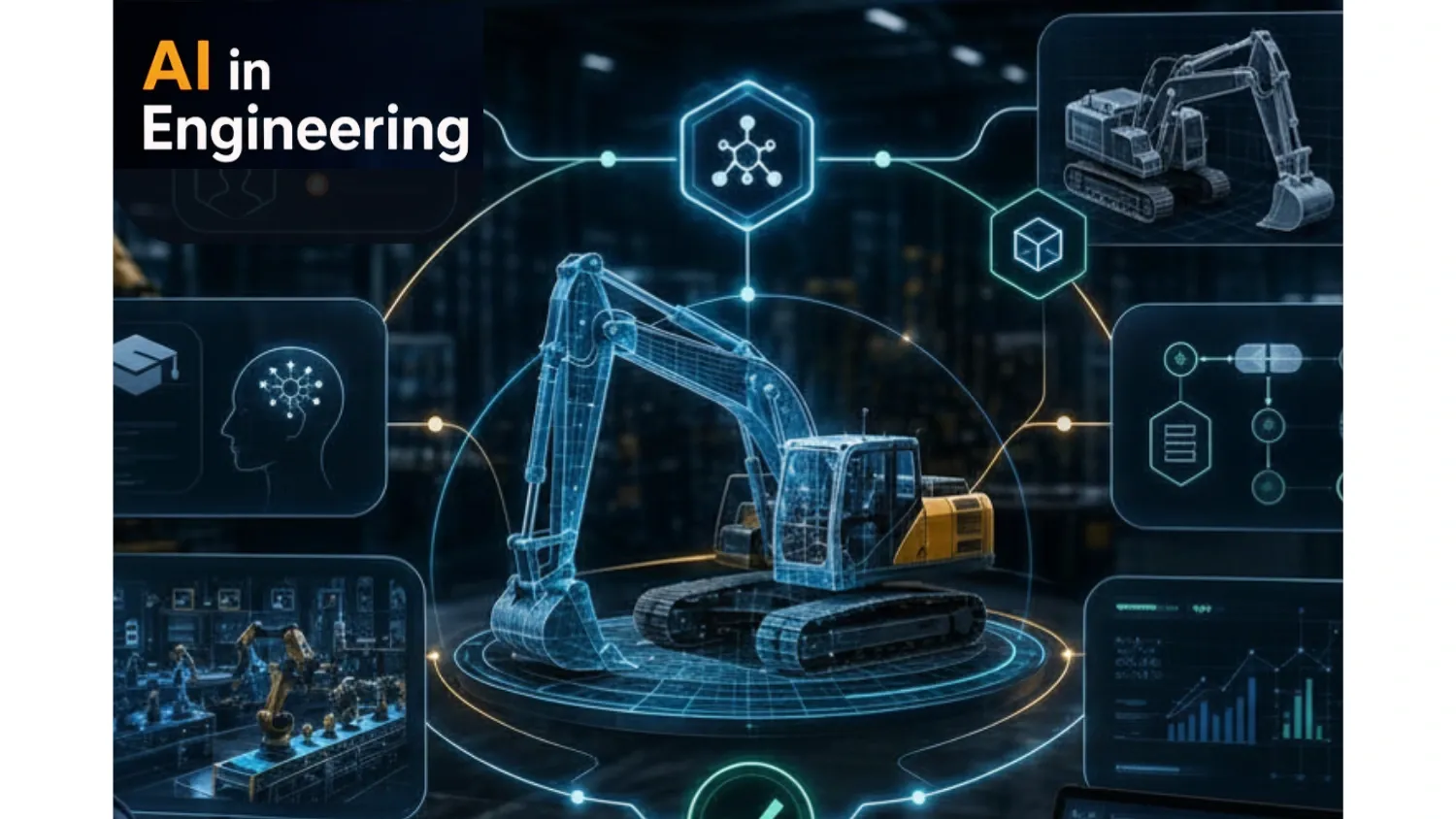
- Unified Product Lifecycle Management (PLM): PTC is demonstrating the power of connected, intelligent product lifecycles through real-world applications like Bobcat’s compact excavator redesign, linking requirements management, generative design, and service analytics into a cohesive AI-enabled fabric.
- Industrial Metaverse and Factory Twins: Siemens has unveiled its Digital Twin Composer, powered by NVIDIA Omniverse libraries. Early adopters like PepsiCo report extraordinary results, utilizing real-time virtual environments to preemptively resolve up to 90% of layout and process issues before physical deployment.
2. Chronology: How AI Integration Accelerated in Engineering
To understand how the engineering industry arrived at the current landscape of agentic workflows and digital twins, it is helpful to trace the rapid evolution of technology adoption over recent years:
- Phase 1: The Chatbot Era (2022–2023): Initial engineering interest in AI focused primarily on Large Language Models (LLMs) used for drafting emails, summarizing documentation, and brainstorming conceptual ideas. Direct integration into core engineering software (such as CAD and CAE) was virtually non-existent, and outputs were prone to hallucinations, requiring rigorous manual verification.
- Phase 2: The Rise of Unofficial Adoption ("Shadow AI") (2023–2024): As commercial AI tools became ubiquitous, engineers increasingly turned to public models to write scripts, optimize code, and parse technical specifications. Organizations struggled to maintain data security, leading to widespread vulnerabilities regarding proprietary intellectual property (IP).
- Phase 3: Native Software Integration and Generative Design (2024–2025): Software vendors began embedding AI assistance natively into design environments. Generative design algorithms matured, allowing engineers to input performance parameters and boundary conditions while AI generated optimized structural components.
- Phase 4: The Agentic and Connected Ecosystem Era (2025–Present): The current landscape is defined by agentic workflows, interoperability protocols (such as MCP), and enterprise-wide PLM integration. AI is no longer viewed merely as an isolated assistant, but as a central coordinator capable of orchestrating complex tasks across requirements, design, manufacturing, and operational twins.
3. Supporting Data: Metrics Driving the Transformation
Quantitative insights from industry studies underscore the urgency, risks, and economic benefits associated with the current wave of AI adoption:
- 9% vs. 32%: While only 9% of U.S. STEM professionals feel pessimistic about their company’s tech adoption curve, nearly triple that number (32%) view the internal skills gap as a critical bottleneck to delivery.
- >50%: More than half of surveyed STEM professionals admit to using unauthorized AI tools on a weekly basis, highlighting a profound disconnect between employee productivity demands and corporate compliance policies.
- 22%: Nearly a quarter of global engineering organizations cite the control and governance of staff AI usage as a primary operational challenge.
- 90% Issue Resolution: PepsiCo’s implementation of Siemens’ Digital Twin Composer has enabled engineering teams to identify and resolve up to 90% of potential operational, logistical, and spatial issues in virtual environments prior to touching physical factory floors.
- 20% Throughput Increase & 10–15% Capex Reduction: Early operational metrics from industrial metaverse deployments demonstrate substantial financial and efficiency gains, validating the business case for high-fidelity simulation twins.
4. Official Responses and Technological Developments
Industry leaders and research institutions are actively responding to the skills crisis and workflow bottlenecks by rolling out new protocols, frameworks, and enterprise solutions.
The Human Element: Bridging the Skills Gap
Experts cited by ASME emphasize that treating the AI skills gap as a future human resources problem is a strategic mistake; it is an immediate delivery risk. Leading firms are responding by moving away from reactive bans and instead auditing existing workflows, combining strategic hiring with targeted upskilling programs, and providing engineers with approved, secure "AI sandboxes." For mechanical engineers working with automation and digital twins, the career path is increasingly clear: mastery of AI tools must be paired with rigorous safety and governance practices.
Software Architecture: Autodesk and Model Context Protocol (MCP)
Autodesk’s introduction of MCP servers represents a fundamental shift in how software vendors expose their functionality to artificial intelligence. By utilizing MCP, AI models are given a structured, secure framework to interact directly with Autodesk tools—most notably through the Fusion MCP Server and Fusion Automation MCP Server.
- Direct Execution: Rather than simply offering text-based recommendations that engineers must manually copy or re-input, the Fusion MCP Server enables AI agents to interact with Fusion designs, construct features, edit geometry, and streamline both design and manufacturing pipelines.
- Cloud-Based Agility: The Fusion Automation MCP Server allows cloud-based access to heavy design and manufacturing tools without requiring local software installations, drastically lowering the barrier to entry for complex computational tasks.
Lifecycle Connectivity: PTC and the Intelligent Product Lifecycle
PTC’s recent showcases—exemplified by Bobcat’s redesign of a compact excavator—demonstrate how modern PLM frameworks can unify previously siloed departments. By leveraging an integrated toolchain (including Creo for global CAD, Windchill for PLM, Codebeamer AI for requirements management, and Servigistics for service parts planning), PTC is positioning AI as an enterprise-wide connector.
- The Connected Workflow: Requirements defined in Codebeamer AI flow seamlessly into Creo generative design iterations. These designs are subsequently reviewed via Windchill and NVIDIA Omniverse integrations, optimized using Windchill AI Parts Rationalization, and fed back into field support through ServiceMax AI. This closed-loop approach drastically minimizes rework and enhances traceability.
Operational Scale: Siemens Digital Twin Composer
Siemens has significantly advanced the industrial metaverse with the launch of Digital Twin Composer, an enterprise tool built on Siemens Xcelerator and powered by NVIDIA Omniverse libraries.
- Virtual Prototyping at Scale: The tool allows engineers to synthesize 2D, 3D, and real-time operational data to construct hyper-realistic virtual environments.
- Real-World Validation: By modeling complex machinery, conveyor systems, autonomous material handling paths, and human operator workflows, companies like PepsiCo are utilizing these digital twins to optimize factory layouts before investing capital in physical infrastructure.
5. Implications for the Future of Engineering
As artificial intelligence solidifies its place in the engineering mainstream, several profound implications emerge for professionals, corporate leadership, and educational institutions:
1. The Redefinition of Engineering Competence
The traditional emphasis on manual drafting, rote calculation, and repetitive data entry is rapidly diminishing in value. In its place, engineering competence is increasingly defined by system-level thinking, critical evaluation, and governance literacy. Because agentic AI and automated CAD tools can rapidly generate design iterations, the modern engineer’s primary role is shifting from a creator of raw geometry to an arbiter of constraints, a validator of assumptions, and a supervisor of automated processes.
2. Governance, Security, and IP Protection
The prevalence of "shadow AI" underscores a dangerous friction point within corporate engineering cultures. When engineers utilize unauthorized external tools to process proprietary CAD assemblies, finite element analysis (FEA) models, or sensitive trade secrets, companies face severe intellectual property and cybersecurity risks. Organizations must transition from prohibitive security postures to enabling strategies—deploying enterprise-grade, secure AI sandboxes that satisfy both productivity demands and strict data governance protocols.
3. The Limits of Autonomous Systems
Despite significant advancements in agentic AI and multi-step workflow automation, industry consensus stresses that AI is not yet ready to operate autonomously in high-stakes engineering environments. Messy legacy data, fragmented software ecosystems, and the inherent physical consequences of manufacturing errors mean that human validation remains non-negotiable. AI can accelerate exploration, automate tedious simulation setups, and coordinate data across the product lifecycle, but ultimate accountability for safety, compliance, and structural integrity rests firmly with human engineers.
Conclusion
The trajectory of AI in engineering is transitioning decisively from experimental hype to pragmatic, high-impact implementation. Whether through solving the internal skills gap, leveraging standardized protocols like Autodesk’s MCP, unifying product lifecycles with PTC, or simulating entire factory floors using Siemens’ Digital Twin Composer, the tools available to modern engineers are more powerful than ever. Success in this new era will not belong to those who resist automation, nor to those who deploy it recklessly, but to engineering teams that master safe experimentation, rigorous validation, and integrated digital workflows.