





As the United States navigates the turbulent waters of 2026, the domestic economic landscape has shifted from a period of recovery to one of acute survival. A sobering reality has taken hold across the American household: the relentless erosion of purchasing power. Fresh data from surveys conducted throughout February and March 2026 reveals a populace increasingly forced to make impossible choices between lifestyle maintenance and basic subsistence.
With inflation lingering at 3.8% as of April and global geopolitical instability—specifically the U.S.-led conflict with Iran—sending fuel prices into a tailspin, the American consumer is signaling a state of distress that political analysts warn could fundamentally reshape the upcoming midterm elections.
The State of the Household: A Deepening Crisis
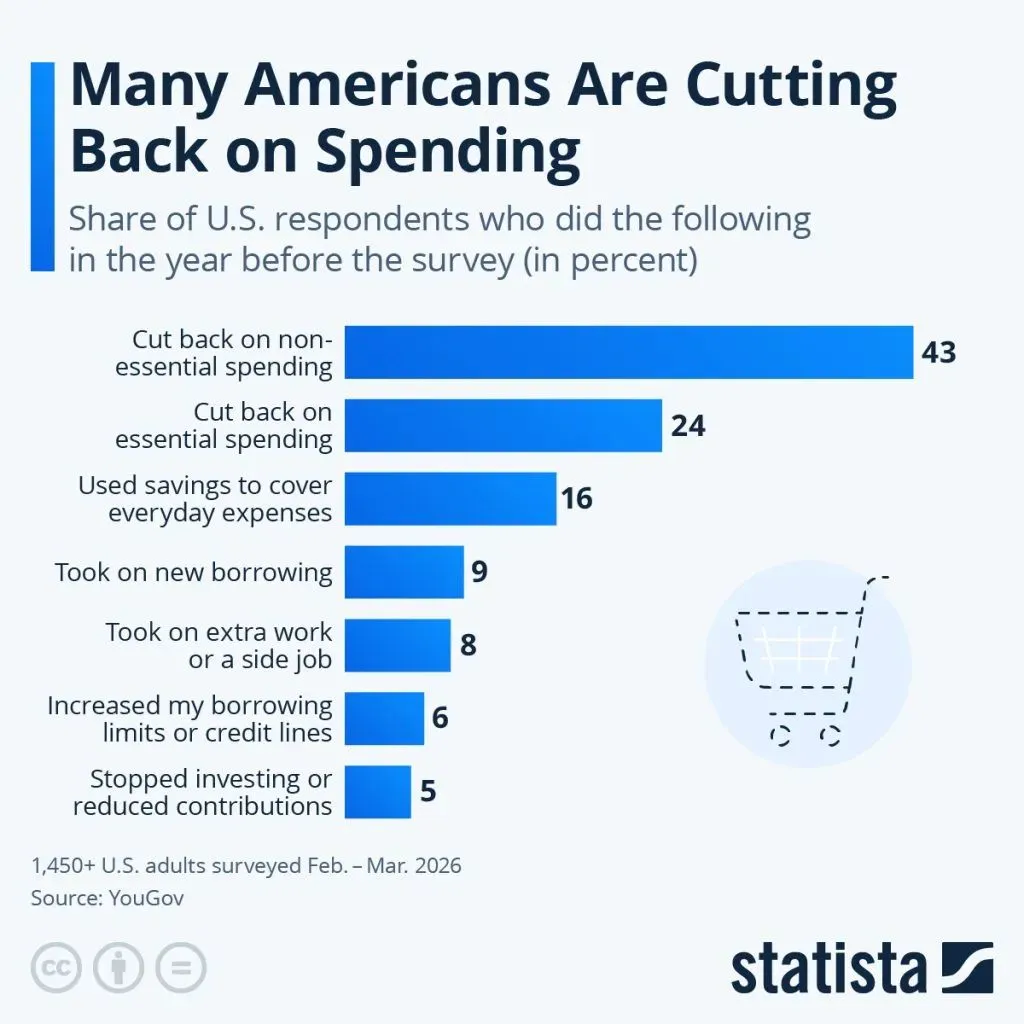
The latest data paints a grim picture of domestic fiscal management. According to the recent survey, a staggering 43% of Americans have been forced to tighten their belts regarding non-essential spending. While the reduction of discretionary income—such as dining out, leisure travel, or luxury goods—is a standard response to economic cooling, the data suggests the problem has moved beyond "belt-tightening" into the realm of emergency measures.
Nearly one-quarter (24%) of respondents reported that they have been forced to cut down on essential spending. This implies that for millions of families, the cost of groceries, basic utilities, and healthcare has outpaced income growth, forcing them to prioritize survival over stability. Perhaps most alarming is the finding that 16% of U.S. adults have been forced to dip into their long-term savings just to cover everyday expenses. This systematic liquidation of assets indicates that the current economic strain is not merely a temporary inconvenience, but a structural threat to the middle-class safety net.
Chronology of the 2026 Economic Downturn
To understand how the U.S. arrived at this precarious juncture, one must look at the timeline of events that have defined the first half of 2026:
- January 2026: Initial reports suggest that the post-holiday season cooling is not abating as expected. Supply chains, strained by regional geopolitical shifts, begin to show signs of volatility.
- February – March 2026: Comprehensive polling is conducted, revealing that consumer confidence has hit a multi-year low. The survey data highlights a sharp divide between those who can adjust their spending and those who are forced to compromise on necessities.
- April 2026: Inflation figures are released, confirming a 3.8% year-on-year increase. The persistent rise in the Consumer Price Index (CPI) is fueled primarily by energy costs.
- May 2026: Public sentiment reaches a boiling point. Polling conducted by SSRS for CNN confirms that the economic malaise is no longer a localized issue but a national consensus, with 76% of Americans identifying high prices as the primary threat to their family’s stability.
Supporting Data: The Anatomy of Financial Anxiety
The economic struggle is not merely a matter of balance sheets; it is a profound psychological burden. The disconnect between the macro-economic reports often touted by policymakers and the lived reality of the average citizen has created a pervasive atmosphere of uncertainty.
The Cost of Living Crisis
The 76% figure—representing the vast majority of Americans who view the cost of living as their number one economic burden—is not an outlier. It is a reflection of the "triple threat" currently facing consumers: energy costs, food inflation, and the stagnation of real wages. As fuel prices continue to climb due to the ongoing U.S.-led war against Iran, the transportation of goods becomes exponentially more expensive, creating a cascading effect on every shelf in every grocery store in the country.
The Psychology of Uncertainty
Beyond the raw numbers of debt and spending, there is the issue of outlook. When 54% of respondents express feelings of uncertainty regarding their financial future, it signals a cessation of investment and long-term planning. When families are uncertain about the next quarter, they stop saving for retirement, postpone home improvements, and delay major life milestones. This "wait-and-see" approach acts as a drag on the broader economy, creating a self-fulfilling prophecy of stagnation.
Official Responses and Policy Tensions
The administration currently finds itself in a precarious position. While the executive branch has pointed to job growth numbers in certain sectors, these metrics are increasingly being viewed as insufficient by the general public.
The Energy Conundrum
The conflict in the Middle East has effectively ended the era of cheap energy for the foreseeable future. While the administration has attempted to tap into strategic reserves to dampen the impact of rising fuel prices, the geopolitical reality of a conflict-heavy environment makes a sustainable decline in energy costs unlikely. Critics argue that the government’s failure to diversify energy sources aggressively enough in the preceding years has left the nation vulnerable to the whims of global conflict.
Monetary Policy and Inflation
The Federal Reserve faces a "soft landing" paradox. By keeping interest rates high to combat the 3.8% inflation rate, they are effectively cooling the economy, but they are also increasing the cost of credit for the very families who are already struggling to pay for basic necessities. The balance between taming inflation and avoiding a full-scale recession has become the defining challenge for fiscal authorities.
Implications: The Shadow of the Midterms
As the calendar moves toward the midterm elections, the political fallout from this economic reality is becoming increasingly evident. Political history dictates that when the "kitchen table" issues—gas, groceries, and housing—become the dominant concern for voters, the party in power typically suffers.
The Voter’s Perspective
The narrative of "economic recovery" is being soundly rejected by the electorate. With 54% of Americans feeling fundamentally insecure about their future, the focus has shifted from "growth" to "protection." Voters are increasingly looking for candidates who prioritize local economic relief over foreign policy objectives. The war in Iran, initially viewed through a lens of national security, is now being filtered through the lens of domestic economic cost.
Future Economic Trajectory
If inflation remains sticky at or above the 3% mark and energy prices continue to fluctuate in response to geopolitical instability, the risk of a "stagflationary" environment—where growth slows while prices remain high—becomes a distinct possibility. Economists are already warning that the second half of 2026 will require significant fiscal intervention to prevent the 16% of the population currently using savings for expenses from falling into deep poverty.
Conclusion: A Nation at a Crossroads
The data from the first half of 2026 tells a story of a nation under duress. The erosion of purchasing power, the depletion of savings, and the overwhelming anxiety regarding the future are not merely data points on a chart—they are the markers of a systemic economic crisis.
As the U.S. moves into the latter half of the year, the combination of a high-inflation environment and the ongoing geopolitical conflict will continue to test the resilience of the American family. Whether the upcoming midterm elections result in a shift in policy direction or a continuation of current efforts remains to be seen. However, one thing is clear: the current state of financial uncertainty is the defining issue of the era, and it will continue to shape the American experience until the fundamental cost of living can be brought under control.
The government’s ability to stabilize energy markets, curb inflationary pressures, and restore a sense of economic security will be the ultimate litmus test for the current leadership. For now, the American public remains in a holding pattern, waiting for the relief that current market conditions have yet to provide.