Main Facts
The architecture of industrial automation is undergoing a foundational paradigm shift. For decades, machine control relied almost exclusively on centralized architectures governed by heavy multicore industrial PCs (IPCs) built around x86 and ARM system-on-chip processors. These units simultaneously handled deterministic real-time motion control and general-purpose operating systems on the same silicon.
Today, the rapid evolution of edge-computing hardware—spanning multicore IPCs, smart servo drives, and intelligent I/O nodes—is decentralizing this intelligence. By pushing deterministic control, local data processing, and integrated safety functions closer to the physical process, modern automation systems are achieving unprecedented levels of efficiency, responsiveness, and reliability.
At the core of this transformation are high-performance industrial networks utilizing protocols such as SERCOS III, EtherCAT, PROFINET, and EtherNet/IP. These networks manage deterministic traffic with strict microsecond-level jitter tolerances required for advanced motion control. Simultaneously, edge-filtering mechanisms process high-frequency telemetry at the point of origin, ensuring that control processors are not overwhelmed by extraneous communications.
Whether implemented in complex multi-axis robotics or traditional single-axis machinery, edge computing transforms raw sensor and drive data into actionable, time-stamped insights. This localized capability minimizes bandwidth bottlenecks, reduces wiring complexity through cabinet-free designs, and enables near-instantaneous responses to prevent machine downtime, jams, and catastrophic failures.
Chronology: The Evolution of Industrial Control Architecture
The Era of Centralized PLC and IPC Hegemony
- Late 20th Century to Early 2010s: Industrial automation relied heavily on centralized Programmable Logic Controllers (PLCs) and IPCs. In this model, every sensor, actuator, and drive communicated back to a central processor via hardwired I/O or basic fieldbuses.
- The Bottleneck Challenge: As machines grew faster and more complex, high-frequency data generated by servomotors—such as phase current, rotor position, and winding temperature—was largely discarded between fieldbus cycles due to bandwidth limitations and processing overhead at the central controller.
The Rise of Deterministic Ethernet and Multicore Silicon
- Mid 2010s: The widespread adoption of deterministic industrial Ethernet standards (EtherCAT, PROFINET, EtherNet/IP) allowed for synchronized, microsecond-accurate communication across complex automated workcells.
- Silicon Advancements: Multicore x86 and ARM processors enabled manufacturers to run real-time kernels alongside general-purpose operating systems on a single piece of silicon, partitioning deterministic control tasks from non-deterministic enterprise functions.
The Shift Toward Distributed Edge Intelligence and Smart Drives
- Recent Years: Motion-component suppliers began introducing advanced servo amplifiers capable of executing local logic, advanced filtering, and certified safety functions directly on the drive.
- Cabinet-Free Architecture: Modern engineering practices increasingly favor decentralizing hardware, placing ruggedized, IP-rated drives and programmable edge controllers directly on the machine frame. This minimizes control cabinet footprints, slashes cabling requirements, and establishes edge computing as the dominant framework for contemporary discrete automation.
Supporting Data and Technical Mechanics
How Edge Platforms Correlate Machine State
In advanced discrete automation setups, data sources are prolific. They include multi-axis servodrives, IO-Link primaries, and physical sensors interfacing directly with workpieces and mechanical assemblies.
A critical enabler of modern edge platforms is distributed clock synchronization. Every data point—ranging from motor current and positioning error to dynamic torque, temperature, and vibration—is stamped with a precise time reference. This allows the edge platform to map telemetry directly to the exact machine state, facilitating deep operational transparency.
| Architecture Component | Traditional Centralized Model | Modern Edge-Computing Model |
|---|---|---|
| Data Processing Location | Central IPC or PLC | Distributed at the drive, edge node, or local IPC |
| Bandwidth Utilization | High; all raw data transmitted over fieldbus | Optimized; local filtering sends only pre-summarized events |
| Safety Implementation | Hardwired safety relays, contactors, and stop circuits | Certified drive-based functions (STO, SS1, SLS) |
| Wiring Complexity | Extensive point-to-point hardwiring to cabinets | Streamlined via hybrid cabling and decentralized nodes |
The Drive as a Data Hub
Servodrives naturally close high-frequency control loops for current, velocity, and position. They inherently capture valuable electrical and thermal metrics—including bus voltage, phase current, and winding temperature.
By integrating logic processing directly into the amplifier, modern drives eliminate the latency of relaying this data to a central controller. Machine status communications now occur within microseconds. When coupled with industrial Ethernet, these systems can autonomously execute corrective actions to prevent crashes, misfeeds, and jams while simultaneously broadcasting health analytics to enterprise operational systems in near-real-time.
Safety Migration to the Edge
Safety engineering has similarly shifted toward edge topologies. Certified safety features—such as Safe Torque Off (STO), Safe Stop 1 (SS1), and various Safe Motion Limits—are increasingly executed natively within the drive firmware. By assuming the responsibilities traditionally managed by external safety relays, hardwired stop circuits, and dedicated contactors, edge-enabled drives simplify system validation and reduce physical footprint.
Official Perspectives and Industry Insights
Makers of automation hardware and motion-control components emphasize that the migration to edge computing is driven by the demand for smarter, more resilient manufacturing systems. Industry engineering leaders note that while decentralized components require ruggedized, IP-rated housings to withstand harsh shop-floor environments—along with specialized hybrid cabling—the long-term operational advantages heavily outweigh the initial hardware considerations.
"Drives are inherently the best-instrumented components on any modern machine," notes automation systems integration specialists. "For years, engineers left massive amounts of valuable phase, torque, and thermal data stranded between fieldbus cycles. Unlocking that data at the edge fundamentally changes how we approach machine health and intervention."
Furthermore, standards bodies and industrial network consortia point out that edge preprocessing acts as a vital bridge between operational technology (OT) and informational technology (IT). By executing functions like local signal debouncing, scaling, thresholding, and feature extraction, smart edge devices ensure that only meaningful events and pre-summarized telemetry are transmitted over standard Ethernet or wireless connections. This dramatically reduces network congestion and facilitates seamless publishing via modern IoT protocols like MQTT and OPC UA.
Implications for Industrial Operations
Use Case: Advanced Industrial Conveyance
To understand the practical impact of edge computing, one need only examine the evolution of the industrial conveyor. Once treated as simple, single-speed transport paths, modern networked conveyors feature intricate webs of sensors, encoders, and coordinated servodrives.
- Traceability and Quality Control: Sub-sensors track workpiece orientation, surface quality, weight, and lot numbers. Timestamped data ensures complete traceability—a mandatory requirement in pharmaceutical, medical device, and food processing facilities.
- Dynamic Handling: Edge processing enables zero-pressure accumulation, gapping, merging, and diverting functions. When multiple robotic arms interface with a single conveyor, edge controls use real-time workpiece positioning to command picking, sorting, labeling, and ejecting tasks on the fly.
- Predictive Maintenance: Motor-torque signature analysis at the edge identifies mistracking belt sections or rising accumulation pressures before a physical jam occurs. Similarly, steady increases in motor-current draw, paired with creeping component temperatures, expose mechanical bearing and seal wear well in advance of catastrophic failure.
Edge Computing in Simpler, Open-Loop Motion Systems
While high-end applications leverage deterministic fieldbuses and networked servocontrols, edge computing offers substantial value to simpler, single-axis machinery. Systems relying on pneumatic cylinder indexers, VFD-driven conveyors, gearmotor rollers, and cam-actuated mechanisms traditionally lacked closed-loop feedback.
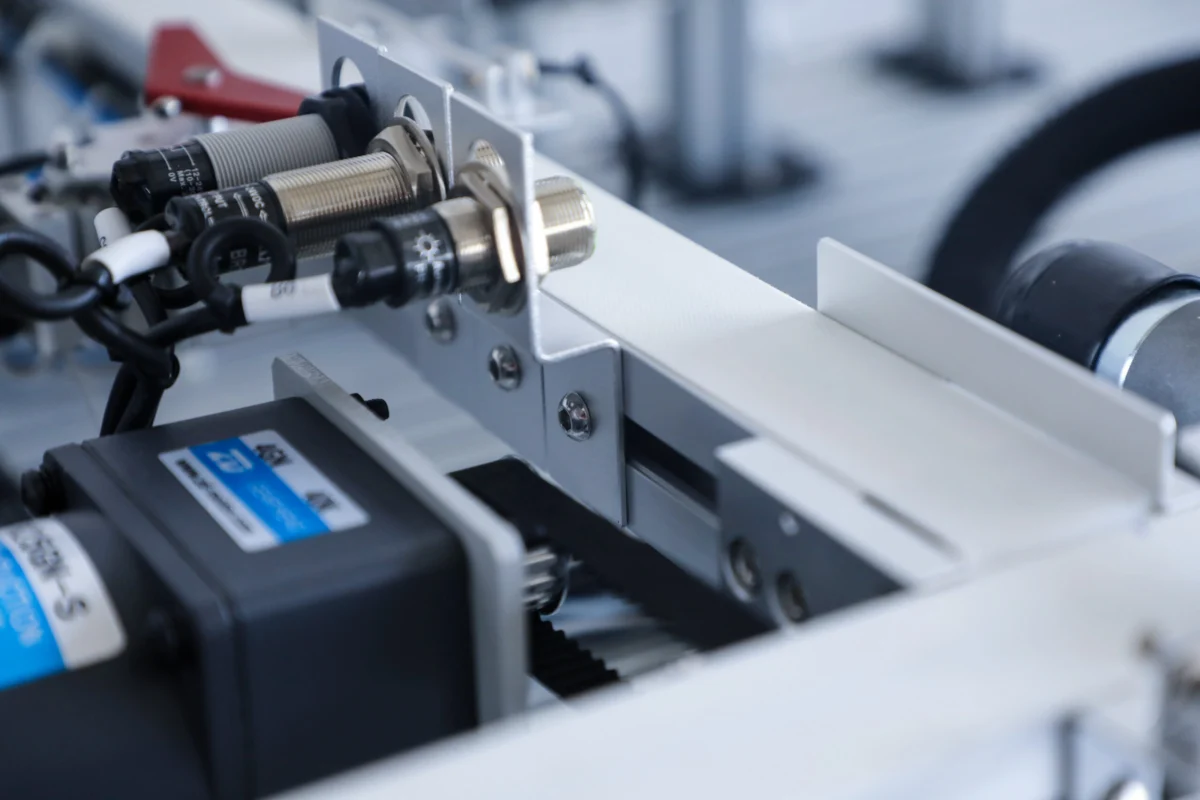
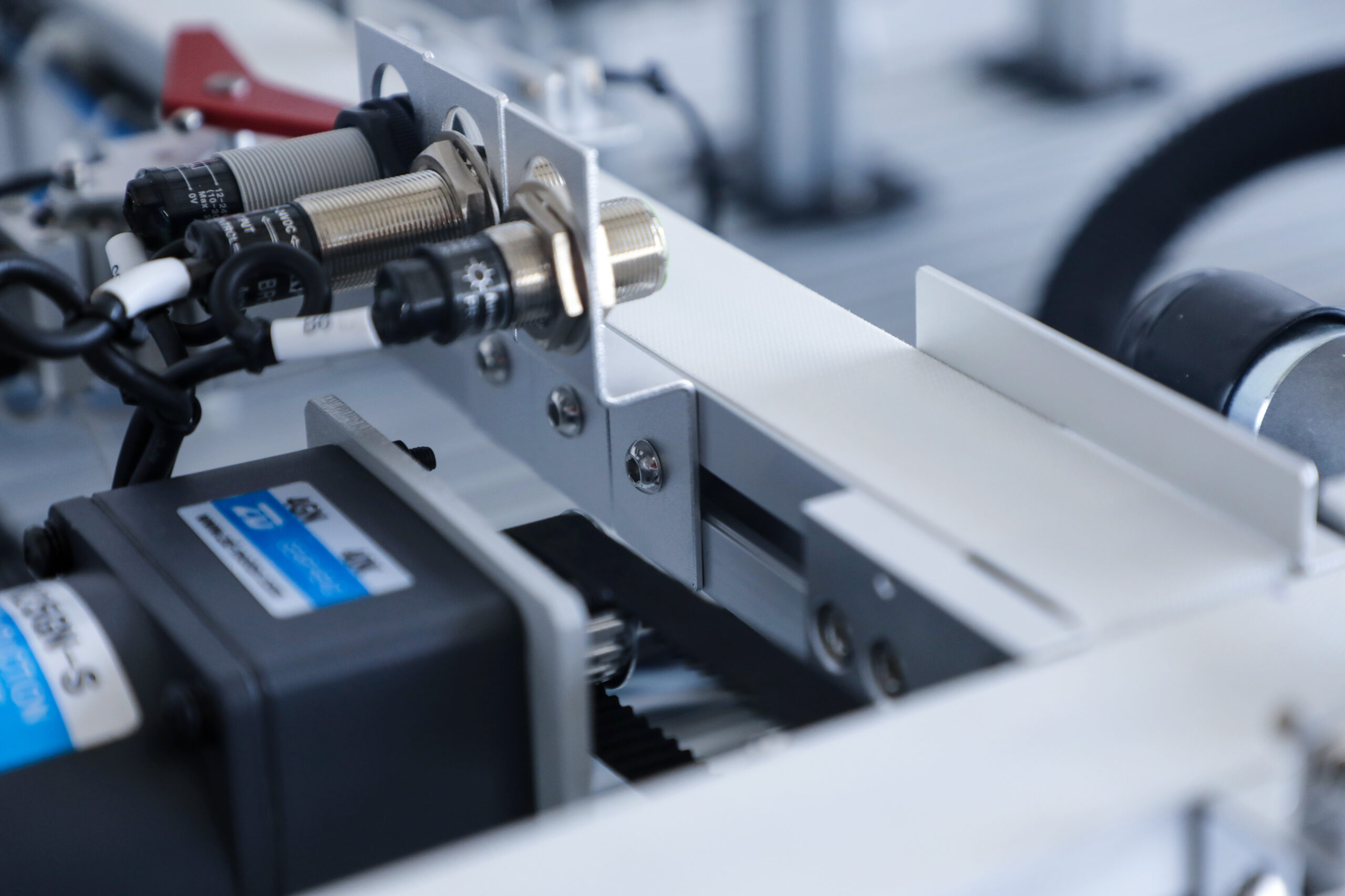
Today, smart edge I/O devices can terminate binary and analog signals directly at the machine. Even basic limit, home, and proximity switches yield valuable telemetry regarding strokes, cycles, and dwells.
- Current Transducers and Accelerometers: Utilizing 4-20 mA outputs, current transducers enable simple motor-current signature analyses on open-loop VFDs. Meanwhile, strategically placed accelerometers monitor peak vibration values on couplings and gearboxes, providing early wear detection without requiring full, costly spectral condition-monitoring suites.
- Programmable Edge Controllers: Commercially available programmable edge controllers integrate digital and analog terminals directly with local code execution engines, allowing older or simpler machines to broadcast standardized telemetry via MQTT and OPC UA.
Conclusion
The transition toward edge-computing hardware in industrial automation represents a decisive maturation of machine control. By distributing intelligence, executing safety at the drive level, and filtering data at the source, manufacturers are building cleaner, safer, and remarkably self-aware production environments. As edge devices continue to drop in cost and rise in processing capability, the boundary between raw mechanical motion and intelligent digital control will continue to dissolve.