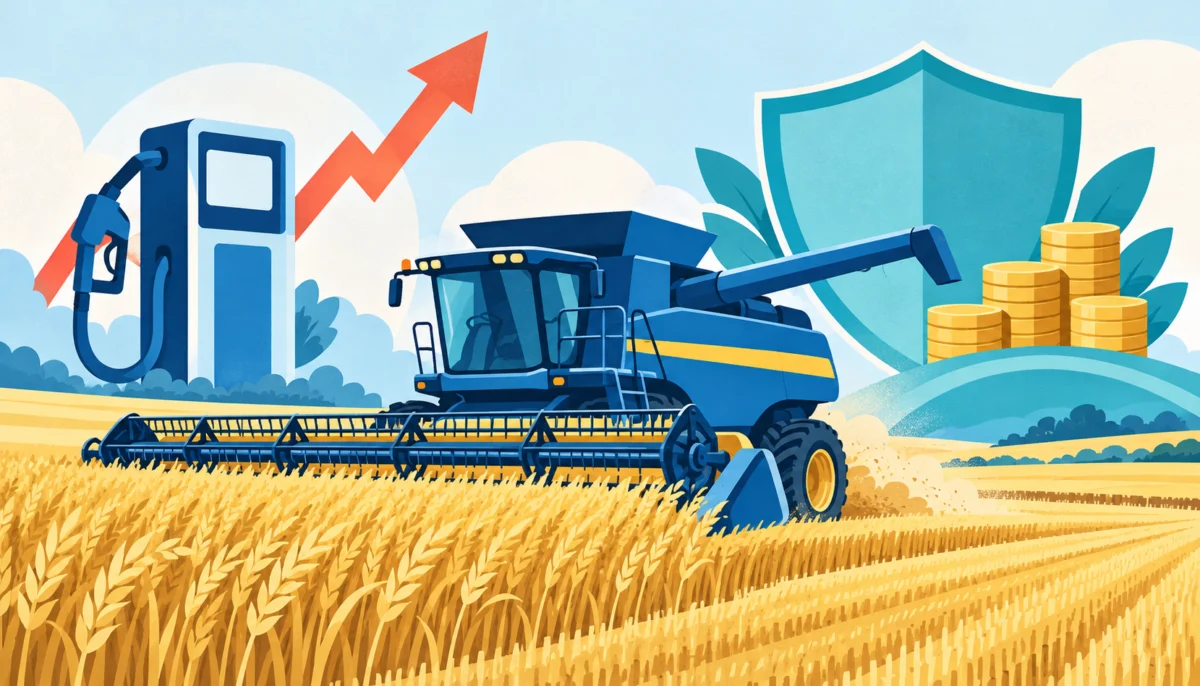
In a decisive move to stabilize the agricultural sector during a period of extreme volatility, the United States government has unveiled the $8 billion "Harvest Fuel Relief" program. Announced on October 19 by President Donald Trump and Agriculture Secretary Brooke Rollins, the initiative aims to mitigate the crushing weight of record-high fuel costs that threaten to derail the 2026 harvest season. Administered by the Farm Service Agency (FSA) under the authority of the Commodity Credit Corporation (CCC) Charter Act, the program represents a critical infusion of liquidity for a sector currently grappling with a confluence of supply chain constraints and inflationary pressures.
As the agricultural industry enters its most labor-intensive and capital-heavy months, the timing of this assistance has become the primary focus of both lenders and producers. While the headline figure of $8 billion provides a significant fiscal cushion, the practical impact on individual farms remains tethered to the complexities of USDA implementation, payment velocity, and the reality of localized fuel markets.
A Chronology of Policy and Market Strain
The path to the Harvest Fuel Relief program was paved by a series of escalating energy market indicators throughout the third quarter of 2026. The situation reached a critical juncture in early October, necessitating rapid federal intervention.
- September 2026: The Energy Information Administration (EIA) reports that U.S. retail diesel prices have surged to an average of $6.29 per gallon. Simultaneously, East Coast distillate inventories are recorded at 32 percent below their five-year seasonal average, signaling significant supply-side fragility.
- October 5, 2026: President Trump issues an executive order on diesel tax relief, directing the Treasury Department to evaluate the feasibility of deferring fuel-tax payments and offering penalty relief for the highway use of dyed diesel through the end of the year.
- October 19, 2026: The USDA officially announces the $8 billion Harvest Fuel Relief program, designed to provide one-time financial assistance to farmers to cover a portion of modeled losses stemming from elevated input costs.
- November 2026 (Forthcoming): The USDA is scheduled to release specific payment rates for Title I commodities, which will serve as the first concrete metric for farmers to calculate potential relief.
The Economics of a High-Cost Harvest
The current crisis is not merely a product of fluctuating oil prices but is exacerbated by the inflexible nature of agricultural operations. Unlike manufacturing or retail, where production can sometimes be throttled in response to rising costs, harvest schedules are dictated by biological maturity and weather windows.
The Inevitability of High-Cost Inputs
For the American farmer, waiting for fuel prices to soften—which the EIA projects might happen by 2027—is not a viable strategy. Once a crop reaches its peak, any delay in harvesting risks significant yield degradation, loss of quality, or vulnerability to late-season weather events. Consequently, producers are often forced to purchase fuel at prevailing market prices, regardless of how high they climb, to keep combines, tractors, and irrigation systems running.
The Ripple Effect on Ancillary Services
The financial strain extends well beyond the farm gate. The logistics of moving a crop—drying, storage, and transport—require massive energy consumption. Contractors and haulers, facing their own inflated overheads, are increasingly passing these costs on to producers through higher service invoices. This means that even farmers who do not purchase bulk fuel directly are feeling the "energy shock" through the rising costs of third-party agricultural services.
Official Responses and Administrative Framework
The USDA has indicated that the relief program will utilize a "national loss average" model to determine disbursements. This approach is intended to provide a uniform, transparent framework for distribution, though it introduces inherent challenges in addressing the diverse realities of the agricultural sector.
Designing the Formula
The payment formula will be based on a combination of reported planted acreage, production-cost estimates, and USDA-derived yield and price projections. By drawing on these data points, the government hopes to ensure that the relief is targeted toward those most affected by rising costs.
For producers of non-Title I commodities—including specialty crops and aquaculture—the USDA has invited submissions of localized cost data. This outreach is designed to refine the payment-rate design, acknowledging that a one-size-fits-all approach may overlook the unique input requirements of specialty sectors.
Tax Deferral vs. Direct Assistance
A critical distinction exists between the October 5 executive order on tax relief and the new Harvest Fuel Relief payments. The former focuses on the deferral of tax liabilities, which improves short-term cash flow but leaves the underlying obligation intact. The latter acts as an injection of working capital. Policymakers have emphasized that these two channels should be viewed as separate, as conflating them can lead to an inaccurate assessment of a farm’s long-term financial health.
Implications for Lenders, Suppliers, and Producers
The introduction of the $8 billion package has created a complex environment for credit management. For lenders, the primary challenge is determining how to integrate these expected payments into existing repayment plans.
Underwriting Risks and Prudent Assessment
Financial institutions are currently advising caution. A loan officer, when reviewing a farmer’s cash-flow statement, must decide whether to factor in the potential relief payment. The consensus among agricultural analysts is that lenders should avoid inserting an assumed payment into a borrower’s repayment plan until the eligibility criteria and payment dates are definitively established. Relying on an unconfirmed cash injection can expose both the lender and the borrower to unnecessary risk if the actual disbursement fails to materialize on schedule.
Supplier Relations
Similarly, machinery dealers and agricultural cooperatives are watching the situation closely. While they anticipate that the relief program will improve their customers’ ability to settle overdue accounts, they are wary of extending additional credit based solely on the general announcement. The expectation is that once individual awards are documented, the credit environment will stabilize, allowing for a more predictable flow of collections.
Sector-Wide Financial Health: The USDA Forecast
The USDA’s Economic Research Service (ERS) September forecast paints a sobering picture of the sector’s financial landscape. Even before the fuel relief announcement, 2026 net farm income was projected to fall by 2.6 percent in nominal terms, while total farm-sector debt was expected to climb to $605.1 billion—a 4.6 percent increase.
These figures illustrate a highly uneven sector. While some operators have the equity to weather a period of high costs, others are operating with razor-thin margins. A single relief payment may improve a farm’s liquid cash position for the current cycle, but it does not fundamentally alter the underlying profitability or the long-term debt-to-asset ratio.
Looking Forward: Evaluation and Long-Term Stability
As the program moves toward implementation, its success will be measured by its ability to prevent financial disruption. If the aid allows farmers to successfully harvest, settle contractor invoices, and maintain their operating credit lines, the program will have achieved its primary goal.
However, there is an ongoing debate regarding the role of recurring government intervention. Analysts warn that while emergency measures are vital for surviving acute shocks, they should not be viewed as a substitute for long-term planning. The reliance on variable, ad-hoc relief can complicate the ability of businesses to forecast accurately for future seasons.
The Analyst’s Perspective
Ultimately, the "Harvest Fuel Relief" program serves as a bridge rather than a destination. For the agricultural community, the path forward requires a disciplined approach to managing liquidity. Lenders and producers alike must distinguish between the "cash-flow cushion" provided by the government and the recurring profitability of the operation.
As November approaches, the release of specific commodity rates will provide the clarity necessary for the industry to transition from the current period of uncertainty to a more stable operational phase. Until then, the agricultural sector remains in a state of watchful waiting, balancing the immediate need for fuel with the necessity of maintaining sound financial foundations in a high-cost environment.
The $8 billion injection is a significant statement of federal intent, but the ultimate health of the 2026 harvest will depend on the speed of delivery, the accuracy of the formula, and the ability of producers to navigate the remainder of a challenging, high-stakes year.