






In the ongoing quest for sustainable, self-sufficient power, energy harvesting has long held a position of prestige. The allure of extracting "something from nothing"—capturing ambient energy that would otherwise dissipate into the environment—is a dream for engineers looking to untether IoT devices, remote sensors, and portable electronics from the constraints of battery life. However, the practical application of this technology has frequently hit a wall: limited power density and the narrow focus of single-source harvesting.
A breakthrough from the Institute of Materials Science of Seville (ICMS), a collaborative effort between the Spanish National Research Council (CSIC) and the University of Seville, may have finally addressed these systemic limitations. The research team has successfully engineered a hybrid device capable of simultaneously harvesting electricity from two distinct environmental phenomena: solar radiation and the kinetic energy of falling raindrops.

The Convergence of Perovskite and Triboelectricity
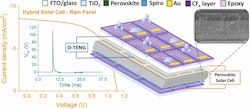
The core innovation lies in the integration of Perovskite Solar Cells (PSCs) with drop-driven Triboelectric Nanogenerators (D-TENGs). While perovskites have emerged as a high-efficiency alternative to traditional silicon-based solar panels, they have historically struggled with environmental stability. Moisture and atmospheric stress are the natural enemies of these crystalline materials, often leading to rapid performance degradation.
The ICMS team’s solution is a patented, multifunctional fluorinated polymer (CFₓ) thin film, approximately 100 nm thick, applied via plasma deposition. This coating serves a triple purpose: it acts as a chemically robust encapsulation layer that protects the delicate perovskite structure from moisture; it maintains high optical transparency, exceeding 90%; and it functions as a triboelectric surface.

When a raindrop impacts this surface, the contact and subsequent separation generate an electrical charge through the triboelectric effect. By integrating this capability directly onto the solar cell, the researchers have created a dual-harvesting system that remains productive even when the sun is obscured by clouds and rain.
A Chronology of the Development
The path to this hybrid device was defined by a systematic approach to material science and electrical integration:
- Initial Research and Material Selection: The team began by analyzing the limitations of standard perovskite solar cells, identifying moisture-induced degradation as the primary hurdle for outdoor deployment.
- The Coating Phase: Researchers experimented with fluorinated polymer films. They found that by utilizing plasma-enhanced chemical vapor deposition (PECVD), they could create a uniform, durable, and highly transparent coating that provided the necessary chemical barrier.
- Triboelectric Integration: Recognizing that the protective layer could serve a secondary function, the team optimized the material properties to maximize electron transfer during the impact of water droplets.
- Proof-of-Concept Development: By 2025, the team successfully integrated the D-TENG layer onto the PSC, utilizing a shared fluorine-doped tin oxide (FTO) electrode. This allowed the device to channel both solar-generated current and triboelectric-generated voltage into a unified energy management circuit.
- Performance Validation: Throughout late 2025 and early 2026, the device underwent rigorous environmental stress testing, culminating in the publication of their findings in the journal Nano Energy.
Supporting Data: Efficiency and Resilience
The performance metrics of the ICMS hybrid harvester suggest that multisource energy harvesting is moving from a laboratory curiosity to a viable industrial technology.
Power Characteristics
Under controlled testing conditions—0.5 sun illumination and dripping Milli-Q water at a frequency of 3 Hz—the device demonstrated impressive output capabilities:
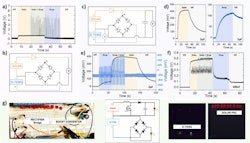
- Voltage Generation: The system produced open-circuit voltage peaks of up to 110 V from the D-TENG component, proving that even low-current pulses can be significant.
- Current Density: The solar component maintained a short-circuit current density of 11.6 mA/cm².
- Peak Power Density: The device delivered a maximum power density of approximately 4 mW/cm² during rainfall simulations.
Durability and Longevity
Perhaps more critical than initial output is the device’s resilience in "real-world" conditions. The researchers subjected the harvester to over 17,000 individual droplet impacts. Remarkably, the system retained over 85% of its initial power-generating capacity, signaling a massive leap forward in the longevity of perovskite-based devices. Furthermore, the cell maintained 80% of its performance after 300 hours of continuous high-humidity, high-light exposure, and functioned consistently under simultaneous stress for over five hours.
Energy Management Integration
The researchers implemented a sophisticated energy management circuit to harmonize the inputs. Because the PSC produces DC current and the D-TENG produces high-voltage AC, the circuit incorporates a full-wave bridge rectifier to convert the triboelectric output. A diode was also included to prevent backflow from the solar cell into the triboelectric generator, ensuring that both sources contribute to the charging of a storage capacitor (e.g., 2 µF or 100 nF) without interfering with each other.

Official Responses and Scientific Context
The scientific community has lauded the ICMS approach, particularly for its pragmatic solution to the "durability gap" in solar materials. In their published work, the team emphasized that the goal was not just to harvest more energy, but to make the harvester "self-defending." By using the energy-harvesting layer itself as a protective shield, they effectively turned a liability (environmental exposure) into an asset (an additional power source).
The integration of a boost converter into their prototype—demonstrated by the simultaneous powering of a red LED array (via solar) and the instantaneous activation of green LEDs (via rain)—serves as a tangible proof-of-concept. It illustrates that for low-power sensors or IoT nodes, this technology could provide a perpetual, maintenance-free power supply in locations where battery replacement is logistically impossible or cost-prohibitive.

Broad Implications for the Energy Landscape
The implications of this technology extend far beyond a single, hybrid solar-rain cell.
1. The Future of Smart Cities and Remote Sensing
For the Internet of Things (IoT), the "energy bottleneck" remains the most significant barrier to scale. Sensors deployed in remote agricultural environments, offshore buoys, or urban infrastructure are often limited by the lifecycle of their internal batteries. A device that harvests energy regardless of whether it is sunny or raining creates a much higher probability of "always-on" availability, reducing the need for site visits and battery disposal.
2. Overcoming the "Myth" of Energy Harvesting
As noted in technical discourse, energy harvesting often suffers from skepticism due to low power density. However, by stacking modalities, the ICMS team has demonstrated that one can broaden the "energy window" of a device. If a device can generate power during the day (sun) and during inclement weather (rain), the duty cycle of that device is significantly extended.
3. The "Triple-Threat" Potential
There is a growing conversation among researchers about "triple-threat" devices. If this hybrid PSC/D-TENG device were further augmented with a radiative cooling harvester—capable of capturing the temperature difference between the Earth and the cold night sky—it would achieve 24/7 power generation. This would effectively move energy harvesting into the realm of base-load power for low-consumption electronics.
Conclusion
The work of the Institute of Materials Science of Seville represents a sophisticated marriage of material science and power electronics. By transforming a protective layer into an active energy-generating component, they have bypassed the historical trade-offs associated with perovskite fragility and single-source harvesting.
While the current power output is optimized for low-power electronics, the scalability of the plasma deposition process and the durability of the CFₓ film suggest a clear path toward commercial viability. As the world continues to demand smarter, more autonomous technology, the ability to turn the very weather that hinders traditional electronics into a source of power will likely become a cornerstone of future sustainable engineering. The "silent, endless" energy source that engineers have long sought may, quite literally, be falling from the sky.