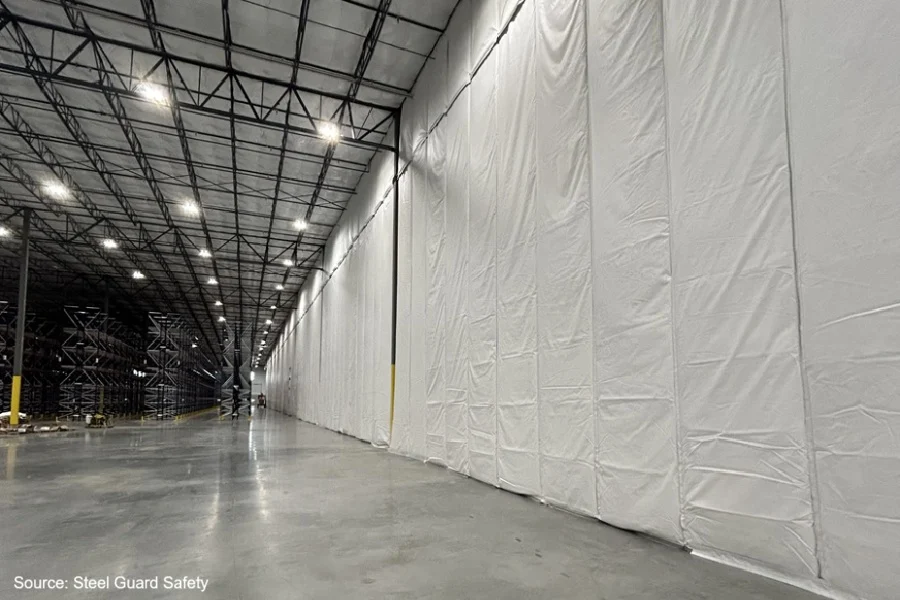
SOUTH HOLLAND, ILL. — In an industrial landscape increasingly defined by stringent fire codes, soaring energy expenditures, and complex facility layouts, Steel Guard Safety Corp. has introduced a groundbreaking product line designed to solve one of the most stubborn engineering challenges in warehouse and manufacturing management. The company has officially rolled out a new generation of insulated curtain walls featuring a proprietary insulation core that strictly meets ASTM E136 noncombustibility requirements.
This latest innovation targets facilities that have historically struggled to secure sign-offs from local fire marshals and municipal inspectors when attempting to deploy standard thermal curtains. By blending high-performance thermal insulation with rigorous fire-resistant properties, Steel Guard Safety aims to provide industrial operators with a dual-purpose solution: absolute code compliance and optimized energy efficiency.
Manufactured entirely at the company’s advanced production facility in South Holland, Illinois, these custom-engineered walls offer a transformative way to segment large footprints into dedicated micro-climates without the prohibitive costs and permanent disruptions associated with traditional drywall or sheet-metal construction.
Main Facts: Engineering Efficiency and Fire Safety
The newly launched insulated curtain walls from Steel Guard Safety are engineered to function as flexible, heavy-duty thermal barriers. Their primary purpose is to divide expansive warehouses, distribution centers, and manufacturing plants into distinct temperature-controlled zones.
- The Fire-Resistance Standard: The cornerstone of the new product is its compliance with ASTM E136, the definitive standard test method for assessing the combustibility of building materials in vertical tube furnaces at 750°C. Standard insulated curtains frequently utilize core materials that, while thermally efficient, fail to satisfy the rigorous noncombustibility criteria demanded by modern building codes, often leading to costly rejections during routine or pre-occupancy fire inspections. Steel Guard’s core bridges this gap, offering robust thermal resistance without compromising fire safety.
- Energy Cost Mitigation: By zoning large facilities, plant managers can selectively heat or cool only the active areas where personnel and temperature-sensitive equipment are located. This targeted approach prevents the wasteful conditioning of empty overhead airspace or underutilized storage bays, leading to immediate reductions in utility consumption and carbon footprints.
- Structural Adaptability: Recognizing that many older or pre-engineered industrial buildings suffer from limited roof or structural beam load capacities, Steel Guard Safety has developed specialized, lightweight hanging systems. These mounting frameworks distribute weight evenly, allowing facilities with delicate or restricted overhead load allowances to install high-performance thermal dividers safely.
- Custom Fabrication: Eschewing a one-size-fits-all model, every single curtain wall is custom-manufactured to the exact specifications of the client’s facility at the company’s South Holland, Illinois plant.
Chronology: The Evolution of Industrial Space Management
To understand the significance of Steel Guard Safety’s latest release, it is helpful to examine the historical trajectory of warehouse climate control and regulatory oversight within the industrial sector.
Phase 1: The Era of Permanent Construction (Pre-1990s)
Historically, dividing a massive industrial facility meant hiring masonry or drywall contractors to build permanent floor-to-ceiling partitions. While these rigid walls easily satisfied fire codes and created reliable thermal barriers, they possessed a fatal flaw: inflexibility. As supply chain demands shifted, tenant footprints changed, or seasonal manufacturing needs fluctuated, tearing down or erecting new permanent walls required weeks of downtime, substantial capital expenditure, and messy construction zones.
Phase 2: The Rise of Flexible Vinyl and Fabric Curtains (1990s–2010s)
As industrial real estate evolved, the demand for modular solutions spiked. Manufacturers introduced industrial curtain walls made of reinforced vinyl and coated fabrics. These systems allowed operators to quickly slide or roll partitions out of the way, creating temporary zones for welding, dust containment, or basic draft reduction. However, as energy costs climbed, simple single-layer fabric curtains proved inadequate for rigorous temperature separation (such as keeping a freezer zone adjacent to an ambient warehouse floor).
Phase 3: The Thermal Curtain Wave and Regulatory Bottlenecks (2010s–2025)
To meet energy demands, manufacturers introduced insulated curtains incorporating materials like fiberglass or specialized foams trapped between vinyl faces. While these successfully cut heating and cooling bills, they frequently collided with an immovable object: the local fire inspector. Standard foam and synthetic insulations often failed ASTM E136 noncombustibility tests, resulting in failed inspections, costly project delays, and forced retrofits. Facilities caught in this regulatory crossfire were often forced to abandon energy-saving initiatives entirely.
Phase 4: The ASTM E136 Breakthrough (2026 and Beyond)
Entering the market in 2026, Steel Guard Safety’s new line represents the synthesis of thermal efficiency and absolute fire compliance. By developing a core material that passes the rigorous ASTM E136 standard, the company has effectively eliminated the friction between energy-saving retrofits and municipal fire safety enforcement, setting a new benchmark for industrial interior architecture.
Supporting Data: The Economics of Zoned Climate Control
The financial justification for implementing insulated curtain walls in large industrial facilities is rooted in thermodynamic efficiency and operational scale. While exact savings vary based on geographical location, fuel sources, and facility size, industrial energy audits consistently highlight HVAC loss as one of the single largest overhead expenses for warehouse operators.
Energy Savings Metrics
- Volume Reduction: In a standard 200,000-square-foot distribution center with a 30-foot ceiling, conditioning the entire volume of air requires massive, continuous HVAC output. By utilizing an insulated curtain wall to isolate an active 50,000-square-foot packing and shipping zone, facility managers can effectively reduce the conditioned volume by up to 75%.
- Thermostatic Differentials: With high-performance insulation cores maintaining a thermal barrier, facilities can sustain significant temperature differentials (often 15 to 30 degrees Fahrenheit) between adjacent zones. This is critical for warehouses storing ambient goods next to climate-controlled pharmaceuticals, electronics, or perishable food items.
- ROI Timelines: Industry analyses indicate that the capital expenditure required to custom-manufacture and install industrial curtain walls is frequently recouped within 12 to 24 months solely through reduced natural gas and electricity consumption.
Structural Load Limitations
According to structural engineering data compiled across the industrial real estate sector, more than 35% of distribution facilities built before the year 2000 feature roof deck and joist systems with strict weight capacities. Traditional insulated partitions, which often rely on heavy, rigid panels or dense composite boards, frequently exceed these allowable dead loads unless expensive structural reinforcements are installed. Steel Guard Safety’s engineering of lightweight suspension hardware directly addresses this data point, opening up thousands of legacy buildings to energy-saving retrofits that were previously deemed structurally impossible.
Official Responses and Industry Perspectives
Industry analysts and manufacturing leaders have responded enthusiastically to the commercial availability of code-compliant insulated partitions.
David Vance, a senior commercial building inspector based in the Midwest, notes that the intersection of energy mandates and fire safety has long been a contentious battleground for facility managers.
"For years, facility operators have walked a tightrope," Vance explains. "They are under immense pressure from corporate mandates to lower their carbon emissions and utility overhead. Yet, when they put up standard insulated curtains to stop heat loss, my office is forced to issue a citation if the core materials don’t meet strict noncombustibility thresholds. An ASTM E136-compliant core changes the conversation entirely. It gives inspectors the peace of mind they require while giving business owners the climate control they desperately need."
Representatives from Steel Guard Safety emphasize that the product’s development was entirely driven by direct feedback from plant managers and installation contractors who encountered repeated pushback from municipal authorities.
"We listened to our customers," noted a spokesperson for Steel Guard Safety Corp. "Too many facility upgrades were stalling out at the final inspection phase because the materials available on the market could not tick every box required by modern building codes. By engineering a noncombustible insulation core that stands up to intense regulatory scrutiny—while remaining flexible and lightweight enough for older structures—we have removed the guesswork from warehouse zoning."
Furthermore, interior contractors have praised the domestic manufacturing model centered out of the company’s South Holland plant. By keeping fabrication stateside, Steel Guard ensures rigorous quality control over every custom order while drastically cutting down lead times compared to overseas suppliers.
Implications: What This Means for the Future of Industrial Facilities
The introduction of ASTM E136-compliant insulated curtain walls carries profound implications for multiple sectors, ranging from logistics and warehousing to manufacturing and cold chain distribution.
1. Streamlining Regulatory Approvals
The most immediate impact will be felt in the permitting and inspection phases of facility modifications. Because the curtain cores meet rigorous noncombustibility thresholds, project engineers can submit architectural and material specifications with confidence, vastly reducing the likelihood of costly inspection failures, redesigns, or stop-work orders. This streamlined approval process translates directly into faster project completion and quicker realization of energy savings.
2. Revitalizing Legacy Infrastructure
Millions of square feet of industrial real estate in North America consist of aging, legacy structures with compromised roof load capacities and inefficient thermal envelopes. By pairing advanced fire-resistant insulation with lightweight hanging mechanisms, Steel Guard Safety has democratized energy efficiency. Older buildings can now compete with modern, state-of-the-art fulfillment centers in terms of climate management overhead, extending the economic lifespan of older industrial parks.
3. Sustainability and ESG Goals
As corporations face escalating pressure from investors, consumers, and regulatory bodies to meet aggressive Environmental, Social, and Governance (ESG) targets, every kilowatt-hour saved matters. Facility-wide climate control is notoriously wasteful; zoning spaces with high-performance thermal barriers offers an immediate, quantifiable method for lowering greenhouse gas emissions associated with industrial heating and cooling.
4. Customization as the New Baseline
The shift toward tailor-made industrial solutions—as evidenced by Steel Guard’s practice of custom-manufacturing every wall to exact facility dimensions—signals an end to the era of rigid, one-size-fits-all construction. As supply chains continue to experience rapid evolution and volatility, the facilities that thrive will be those that can adapt their internal footprints dynamically, safely, and efficiently.
Conclusion
Steel Guard Safety Corp.’s launch of its ASTM E136-compliant insulated curtain walls marks a significant milestone in industrial facility management. By successfully fusing thermal performance with strict noncombustibility, the company has resolved a long-standing conflict between energy conservation and fire safety regulations. Supported by lightweight engineering for delicate structures and entirely custom-built in the USA, these modular thermal barriers provide warehouse operators, plant managers, and logistics firms with a powerful tool to slash utility costs, protect assets, and sail through municipal inspections.
For facilities looking to optimize their operational footprints without stumbling over regulatory hurdles, this innovation offers a clear, compliant path forward into a more energy-efficient future.
For more information on custom warehouse curtain dividers and technical specifications, visit the official Steel Guard Safety Warehouse Curtain Dividers Page.