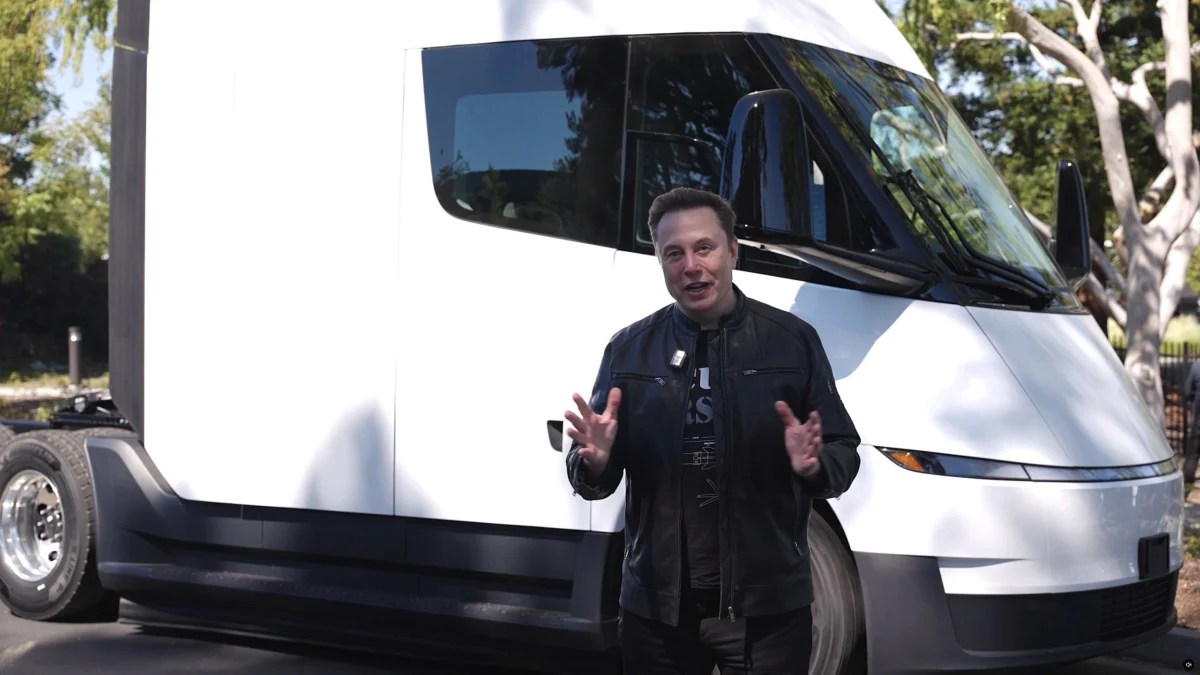
AUSTIN, Texas — Tesla has officially crossed a critical threshold in the commercial vehicle sector, confirming the commencement of volume production for its Class 8 electric Semi truck at its sprawling manufacturing facility in Nevada. The milestone, revealed alongside the company’s third-quarter earnings report, marks a decisive shift for the automaker as it transitions from pilot fleet deployments with select partners to full-scale commercial manufacturing.
While the announcement underscores Tesla’s long-term ambitions to disrupt the freight and logistics industry, it arrives against a backdrop of tighter financial margins, rising operational expenditures, and a slight dip in overall corporate profitability. Nevertheless, executive leadership remains bullish on the Semi’s disruptive potential, outlining ambitious timelines for domestic commercial expansion and a subsequent entry into the European market by late 2027.
Main Facts: The Tesla Semi Enters High-Volume Production
The centerpiece of Tesla’s commercial updates this quarter is the operational status of its Nevada factory line, which is now formally configured for mass production. According to the company’s Q3 disclosures, the facility boasts an installed annual manufacturing capacity of 25,000 Semi trucks.
During the quarterly earnings call with analysts and investors, Tesla CEO Elon Musk spotlighted the milestone, emphasizing the engineering and operational efficiencies baked into the Class 8 vehicle.
"We also began production of the Tesla semi-truck in Q3, our Class 8 heavy-duty truck," Musk stated during his opening remarks.
Tesla also reaffirmed the performance metrics of its premier variant. The vehicle is engineered to deliver a 500-mile range while carrying a full gross combination weight of 82,000 pounds. According to company data, the truck achieves an energy consumption rate of 1.7 kilowatt-hours per mile. Musk argued that this efficiency level enables the Semi to consume roughly one-third of the energy utilized by a comparable diesel-powered truck hauling an identical payload.
In the freight sector, where fuel and energy expenditures represent a substantial portion of the total cost per mile, this efficiency margin is expected to serve as a primary selling point for fleet operators. However, despite confirming the start of volume manufacturing, Tesla withheld specific figures regarding exact production volumes or the number of trucks physically delivered to customers during the third quarter. Consequently, the installed capacity of 25,000 units reflects maximum factory capability rather than immediate manufacturing run rates.
Chronology of Development: From Concept to Global Expansion
The road to volume production for the Tesla Semi has been characterized by iterative testing, strategic pilot deployments, and careful scaling of specialized charging infrastructure.
- Initial Unveiling and Early Piloting: Originally unveiled to great fanfare, the Semi spent several years undergoing rigorous real-world testing, notably within PepsiCo’s regional fleet operations, where the vehicles demonstrated their capability on demanding distribution routes.
- September 2026 (ZET SCALE Alliance): Momentum accelerated significantly ahead of the Q3 report. In September, Tesla was named the lead supplier for a monumental 2,500-truck battery-electric Class 8 order coordinated through ZET SCALE (the Zero-Emission Truck Shipper-Carrier Alliance Leading Electrification), an initiative organized by Catalyst Mobility and the Smart Freight Centre.
- September 2026 (IAA Transportation Conference): Later that month, at the IAA Transportation conference in Hannover, Germany, Dan Priestley, head of Tesla’s Semi program, detailed the brand’s international strategy. He announced that Tesla intends to launch European customer demonstrations during the first half of 2027, with the initial wave of vehicles shipped directly from the Nevada factory.
- Late 2026 (Q3 Earnings Confirmation): Tesla formally confirmed the commencement of volume manufacturing at its Nevada plant in its third-quarter earnings release, cementing its transition into a high-rate commercial producer.
- 2027 and Beyond: Looking forward, Tesla plans to initiate European customer deliveries by the end of 2027, supported by the deployment of over 100 Megacharger stalls across Europe capable of delivering up to 1.2 megawatts of charging capacity per stall.
Supporting Data: Q3 Financial Health and Operational Metrics
Tesla’s aggressive push into commercial trucking coincides with a period of heavy capital investment and compressed financial margins across its broader automotive business.
Total revenue for the third quarter stood at $28.05 billion, remaining virtually flat compared to the $28.1 billion reported during the same period in the previous year. Profitability metrics, however, experienced notable contractions. Adjusted earnings per share (non-GAAP) fell 4% year-over-year to 48 cents, down from 50 cents. GAAP diluted earnings per share dropped more steeply, falling 44% to 22 cents compared to 39 cents in Q3 2025.
Net income attributable to common stockholders on a GAAP basis totaled $787 million, representing a 43% decline from the $1.37 billion recorded a year earlier. Operating income fell 56% to $718 million, while operating expenses surged 39% to $4.78 billion as the company ramped up R&D and infrastructure spending.
Despite lower earnings, Tesla maintained a robust balance sheet. The company generated $1.53 billion in free cash flow during the quarter and closed out the period with approximately $45.45 billion in cash, cash equivalents, and short-term investments. In the core passenger vehicle segment, Tesla produced 464,391 units and delivered 486,532 vehicles, reflecting a slight 2% decrease year-over-year. To sustain its long-term growth trajectory across manufacturing, artificial intelligence, robotics, and energy infrastructure, Tesla revised its full-year 2026 capital expenditure guidance to approximately $20 billion.
Key Financial and Operational Metrics (Q3 2026 vs. Q3 2025)
| Metric | Q3 2026 | Q3 2025 | Change |
|---|---|---|---|
| Adjusted (non-GAAP) Diluted EPS | $0.48 | $0.50 | -4% |
| GAAP Diluted EPS | $0.22 | $0.39 | -44% |
| GAAP Net Income (Stockholders) | $787 million | $1.37 billion | -43% |
| Operating Income | $718 million | $1.63 billion* | -56% |
| Total Company Revenue | $28.05 billion | $28.10 billion | 0% |
| Passenger Vehicle Deliveries | 486,532 | ~496,500 | -2% |
(Note: Prior year operating income referenced from baseline contextual comparisons in financial summaries).
Official Responses and Executive Perspective
Company executives used the Q3 earnings call to frame the Semi not merely as a niche product, but as a foundational pillar of Tesla’s commercial utility ecosystem. Elon Musk emphasized that the vehicle’s unparalleled energy efficiency will fundamentally alter the economics of long-haul freight.
"In a transportation market where energy is one of the largest components of total cost per mile, this will provide a meaningful advantage to Tesla Semi operators," Musk reiterated to analysts.
On the international front, Dan Priestley’s disclosures at the Hannover conference underscored a methodical, customer-centric approach to global deployment. Rather than rushing to construct a dedicated manufacturing facility in Europe—a decision still under evaluation given the ample capacity currently available at the Nevada plant—Tesla is focusing on localized testing and validation.
"What we’re working on right now is lining up customers that are highly interested in experiencing the truck through demonstrations in the first half of next year, with the opportunity then to take delivery, targeting by the end of next year," Priestley explained.
Furthermore, the integration of high-capacity Megacharger infrastructure remains a core tenet of the company’s deployment strategy. By establishing 1.2-megawatt charging stalls in Europe, Tesla aims to alleviate range anxiety and turnaround-time concerns that have historically hindered the adoption of heavy-duty commercial electric vehicles.
Implications: Reshaping the Class 8 Market
Tesla’s formal entry into volume production for the Class 8 Semi carries profound implications for the commercial transportation sector, which is under increasing regulatory and economic pressure to decarbonize.
- Competitive Pressure on Legacy Manufacturers: Traditional heavy-duty truck manufacturers—such as Daimler, Volvo, PACCAR, and Freightliner—have been rolling out their own electric Class 8 offerings. However, Tesla’s claimed 500-mile range at maximum gross vehicle weight, combined with a dedicated high-volume production line and proprietary high-power charging ecosystem, raises the competitive bar significantly.
- Validation of Commercial EV Economics: For years, skeptics argued that heavy battery-electric trucks were economically unviable due to payload penalties and excessive charging times. By demonstrating an energy efficiency of 1.7 kWh/mile and securing massive commitments like the 2,500-truck ZET SCALE order, Tesla is helping to validate the commercial viability of long-haul electrification.
- Infrastructure Bottlenecks and Execution Risks: Despite the optimistic production capacity figures of 25,000 units annually, significant hurdles remain. The buildout of heavy-duty megacharging corridors across North America and Europe requires extensive collaboration with utility providers, municipal governments, and logistics hubs. Moreover, because Tesla has not disclosed exact production run rates or delivery totals for the quarter, market observers will be watching closely to see how rapidly the company can convert factory capacity into physical trucks on the road.
As Tesla navigates its elevated capital expenditures and works to balance its core passenger vehicle business with aggressive new ventures in commercial trucking, energy, and AI, the success of the Semi program will serve as a vital litmus test for the company’s ability to scale industrial-grade B2B solutions on a global stage.