




By Industry News Service
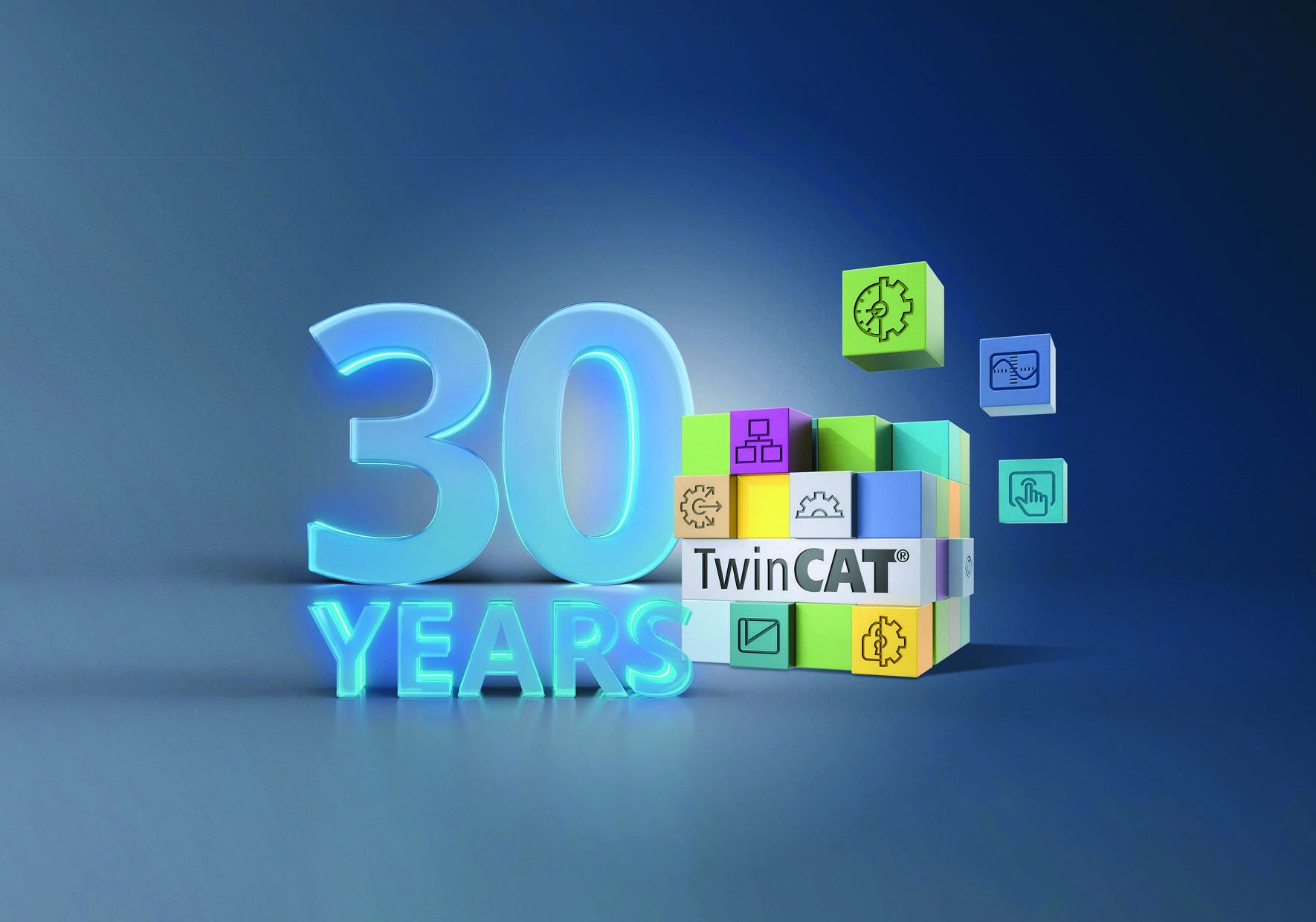
In the fast-paced world of industrial automation, few software platforms have shaped the landscape of modern manufacturing as profoundly as Beckhoff Automation’s TwinCAT. Marking its 30th anniversary since its initial commercial release in 1996, TwinCAT (The Windows Control and Automation Technology) stands today as a cornerstone of PC-based control. What began as a visionary effort to transition industrial logic from proprietary, locked-down hardware to flexible, software-driven PC environments has evolved into an all-encompassing engineering ecosystem.
Today, TwinCAT bridges the once-impenetrable gap between Information Technology (IT) and Operational Technology (OT), incorporating everything from traditional Programmable Logic Controllers (PLCs) and high-speed motion control to artificial intelligence (AI), machine vision, and advanced robotics—all running within a single, deterministic real-time environment.
Main Facts: The Evolution of a Paradigm Shift
At its core, TwinCAT was built on a deceptively simple yet revolutionary premise: decouple control functions from proprietary hardware. In the mid-1990s, industrial automation was dominated by Application-Specific Integrated Circuits (ASICs) and dedicated black-box controllers. Beckhoff shattered this convention by harnessing the surging processing power of standard personal computers, moving the control logic first from DOS to the Windows operating system, and eventually expanding to support modern robust architectures like TwinCAT/BSD and Linux.
By leveraging commercial-off-the-shelf (COTS) computer hardware, TwinCAT allowed machine builders and system integrators to leverage memory resources and processing speeds far exceeding those available in traditional controllers of the era.
Over the decades, the platform has expanded dramatically in capability and scale. What started primarily as a software-based PLC and basic motion environment has blossomed into a comprehensive suite boasting over 100 integrated functions for measurement, control, communication, and safety. Central to this execution is the EtherCAT industrial Ethernet fieldbus, which pairs with central industrial PCs (IPCs) to deliver synchronized, ultra-low jitter, deterministic timing down to 100 microseconds.
Chronology: Milestones in PC-Based Control
To understand the trajectory of TwinCAT is to understand the evolution of modern industrial computing.
- 1996: Beckhoff officially introduces TwinCAT as a core component of its PC-based control platform, successfully transitioning industrial logic from DOS to Windows. The software establishes native support for IEC 61131-3 PLC programming standards, merging disparate engineering tools into a unified environment.
- Late 1990s to 2000s: As industrial PC hardware matures, TwinCAT expands its motion control repertoire. It moves beyond basic axis control to handle complex kinematics, including electronic gearing, electronic cam plates, and multi-axis CNC interpolation. Concurrently, the platform begins scaling its axis capacity from double digits into the hundreds.
- The TwinCAT 3 Era: Beckhoff introduces profound structural advancements, seamlessly blending traditional IEC 61131-3 languages with mainstream IT programming tools such as C, C++, MATLAB®, and Simulink®. This integration fundamentally changes how engineers approach complex automation tasks, inviting software developers from non-traditional industrial backgrounds into the OT fold.
- 2010s to Present: The platform transcends traditional bounds to incorporate advanced technological domains. Vision systems (TwinCAT Vision), system-integrated robotics, and deterministic edge-computing modules are embedded directly into the runtime environment.
- Modern Day (30th Anniversary): TwinCAT breaks previous performance barriers, supporting individual machine implementations with well over 1,000 synchronized axes while driving down the cost per axis. Recent updates focus heavily on artificial intelligence, featuring specialized tools like the TwinCAT Machine Learning Creator and the TwinCAT CoAgent programming assistant.
Supporting Data: Scalability, Performance, and Economics
The true impact of TwinCAT’s 30-year journey is best illustrated through measurable performance metrics and architectural economics:
- Axis Scalability: In its early iterations, TwinCAT comfortably managed modest machine layouts of 10 to 50 axes. Through continuous optimization of CPU core distribution and real-time execution kernels, modern TwinCAT deployments routinely orchestrate over 1,000 synchronized axes on a single industrial PC.
- Cycle Times: Maintaining deterministic performance at high axis counts requires blistering speeds. TwinCAT has historically supported cycle times as low as 100 microseconds, ensuring that high-speed packaging, printing, and semiconductor manufacturing equipment operate with microsecond-level precision.
- Cost-per-Axis Reduction: By replacing dedicated multi-axis motion cards and proprietary motion controllers with software licenses running on scalable industrial hardware, machine builders have experienced a steady, long-term decline in the cost-per-axis equation.
- Unified Functionality: Rather than requiring disparate software packages for PLC programming, safety engineering (TwinCAT Safety), motion profiles, CNC configuration, and robot kinematics, engineers utilize a single software shell integrated within Microsoft Visual Studio®. This reduces training overhead, project setup time, and human error.
Official Perspectives and Industry Response
Reflecting on the milestone, automation industry analysts and engineering leaders have underscored the profound foresight embedded in Beckhoff’s original software architecture. When the company first pitched PC-based control in the 1990s, skeptics questioned the reliability of operating systems like Windows in mission-critical manufacturing plants.
Beckhoff addressed these concerns by developing a proprietary real-time kernel that runs alongside or underneath the host operating system, ensuring that deterministic control tasks are never starved of CPU cycles, regardless of background IT processes.
"The separation of hardware and software was not merely a technical choice; it was a philosophical redirection for the entire automation sector," notes industrial automation historian and consultant Elena Vance. "While legacy automation vendors sought to lock customers into proprietary hardware ecosystems, Beckhoff democratized computing power. They proved that software could outlive hardware cycles, protecting capital investments for machine builders."
Furthermore, modern manufacturing leaders emphasize that TwinCAT’s early embrace of open standards paved the way for today’s Industrie 4.0 and Smart Factory revolutions. By natively supporting open fieldbuses like EtherCAT and standard IT communication protocols (such as OPC UA, MQTT, and TCP/IP), Beckhoff ensured that machines running TwinCAT were inherently ready for cloud analytics and edge computing long before those terms became industry buzzwords.
Implications for the Future of Automation
As TwinCAT enters its fourth decade, the platform’s trajectory offers a clear window into where industrial manufacturing is heading. The modern factory floor is no longer just about mechanical repeatability; it is about cognitive adaptability, predictive maintenance, and data sovereignty.
1. Deep IT/OT Convergence
The historical friction between IT departments (focused on data lakes, cloud infrastructure, and enterprise resource planning) and OT engineers (focused on ladder logic, safety, and physical machinery) is dissolving. Because TwinCAT natively accommodates C/C++, MATLAB/Simulink, and standard IT security frameworks, software engineers and data scientists can collaborate directly within the automation ecosystem without needing to learn obscure, proprietary programming paradigms.
2. The Democratization of Artificial Intelligence
AI in manufacturing has often suffered from a "pilot purgatory"—stuck in proof-of-concept phases because integrating machine learning models into hard real-time control loops was too complex. Tools like the TwinCAT Machine Learning Creator directly address this barrier. By allowing engineers to train AI models locally using operational data—and subsequently execute those models deterministically inside the TwinCAT runtime—machines can perform real-time anomaly detection, predictive tool wear analysis, and adaptive quality control at the millisecond level.
3. Generative Engineering and AI Assistants
With the introduction of tools like the TwinCAT CoAgent, Beckhoff is signaling its readiness for the era of AI-assisted engineering. Programming complex multi-axis motion sequences, configuring safety zones, and debugging intricate state machines traditionally require hundreds of man-hours. AI co-pilots integrated directly into the engineering environment promise to accelerate development cycles, automate repetitive coding tasks, and assist commissioning engineers in real-time operation.
4. Cybersecurity and Resilient Architectures
As industrial systems become increasingly connected to edge gateways and cloud services, cybersecurity is paramount. The modular, scalable framework of TwinCAT allows Beckhoff to continuously update its security protocols—incorporating encrypted communications, secure boot mechanisms, and granular user access management—without requiring machine builders to completely re-architect their mechanical designs.
Conclusion
Thirty years after its inception, Beckhoff’s TwinCAT automation software remains a masterclass in forward-looking software architecture. By betting on the boundless potential of PC-based control, rejecting hardware lock-in, and continuously expanding its functional scope from basic logic to artificial intelligence, TwinCAT has transitioned from a daring alternative to an undisputed industry standard.
For machine builders, system integrators, and modern manufacturing enterprises, the platform offers a stable yet endlessly expandable bridge between the mechanical realities of today and the intelligent, software-defined factories of tomorrow. As industrial automation continues its rapid evolution, TwinCAT stands firmly as a testament to the power of openness, determinism, and relentless software innovation.