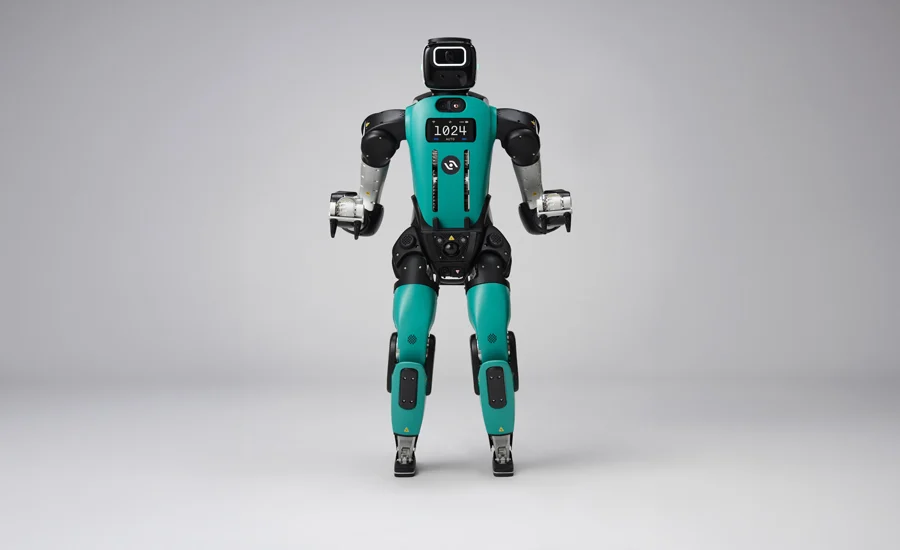
SALEM, OR — Marking what industry analysts are calling a pivotal milestone in the commercialization of robotics, Agility Robotics has officially pulled back the curtain on the fifth generation of its flagship humanoid robot, Digit. Designed from the ground up to operate safely alongside human workers without the traditional constraints of safety cages or physical barriers, Digit 5 represents a profound leap forward in industrial automation.
According to company leadership, the launch is backed by significant market validation. Agility Robotics reports that the new platform has already secured more than $300 million in multiyear advance orders, driven by an expanding pipeline of enterprise clients across the manufacturing, warehousing, and logistics sectors.
Main Facts: What is Digit 5?
Digit 5 is a general-purpose bipedal humanoid robot engineered specifically for demanding industrial environments. Standing 5 feet, 11 inches tall, weighing 284 pounds, and boasting a maximum reach of 7.2 feet, the machine is physically proportioned to interact with workspaces originally designed for humans.
Unlike its predecessors and many competing humanoids that remain confined to controlled research laboratories or heavily guarded industrial cells, Digit 5 is built for human-robot collaboration (cobotics). Its headline features include:
- Collaborative Safety Architecture: Engineered to eliminate the need for traditional protective fencing and light curtains, allowing safe, side-by-side work with human operators.
- Enhanced Payload Capacity: A newly redesigned leg and skeletal architecture allows Digit 5 to repeatedly lift loads weighing up to 50 pounds.
- Rapid-Charge Battery System: A high-efficiency 90-minute runtime battery that recharges completely in just 9 minutes, establishing an impressive 10-to-1 run-to-charge ratio. This enables more than 20 hours of continuous, productive work within a standard 24-hour operational cycle.
- Versatile Tooling: A swappable gripper design equipped with industry-standard ISO mounting flanges, allowing the robot to rapidly change end-effectors to suit specific tasks.
- Fleet Management Integration: Full native integration with Agility Arc, a centralized cloud platform designed to monitor, deploy, and scale fleets of robots.
Chronology: The Road to Digit 5
The arrival of the fifth-generation Digit is not an overnight breakthrough; it is the culmination of years of iterative engineering, real-world deployment, and rigorous safety evaluations.
The Foundation Years (2020–2022)
Agility Robotics spent years refining the underlying bipedal locomotion algorithms that allowed early iterations of Digit to navigate complex, unstructured human environments. Moving away from wheeled or quadrupedal designs, the company doubled down on bipedalism because human-centric facilities—ranging from automotive assembly lines to e-commerce fulfillment centers—are inherently built for walking bipeds that can climb stairs, step over debris, and reach high shelves.
The Digit 4 Prototyping Phase (2022–2025)
The direct predecessor to the current model, Digit 4, spent three grueling years deployed directly on customer production floors. This deployment served as a massive real-world stress test. During this period, an earlier version of Digit achieved a historic industry first: it successfully passed an independent field evaluation on a customer’s production line for industrial safety standards administered by the U.S. Occupational Safety and Health Administration (OSHA).
However, customer feedback from these deployments highlighted specific bottlenecks. While Digit 4 proved its viability, enterprise clients demanded higher payload limits, faster turnaround times on battery charging, and safety certifications robust enough to completely remove protective enclosures.
The Commercial Breakthrough (2026)
Synthesizing three years of operational telemetry and direct customer feedback from Digit 4’s deployment—which included moving upwards of 100,000 totes in live distribution centers—Agility Robotics finalized the engineering specifications for Digit 5, leading to its commercial launch and the securing of a $300 million multiyear order pipeline.
Supporting Data: Hardware, Software, and Security
To transition from a proof-of-concept novelty to an indispensable enterprise asset, Digit 5 integrates cutting-edge mechanical engineering with enterprise-grade software and cybersecurity.
Mechanical and Electrical Specifications
- Dimensions: 5 feet, 11 inches tall; 284 pounds.
- Reach: Up to 7.2 feet, allowing access to top-tier pallet racking and high-bay storage.
- Lifting Capacity: Up to 50 pounds repeatedly, covering the vast majority of ergonomic lift limits for manual warehouse tasks.
- Power & Uptime: The 90-minute battery paired with a 9-minute fast-charge cycle means a single robot can remain operational for over 20 hours a day, minimizing fleet downtime and reducing the total number of units required to maintain operational throughput.
- End-Effectors: The ISO-standard mounting flanges allow Digit 5 to transition seamlessly from bin-picking and tote-handling to machine tending and palletizing.
Software Architecture: Agility Arc
As warehouses scale automation from a handful of pilot robots to fleets numbering in the hundreds, software orchestration becomes paramount. Digit 5 integrates directly with Agility Arc, a cloud-based fleet management system.
- Arc provides real-time operational visibility into Key Performance Indicators (KPIs) such as uptime, task throughput, and Mean Time Between Incidents (MTBI).
- The platform interfaces smoothly with existing enterprise infrastructure, including Warehouse Management Systems (WMS), Warehouse Execution Systems (WES), and Manufacturing Execution Systems (MES).
Cybersecurity and Data Privacy
Industrial environments demand rigorous data protection. Digit 5 utilizes an array of onboard sensors—including high-definition cameras, depth sensors, and inertial measurement units (IMUs)—to navigate dynamically.
All sensory data is processed locally on the robot to ensure rapid decision-making and reaction times. Essential system health and diagnostic logs are transmitted to the Agility Arc cloud using secure protocols. Data in transit is protected via end-to-end encryption, segregated by customer, and secured using mTLS and TLS 1.2+ protocols rooted to a private certificate authority. Furthermore, all on-robot storage is fully encrypted for data at rest.
Official Responses and Industry Commentary
The release of Digit 5 has elicited strong reactions from industry executives and automation experts alike, emphasizing that humanoid robotics has officially entered a commercial scaling phase.
"Digit 5 is removing a major barrier to scaling humanoid robots in industrial environments," said Peggy Johnson, CEO of Agility Robotics, during the launch announcement. "We built it to the exact requirements our customers gave us after three years of Digit 4 working on their production floors. The market has responded with more than $300 million in multiyear orders and a growing pipeline of customers across manufacturing, warehousing and logistics."
Industry observers note that the shift away from safety cages is perhaps the most significant aspect of the release. Historically, industrial robots have been treated as high-speed hazards, fenced off to protect human workers from accidental collisions. By engineering safety architectures that allow Digit 5 to operate safely in dynamic human workspaces, Agility Robotics is effectively redefining the factory floor layout.
Manufacturing consultants have also pointed out that the 10-to-1 run-to-charge ratio directly addresses the "battery anxiety" that has long plagued electric mobile robotics. By cutting charging times down to single-digit minutes, facilities can avoid the capital-intensive requirement of maintaining massive pools of backup charging batteries or suffering extended operational pauses.
Broader Implications for the Global Workforce and Supply Chain
The commercial deployment of Digit 5 carries profound implications for the future of global supply chains, labor markets, and manufacturing economics.
Alleviating Labor Shortages
Across North America, Europe, and parts of Asia, warehousing and manufacturing sectors continue to suffer from chronic labor shortages, high turnover rates, and escalating injury claims associated with repetitive strain and heavy lifting. By absorbing dull, dirty, and dangerous tasks—such as continuous tote handling, pallet staging, and machine tending—humanoid robots like Digit 5 can alleviate physical strain on human workers. Rather than outright replacing human labor, many enterprises are positioning humanoids to fill unfillable vacancies, allowing human staff to transition into higher-level supervisory, maintenance, and quality-control roles.
Transforming Facility Design
For decades, factory and warehouse design has been dictated by the operational limitations of traditional automation. Conveyor belts, fixed robotic arms, and automated guided vehicles (AGVs) require rigid, highly structured paths. Humanoid robots introduce unprecedented flexibility. Because Digit 5 can navigate standard human walkways, climb stairs, and use existing infrastructure, companies can automate legacy facilities without undergoing multi-million-dollar structural renovations.
The Competitive Landscape of Humanoid Robotics
Agility Robotics’ $300 million order book signals that the market for humanoid robotics has transitioned from speculative venture-capital funding to hard enterprise procurement. As Digit 5 hits production lines, the race among competing humanoid developers will likely pivot from raw hardware demonstrations to proven reliability, safety certifications, and seamless software integration.
Conclusion
With the release of Digit 5, Agility Robotics has delivered a mature, enterprise-ready machine that addresses the core bottlenecks of early humanoid robotics: safety, power efficiency, payload capacity, and fleet management. As these robots take their places beside human workers on factory floors and in distribution centers worldwide, Digit 5 stands as a defining vanguard in the ongoing industrial revolution of collaborative automation.