By Quinn Poor, Manager of Engineering and Product Development, SLIPNOT
For facility managers in the dry food, dairy, and pharmaceutical sectors, the quest for the perfect plant floor has long been a pursuit of the impossible. They operate in a high-stakes balancing act: provide enough traction to prevent the catastrophic injuries associated with slips and falls, while simultaneously maintaining a sterile, dust-free environment that meets the rigorous standards of the Food Safety Modernization Act (FSMA) and the U.S. Department of Agriculture (USDA).
For decades, the industry has accepted a flawed compromise. To achieve traction, plants utilized surfaces riddled with deep grooves and abrasive textures. However, in dry-processing facilities where water washdowns are prohibited—to prevent the introduction of moisture-loving pathogens like Listeria and Salmonella—these very textures became "harborage points" for organic dust, flour, and powders. The floor became a safety hazard for two reasons: the risk of a fall on slick surfaces and the risk of a biological contamination event due to trapped debris.
Today, that paradigm is shifting. Through advancements in material science and engineered surfaces, the industry is moving toward a new standard: sweepable, high-traction stainless steel that does not sacrifice sanitation for grip.
The Chronology of a Persistent Industrial Problem
The Era of "Rough-and-Ready" Solutions
Historically, plant managers faced limited options. Early attempts at flooring safety relied on basic, often ineffective, aftermarket solutions.
- Adhesive Tapes and Paints: These were the first line of defense, but they suffered from rapid degradation. Under the heavy foot traffic of a 24/7 manufacturing facility and the constant grinding of pallet jacks, these coatings would peel and chip, creating new tripping hazards.
- The Diamond Plate Era: The industry standard for decades, diamond plate relied on raised metal patterns. While durable, it provided poor traction once a thin layer of fine powder or light oil was introduced. The geometry was "directional" rather than truly slip-resistant.
- Welded Beads: Some facilities turned to custom-welded traction beads. While these offered a high coefficient of friction, they were notoriously difficult to clean. Dust would pack into the base of the beads, and the constant stress of heavy rolling loads would eventually cause the welds to snap, leaving behind sharp, jagged metal and smooth, dangerous patches.
The Rise of Engineered Surfaces
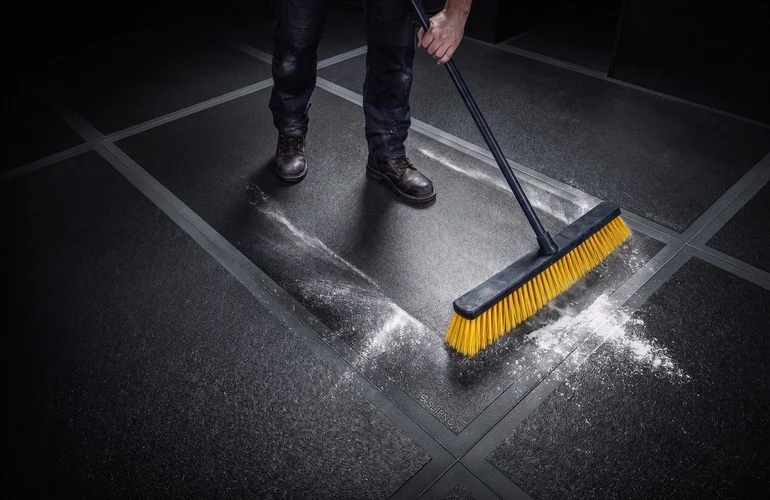
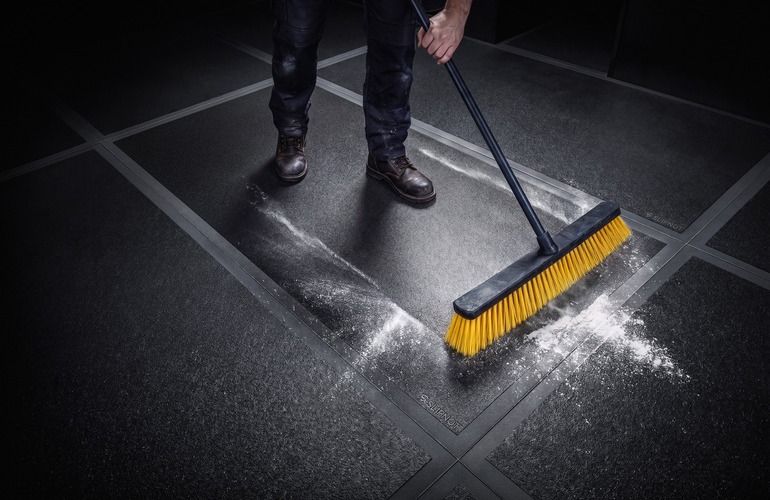
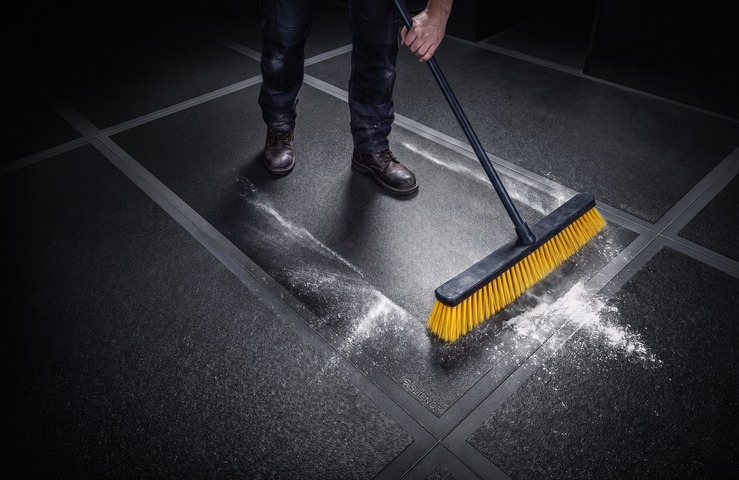
The current evolution began with a deeper understanding of "sweepability." Engineers realized that to achieve both safety and sanitation, the texture could not be subtractive (cutting into the material) or additive (welding beads on top). Instead, they developed surfaces that fill the microscopic valleys of a high-friction texture while leaving millions of hardened, tool-steel traction peaks exposed. This allows for the high-friction "bite" needed for safety, while permitting a standard push broom to clear the surface in a single pass.
Supporting Data: Why "Clean" Ratings Are Not Enough
The most critical mistake a plant manager can make is relying on static, clean-surface data when choosing flooring.
The Shift to DCOF
Plant leaders should prioritize the Dynamic Coefficient of Friction (DCOF) over older, static testing methods. Static tests measure the force required to start an object moving; DCOF measures the friction while a person is actively in motion. This provides a significantly more accurate representation of how slips occur in a real-world manufacturing setting.
The Contamination Standard
Under ANSI A326.3 protocols, a dry DCOF reading of 0.80 on a clean surface is considered excellent. However, a clean-surface reading is largely irrelevant in a facility where fine powders are constantly present. The industry must demand DCOF data measured after the surface has been contaminated with fine dust or flour.
- The Benchmark: An engineered surface should maintain a DCOF above 0.60, even with contamination present.
- Performance Metrics: In internal testing, advanced engineered surfaces have recorded a clean DCOF of 0.97, and a DCOF of 0.71 even when heavily coated in flour. This performance ensures that the "grip" is functional, not just theoretical.
Implications: The High Cost of the Wrong Choice
The decision to install sub-par flooring carries significant financial and operational weight.
The Cost of Safety
According to the Liberty Mutual Workplace Safety Index, overexertion injuries related to slips, trips, and falls remain a top-tier cost for employers, totaling over $13 billion annually. These are not merely administrative costs; they represent lost productivity, increased insurance premiums, and the potential for long-term labor shortages in specialized manufacturing roles.
Operational Efficiency and OEE
The math regarding sanitation is equally compelling. In a three-line facility, traditional, hard-to-clean flooring might require 20 minutes of manual scrubbing per line, twice a day. If a new, sweepable surface reduces that cleaning time significantly, the plant can recover over 730 hours of production availability annually. This is a direct, measurable improvement to Overall Equipment Effectiveness (OEE).
The Retrofit Penalty
Perhaps the most important implication is the "Retrofit Penalty." Specifying a high-performance, sanitary-grade floor during the design or construction phase of a new facility is a fraction of the cost of replacing flooring in an active, functioning line. Attempting to install new flooring in a live environment requires total production shutdowns, containment protocols to prevent cross-contamination, and the high cost of industrial demolition.
Official Guidelines: How to Vet Your Flooring Solution
Before signing a contract, plant leaders must move beyond the marketing brochures and demand evidence. Here are four questions every project manager must ask their supplier:
1. What is the contaminated DCOF?
Do not accept a "clean" sample rating. Request a technical data sheet that explicitly lists the DCOF under conditions that mirror your specific production environment—whether that involves flour, dry chemicals, or fine dust. If the supplier cannot provide this, the data does not exist.
2. How is debris removed?
Request comparative lab testing. The industry is beginning to adopt UV tracer powder testing to visualize how much debris remains in a texture after a single sweep. If a supplier claims their floor is "easy to clean," ask them to prove it with before-and-after imagery.
3. How does it handle perimeter sealing?
In food-grade environments, flooring is only as good as its weakest seam. FSMA and USDA compliance often require full seam-welding along every edge to prevent bacterial harborage. Ensure your chosen surface is compatible with standard field-welding techniques and that the finish won’t burn, peel, or delaminate during the installation of these critical seals.
4. What is the five-year Total Cost of Ownership (TCO)?
Compare the initial installation price against the projected maintenance costs, cleaning labor, and the expected lifespan of the surface. A cheaper material that requires constant re-application of grit or frequent patching will be significantly more expensive than a durable, sweepable, long-life stainless steel solution over a five-year horizon.
Conclusion: Ending the Compromise
For decades, the manufacturing industry has operated under the assumption that safety and sanitation were mutually exclusive goals. We built floors that were safe but impossible to clean, or clean but dangerously slippery.
The advent of engineered, sweepable, high-traction surfaces represents the end of this era. By focusing on data-driven metrics like contaminated DCOF, verifiable sweepability, and TCO-focused decision-making, plant leaders can finally stop choosing between the safety of their workforce and the integrity of their product. The technology exists to satisfy both—it is time for the industry to demand it.
Quinn Poor is the Manager of Engineering and Product Development at SLIPNOT, a Detroit-based manufacturer of slip-resistant metal flooring and surface technologies. For more information, visit slipnot.com.