HOUSTON/DALLAS — Autonomous trucking technology developer Kodiak AI is hurtling toward a major industry milestone. The company has announced that its long-haul commercial truck route spanning the 219-mile stretch of Interstate 45 between Dallas-Fort Worth and Houston is on track to launch without safety drivers by the end of 2026.
The announcement, published in late 2025/early 2026, underscores a rapid acceleration in the commercialization of driverless freight movement. While Kodiak has spent years building a robust safety record on this key Texas corridor—frequently moving retail goods for corporate giants like IKEA—the transition to an entirely unsupervised model marks a watershed moment for the logistics sector, promising heightened operational efficiency, reduced transit times, and transformed supply chain dynamics.
Main Facts
The core of Kodiak AI’s latest operational milestone centers on the deployment of truly driverless, Level 4 autonomous trucks across high-density freight corridors.
- The Route: The targeted commercial lane runs along Interstate 45, connecting the major logistics hubs of Dallas-Fort Worth and Houston—a heavily traveled 219-mile corridor essential to Texas commerce.
- The Timeline: Kodiak is officially scheduled to initiate unsupervised long-haul operations on this lane before the close of 2026.
- Readiness Metrics: The company tracks its readiness using an internal standard known as the Autonomous Readiness Measure (ARM). The long-haul domain currently stands at 93% ARM readiness. Once it hits the 100% threshold, commercial deployment will proceed without human intervention.
- Proven Precedent: Kodiak’s industrial-focused autonomous fleet—operated by partner Atlas Energy Solutions in the Permian Basin of West Texas and eastern New Mexico—has already achieved the 100% ARM threshold, proving that the underlying technology is robust enough for unassisted real-world operation.
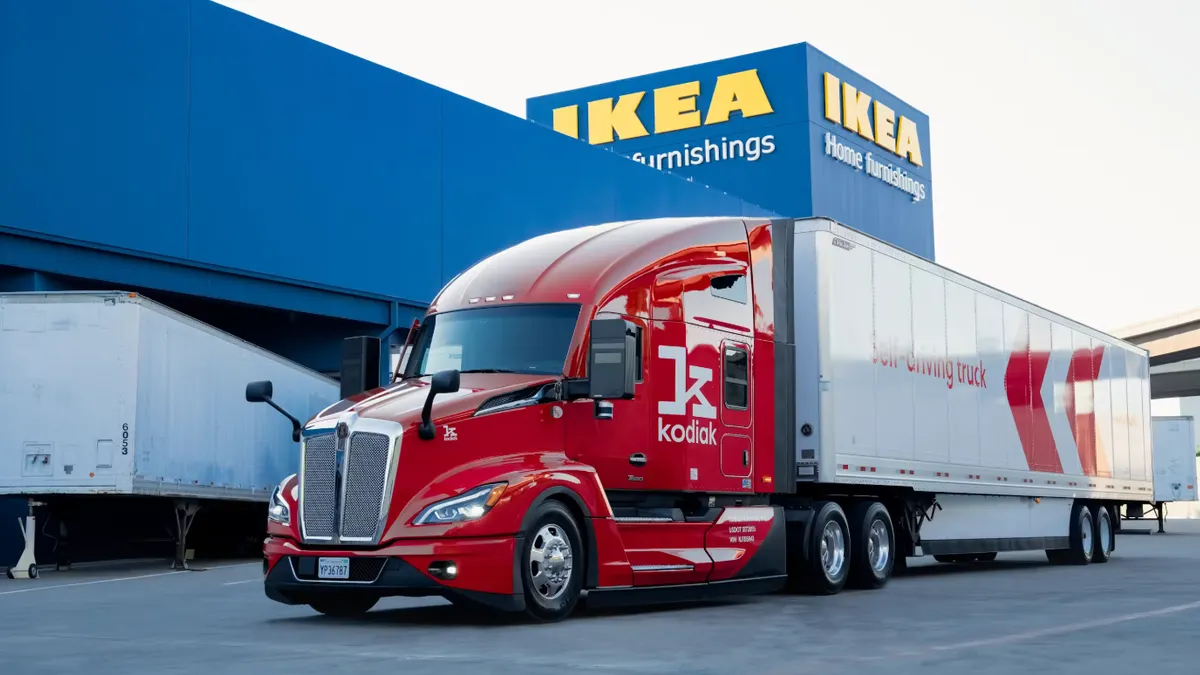
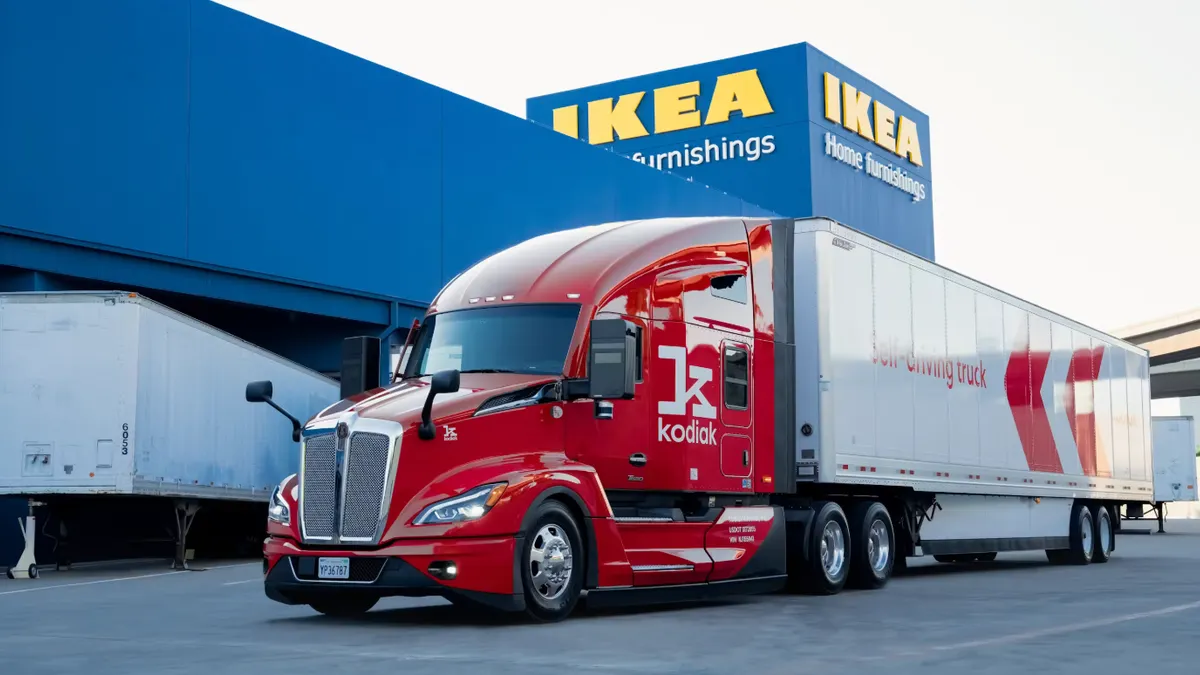
- Retail Partnerships: On the Dallas-Houston lane specifically, Kodiak has a rich history of commercial integration, having delivered more than 1,300 loads for retail giant IKEA over a four-year partnership, accumulating over 750,000 autonomous miles with safety observers in the cab.
Chronology of Development: From Concept to Commercialization
Kodiak’s path to an unsupervised late-2026 launch is built upon years of methodical testing, regulatory engagement, and strategic corporate milestones.
Foundation and Early Testing (2019–2024)
Kodiak began hauling commercial freight between Dallas and Houston back in 2019. From the outset, the company utilized autonomous-ready trucks, but federal and state testing mandates required a trained safety driver to remain behind the wheel at all times. During this foundational phase, Kodiak focused on edge-case training, refining its perception systems to handle unpredictable weather, heavy urban traffic, and sudden wildlife or debris hazards along the I-45 corridor.
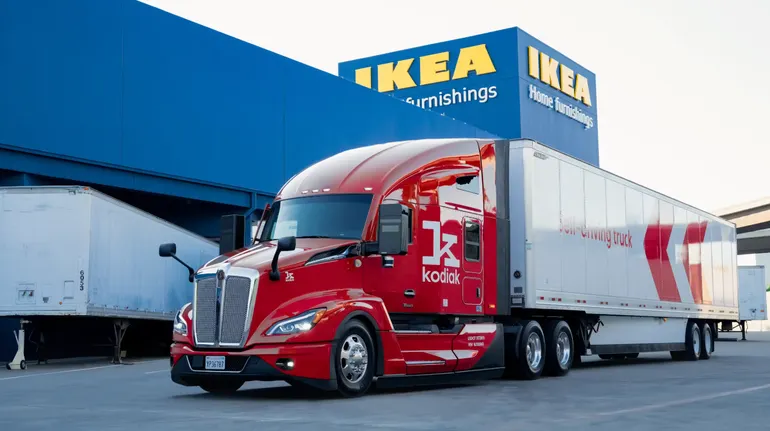
Concurrently, the company formed key commercial partnerships. Its work with IKEA served as a real-world stress test, proving that autonomous trucks could meet the strict scheduling, handling, and safety requirements of multinational supply chains.
Public Debut and Scaling (Late 2025)
A significant inflection point occurred when Kodiak went public in late 2025. The transition to a publicly traded entity injected fresh capital and heightened scrutiny into the company’s operational timelines, prompting executives to officially target a Q4 2025/2026 window for their first major unsupervised long-haul deployment.
During this period, Kodiak expanded its operational footprint beyond retail logistics. Through its partnership with Atlas Energy Solutions, the company deployed autonomous trucks into the grueling, off-road, and high-intensity environment of the Permian Basin. This specialized industrial fleet successfully met Kodiak’s 100% Autonomous Readiness Measure (ARM), providing the company with vital telemetry and confidence needed to scale the technology up to public interstate highways.
Regulatory Expansion in California (Late 2025)
As the Texas operations matured, Kodiak set its sights on the West Coast, successfully clearing a major regulatory hurdle in California. The state’s regulatory bodies approved Kodiak’s heavy-duty autonomous vehicle testing permit, enabling the company to begin hauling perishable goods for long-haul freight carrier DTL Transport along the critical arteries of Interstate 5 and State Route 99.
Although California’s phased permitting process requires a safety driver to remain in the cab initially, the approval represents a crucial stepping stone toward nationwide multi-state autonomous operations.

The Road to Late 2026
With the ARM metric for long-haul routes resting at 93% and climbing, Kodiak is dedicating the remainder of 2026 to rigorous simulation testing, hardware refinement, and regulatory alignment. The culmination of these efforts will be the removal of the safety driver on the Dallas-Fort Worth to Houston lane by the end of the year.
Supporting Data and Technical Metrics
To understand how Kodiak plans to achieve unassisted long-haul trucking, it is necessary to examine the hard data underpinning its operations:
- 219 Miles: The exact length of the primary commercial target lane (I-45 between Dallas and Houston).
- 93% vs. 100%: The current Autonomous Readiness Measure (ARM) for long-haul operations versus the absolute threshold required for full, unassisted commercial deployment.
- 1,300+ Loads: The volume of commercial freight successfully delivered for IKEA on the Texas corridor over the past four years.
- 750,000+ Miles: The total number of autonomous miles logged for IKEA alone, showcasing extensive real-world data collection.
- Interstate 5 & State Route 99: The dual West Coast corridors where Kodiak is expanding its footprint via its partnership with DTL Transport.
This vast accumulation of telemetry data allows Kodiak’s machine-learning models to anticipate complex driving scenarios better than human drivers, who are susceptible to fatigue, distraction, and human error.
Official Responses and Industry Perspectives
The announcement of an impending unsupervised long-haul route has generated significant commentary from corporate executives and logistics leaders eager to capitalize on the technology.
Lucky Dosanjh, President and CEO of DTL Transport, emphasized the strategic necessity of adopting autonomous solutions in a volatile market. In a statement regarding the company’s recent California permitting, Dosanjh noted:

"In a constantly evolving freight market, DTL is always looking for ways to leverage new innovations that drive efficiency and value in our operations. Our work with Kodiak helps us understand how embracing this cutting-edge technology improves safety, increases margins, and affirms our leadership position in the industry."
Kodiak executives have similarly stressed that autonomous technology is no longer a futuristic sci-fi concept, but an urgent, practical necessity for an industry facing chronic driver shortages, rising fuel costs, and stringent Hours of Service (HOS) regulations. By removing the biological limitations of human drivers—who must legally pull over to rest after 11 hours behind the wheel—autonomous trucks promise drastically improved asset utilization.
Implications for the Logistics and Trucking Industries
The impending launch of Kodiak’s unsupervised Dallas-Houston service carries profound implications for the future of supply chains, labor markets, and regional economies.
1. Transformation of Long-Haul Logistics Economics
Long-haul trucking is historically plagued by high turnover rates, soaring driver wages, and strict safety regulations that limit vehicle utilization. Autonomous trucks can theoretically operate nearly 24 hours a day, stopping only for refueling, maintenance, and loading/unloading. This dramatic increase in asset turnover will lower the per-mile cost of freight transportation, ultimately easing inflationary pressures on consumer goods.
2. The Hub-and-Spoke Model Realized
Industry experts anticipate that fully autonomous long-haul routes will accelerate the transition to a hub-and-spoke logistics model. In this setup, autonomous trucks handle the monotonous, long-distance, highway stretches (such as the I-45 corridor), while human drivers manage the complex "first-mile" and "last-mile" urban navigation. This shields human drivers from grueling cross-country assignments while keeping them employed in localized roles where they can return home nightly.
3. Regulatory Precedent for Other States
Texas has long positioned itself as a welcoming incubator for autonomous vehicle technology due to its favorable regulatory climate. However, Kodiak’s simultaneous expansion into California—a state renowned for its rigorous, safety-first regulatory framework—signals that autonomous trucking is gaining institutional legitimacy nationwide. A successful, trouble-free unsupervised launch on I-45 could pave the way for accelerated regulatory approvals in neighboring states, creating continuous cross-country autonomous corridors by the end of the decade.
4. Safety and Risk Mitigation
While public apprehension regarding driverless semi-trucks remains a persistent hurdle, empirical data from companies like Kodiak suggests that autonomous systems drastically reduce human-error-induced accidents, such as those caused by distracted or drowsy driving. As the ARM metric approaches 100%, the burden of proof shifts to autonomous developers to demonstrate flawless execution—a challenge Kodiak’s industrial fleet in the Permian Basin has already begun to master.
Conclusion
Kodiak AI’s target to launch unsupervised long-haul trucking between Dallas-Fort Worth and Houston by the end of 2026 represents a critical milestone not just for the company, but for the entire global supply chain. Backed by millions of accumulated autonomous miles, successful long-term retail partnerships with brands like IKEA, and expanding regulatory footholds in states like California and Texas, the era of the driverless commercial semi-truck is rapidly transitioning from a bold corporate vision into everyday highway reality.