
Europe is currently undertaking the most ambitious digital renovation in its history. Through the Gigabit Infrastructure Act (GIA), the European Union has successfully codified the necessity of high-speed connectivity, ensuring that fibre-optic cables reach the doorsteps of nearly every citizen. Yet, a critical paradox remains: while the EU has secured the "highway" to the building, it has failed to provide the "lanes" required for the final ten metres inside the home. As residential demand for data skyrockets, the scarcity of Wi-Fi spectrum in the 6 GHz band is threatening to render the gigabit promise obsolete before it even reaches the consumer’s device.
The Gigabit Promise vs. The Spectrum Reality
The GIA represents a triumph of legislative foresight. By mandating that all new or majorly renovated buildings be "fibre-ready," the EU has effectively treated high-speed internet as a fundamental utility, much like water or electricity. However, the legislation stops abruptly at the network termination point.
In the modern household, connectivity is almost exclusively wireless. From 4K streaming and high-fidelity video conferencing to the burgeoning ecosystem of smart home sensors and automated climate control, the "last ten metres" are where the user experience is defined. Currently, this crucial segment relies on the 6 GHz spectrum. While Europe has opened a portion of this band (5945-6425 MHz) for unlicensed Wi-Fi, it has capped the allocation at 480 MHz. The upper band—the space required to facilitate true multi-gigabit wireless performance—remains largely locked away, earmarked for potential future mobile network use.

This creates a dangerous mismatch: policymakers are mandating a gigabit-capable infrastructure at the wall, but withholding the spectrum necessary to transmit that capacity through the air.
A Chronology of Policy and Oversight
The friction between infrastructure and spectrum policy is not a mere technical disagreement; it is a structural oversight born from disconnected regulatory silos.
- 2021: The European Commission issues Implementing Decision (EU) 2021/1067, opening the lower 6 GHz band for license-exempt Wi-Fi.
- 11 May 2024: The Gigabit Infrastructure Act (Regulation (EU) 2024/1309) enters into force, replacing the 2014 Broadband Cost Reduction Directive. It sets rigorous requirements for in-building wiring and operator access.
- 12 November 2025: Deadline for Member States to adopt technical specifications for in-building access points, ducts, and cabling.
- November 2025: The Radio Spectrum Policy Group (RSPG) recommends prioritizing the 6585-7125 MHz band for mobile networks, further clouding the future of Wi-Fi expansion.
- 12 February 2026: The GIA’s core mandates regarding fibre-ready infrastructure for new and renovated buildings officially become applicable.
- 21 January 2026: The proposed Digital Networks Act is introduced, offering a potential legislative vehicle to re-evaluate the EU’s approach to connectivity and spectrum.
- April 6-8, 2027: The RISER Summit in Amsterdam is set to convene, serving as a critical forum to bridge the gap between building owners, regulators, and technologists.
Supporting Data: The Congestion Crisis
The impact of this policy gap is most acute in Multi-Dwelling Units (MDUs). In dense urban blocks, dozens of routers compete for the same limited spectrum. Without access to wider channels, the "gigabit" speed delivered to the building’s basement is throttled to a fraction of its potential by the time it reaches a tablet or laptop in a fifth-floor apartment.
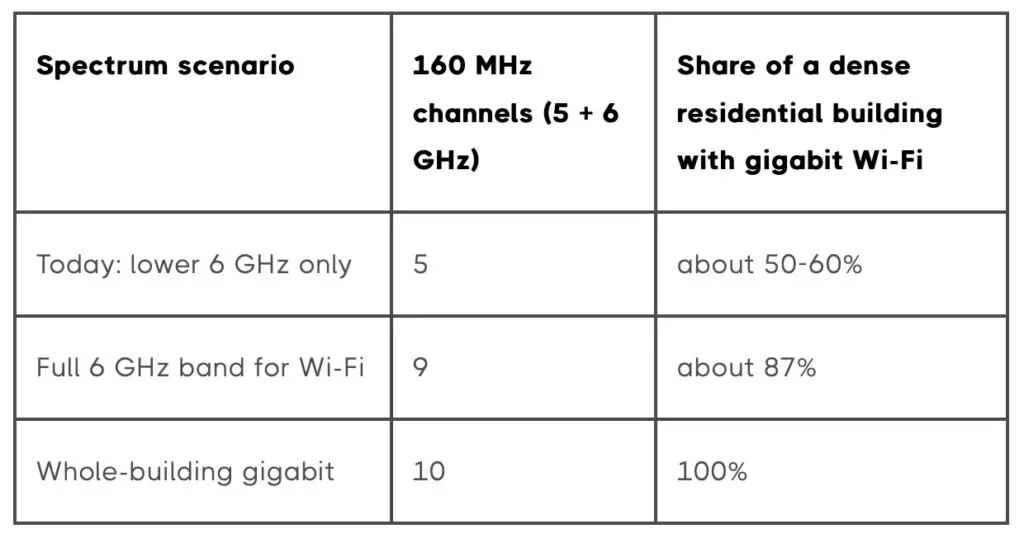
According to data cited by the Wi-Fi Alliance, there are currently five 160 MHz channels available in Europe. In contrast, the US and other regions have adopted a more aggressive spectrum policy, allowing for significantly more breathing room in the 6 GHz band. The discrepancy is visible in the metrics: Ookla’s Q1 2026 figures indicate that 6 GHz adoption for Wi-Fi in Europe sits at a meager 1.6%, compared to 13.8% in North America. This is not a hardware failure; it is a regulatory one. Manufacturers are forced to disable the upper 6 GHz capability on devices sold in the EU to remain compliant with restrictive spectrum laws.
The MDU Model: A Call for Managed Connectivity
The European MDU model exacerbates the problem. Unlike the US, where "managed Wi-Fi"—a system where a single provider handles the connectivity for an entire building—is becoming standard in new multi-family developments, the European market remains fragmented. In most EU apartment blocks, each resident is responsible for their own broadband contract and their own router.
This leads to "uncoordinated congestion." Forty households, each with a consumer-grade router operating on the same crowded frequencies, create a high-noise environment where interference is constant. The GIA, while excellent for ensuring physical access, does nothing to address this "radio noise" problem. It encourages more providers to enter the building, but provides no framework for coordinating the airwaves they share.

Managed Wi-Fi could mitigate this, but even the best management software cannot create spectrum where none exists. As Wi-Fi Alliance CEO Kevin Robinson has noted, cellular networks are simply not economically feasible for the vast majority of indoor, high-bandwidth residential use cases. Wi-Fi must remain the primary solution for the indoor environment; the question is whether the EU will give it the resources to succeed.
Official Responses and the Policy Path Forward
The debate has now shifted toward the Digital Networks Act, which is currently working its way through the European Parliament. Unlike technical directives, the Parliament is composed of elected members who are increasingly sensitive to the frustrations of their constituents regarding connectivity.
Several key arguments are being presented to lawmakers:
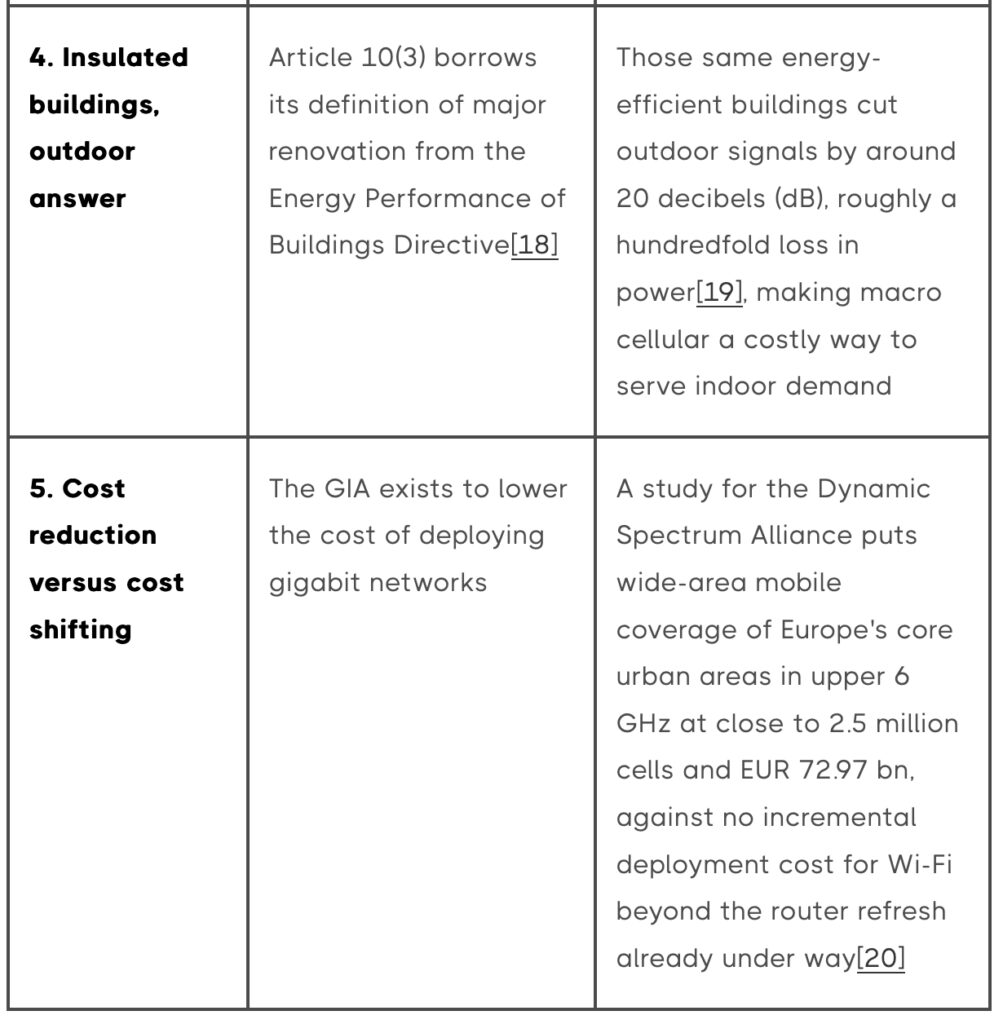
- Economic Impact: The lack of spectrum hinders the development of the European PropTech and managed services ecosystem, which could otherwise drive significant energy and cost savings in residential buildings.
- Digital Inclusion: Without robust indoor connectivity, social and student housing will remain digitally disadvantaged, undermining the EU’s Digital Decade goals.
- The "UK Model": The UK regulator, Ofcom, has moved toward a hybrid spectrum approach, prioritizing Wi-Fi in specific segments of the upper 6 GHz band while allowing for coexistence. This provides a pragmatic, proven roadmap for the EU to follow.
Implications for the Future
The current disconnect between the Gigabit Infrastructure Act and spectrum policy risks creating a "gilded cage" of connectivity. Europe is successfully building the most sophisticated physical networks in the world, only to place them behind a bottleneck of restrictive regulation.
If the EU aims to meet its 2030 target of ubiquitous gigabit connectivity, it must synchronize its building codes with its radio frequency policies. The upcoming RISER summit in April 2027 represents a critical window of opportunity. With CEPT sharing-scenario conclusions expected to be public by then, the industry will have a rare chance to present hard evidence to regulators that the "last ten metres" is not just a technical challenge, but an economic and social imperative.
The path forward is clear: recognize that indoor connectivity is an indoor problem requiring an indoor solution. By opening the upper 6 GHz band to license-exempt use, the EU can ensure that the fibre-optic revolution it has started in the basement is actually felt in the living room. Without this alignment, the gigabit promise remains, for millions of European households, a promise that stops at the socket.