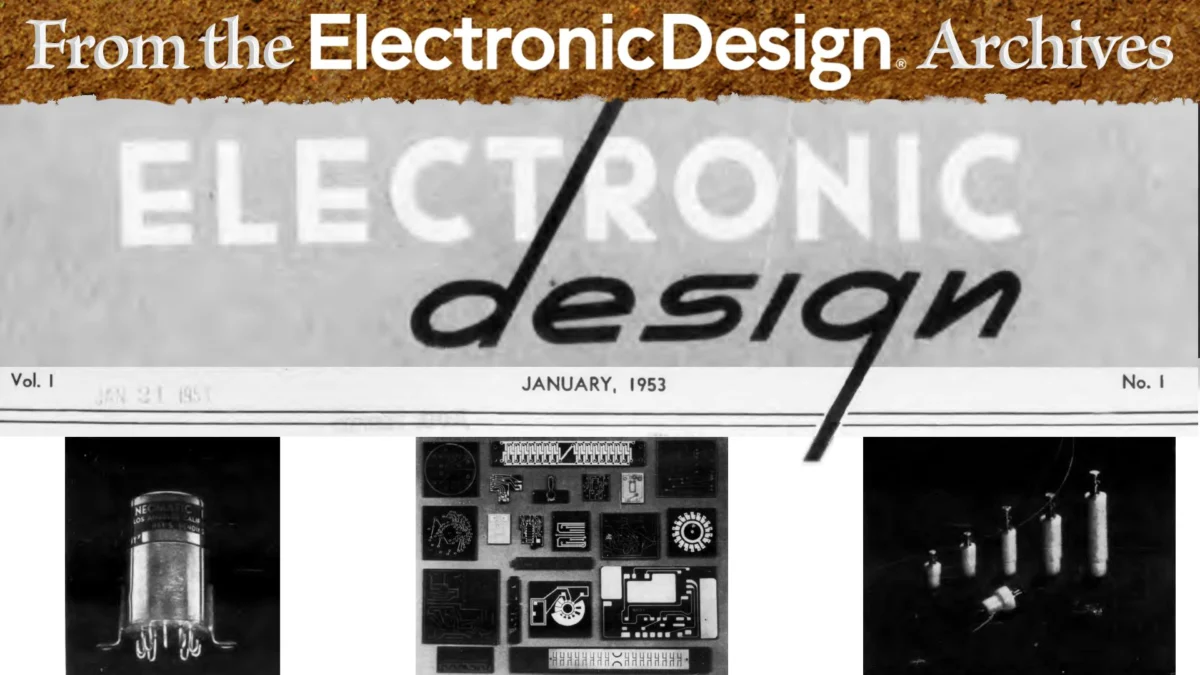
Main Facts: A Digital Window Into the Dawn of Modern Electronics
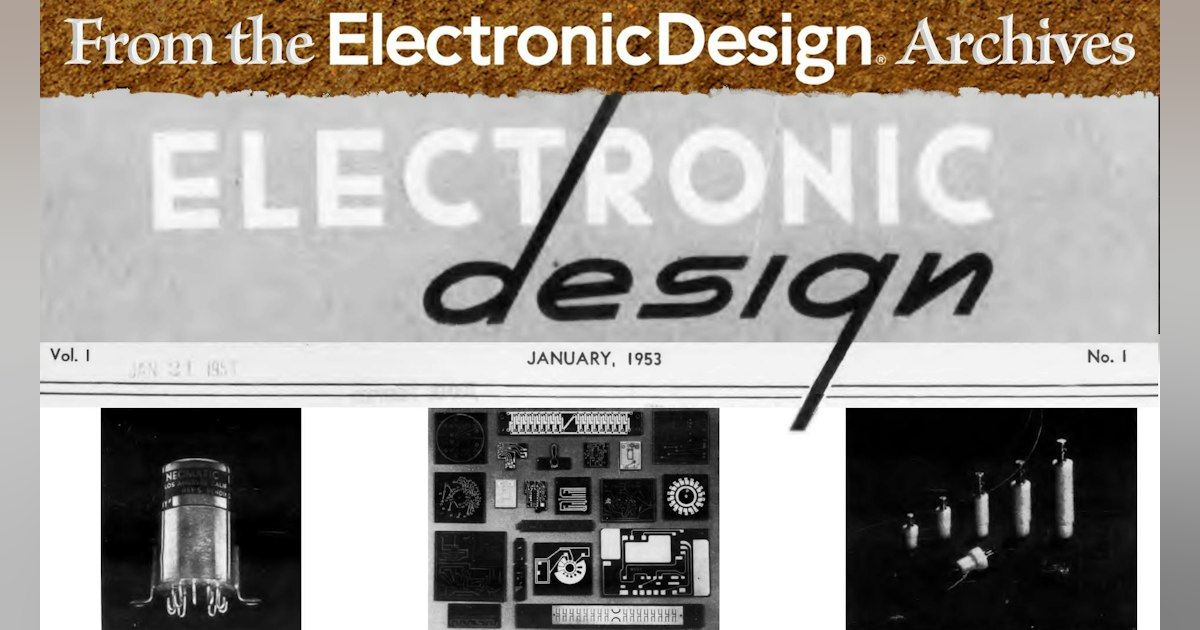
Electronic Design, a premier independent technology information source for electronics developers and engineers, has announced a significant archival milestone. Registered members can now access and download complete, digitized PDF copies of the publication’s foundational print issues, starting with Volume 1, Number 1, published in 1953.
This comprehensive digital release serves as a bridge connecting modern semiconductor engineering, artificial intelligence, and quantum computing with the nascent post-war era of electronic design automation and vacuum-tube engineering. The release is part of an ongoing buildup to a major corporate milestone: Electronic Design will celebrate its 75th anniversary in 2028.
By opening the vault to these historical documents, the publication allows researchers, historians, students, and contemporary hardware developers to examine the exact blueprints, advertisements, component specifications, and industry forecasts that shaped the modern technological landscape.
Chronology: Tracing the Evolution of Electronics Engineering
To understand the weight of the 1953 archive, it is necessary to examine the historical trajectory of the electronics industry and the publication that chronicled its growth decade by decade.
1953: The Inception and the Vacuum Tube Era
When Volume 1, Number 1 of Electronic Design hit desks in 1953, the electronics industry was standing on the precipice of a revolution. The transistor, invented just a few years prior at Bell Labs in 1947, was still in its infancy, and commercial circuits were dominated by thermionic valves (vacuum tubes). Computers occupied entire rooms, reliability was measured in hundreds of hours rather than years, and the term "integrated circuit" did not yet exist.
The inaugural issues focused heavily on:

- Improving the lifespan and thermal efficiency of vacuum tubes.
- Early applications of Germanium and early Silicon semiconductor diodes.
- Measuring instruments, oscilloscopes, and analog computing topologies.
- Military and defense electronics, which heavily subsidized early R&D during the Cold War.
The 1960s–1980s: The Silicon Age and Microprocessor Boom
As the decades progressed, Electronic Design documented the seismic shift from discrete components to integrated circuits (ICs). The pages from the late 1950s and 1960s detail the breakthrough work of figures like Robert Noyce and Jack Kilby, capturing the commercialization of planar transistors and the birth of digital logic families (such as TTL and ECL).
By the 1970s and 1980s, the magazine was tracking the microcomputer revolution. The introduction of 4-bit, 8-bit, and eventually 32-bit microprocessors—such as the Intel 4004 and Motorola 68000—transformed the industry from specialized military and mainframe applications into consumer-facing personal computing and embedded systems.
The 1990s–2010s: Surface Mount Technology, FPGAs, and Connectivity
The turn of the millennium brought rapid miniaturization. Surface-mount technology (SMT) replaced through-hole components, Field Programmable Gate Arrays (FPGAs) revolutionized hardware flexibility, and the rise of the internet demanded unprecedented speeds in mixed-signal and radio-frequency (RF) design. Electronic Design served as a critical technical manual for engineers navigating high-speed digital design, electromagnetic interference (EMI) challenges, and the early days of mobile cellular networks.

2020s and Beyond: AI Hardware, Advanced Packaging, and Quantum Computing
Today, the industry faces entirely new paradigms: heterogeneous integration, chiplets, 2.5D/3D advanced packaging, edge AI accelerators, and quantum processing units (QPUs). By releasing the 1953 archives now, Electronic Design provides a stark, humbling contrast to today’s multi-billion-transistor system-on-chips (SoCs).
Supporting Data: The Technical and Cultural Shift
To contextualize the contents of the 1953 archive against today’s engineering standards, industry analysts often point to exponential curves in manufacturing, computational power, and component density.
- Component Scale: In 1953, a single active switching element (a vacuum tube) occupied cubic inches of space, consumed significant wattage, and generated massive amounts of heat. Today, cutting-edge semiconductor nodes pack tens of billions of transistors into a single square millimeter, operating at fractions of a volt.
- Information Access: In the 1950s, sharing engineering breakthroughs relied heavily on physical print mailers, trade shows, and academic journals with months-long publication lags. The modern digital archive transforms these fragile paper artifacts into instantly searchable, high-resolution PDF documents available globally to members at the click of a button.
- Target Audience Expansion: While early issues catered primarily to defense contractors, radio engineers, and industrial equipment builders, the current readership spans a massive global ecosystem including automotive EV developers, IoT hardware architects, aerospace engineers, and software-defined silicon designers.
Official Responses and Industry Perspectives
Leadership at Electronic Design and its parent organization have emphasized that preserving these historical documents is vital not just for nostalgia, but for educating the next generation of engineers.
William G. Wong, a long-standing fixture and contributor at Electronic Design, has been instrumental in curating and managing digital access to these deep archival resources. Speaking on the value of looking backward to move forward, editorial stakeholders have noted that many fundamental principles of analog design, signal integrity, and power management established in the 1950s remain foundational, even as the implementation mediums have shifted from copper and glass to silicon and photonics.
"When you open Vol. 1, No. 1, you are looking at the foundational DNA of modern electronics," noted a representative close to the archiving project. "The challenges those engineers faced—minimizing noise, managing thermal dissipation, maximizing efficiency—are remarkably similar to the hurdles engineers face today when designing dense AI accelerators or power-sensitive IoT nodes. The tools have changed; the engineering mindset has not."
Industry reactions from veteran hardware designers and academic institutions have been overwhelmingly positive. University engineering departments have expressed interest in utilizing the 1953–1960 archives as pedagogical tools to show students how early pioneers solved complex electro-mechanical problems with slide rules, analog meters, and vacuum tubes.
Implications: Why the 1953 Archive Matters for Future Engineering
The release of the 1953 Electronic Design archive carries several profound implications for the engineering community as the industry approaches the publication’s 75th anniversary in 2028:
1. Preserving Institutional Memory
As the electronics industry ages, senior engineers who lived through the transition from discrete semiconductors to microprocessors are retiring. Archival initiatives like this ensure that the institutional memory, design philosophies, and problem-solving methodologies of early electrical engineering are not lost to time.
2. Contextualizing Technological Acceleration
By reviewing advertisements and editorial predictions from 1953, modern developers gain a profound appreciation for exponential technological growth. Predictions made in early issues regarding automation, miniaturization, and computing power often anticipated the direction of the industry, even if the underlying physics and materials science required decades to catch up.
3. Fostering Cross-Generational Innovation
Younger engineers entering fields like quantum computing, neuromorphic engineering, and advanced robotics can benefit greatly from studying foundational analog and digital principles. The archive acts as a masterclass in first-principles engineering—reminding modern designers how to build systems from the ground up when complex, highly integrated pre-packaged modules do not exist.
4. A Countdown to 2028
As Electronic Design marches toward its Diamond Jubilee (75th anniversary) in 2028, the unsealing of the 1953 volumes marks the official kickoff of a multi-year retrospection. Subscribers and members can expect further historical features, retrospective analyses, and deeper dives into the archives as the publication prepares to celebrate three-quarters of a century of chronicling human technological achievement.
Registered members of Electronic Design can log into their accounts today to explore the complete 1953 archive, browse weekly top stories, and utilize the expanded digital issue database.