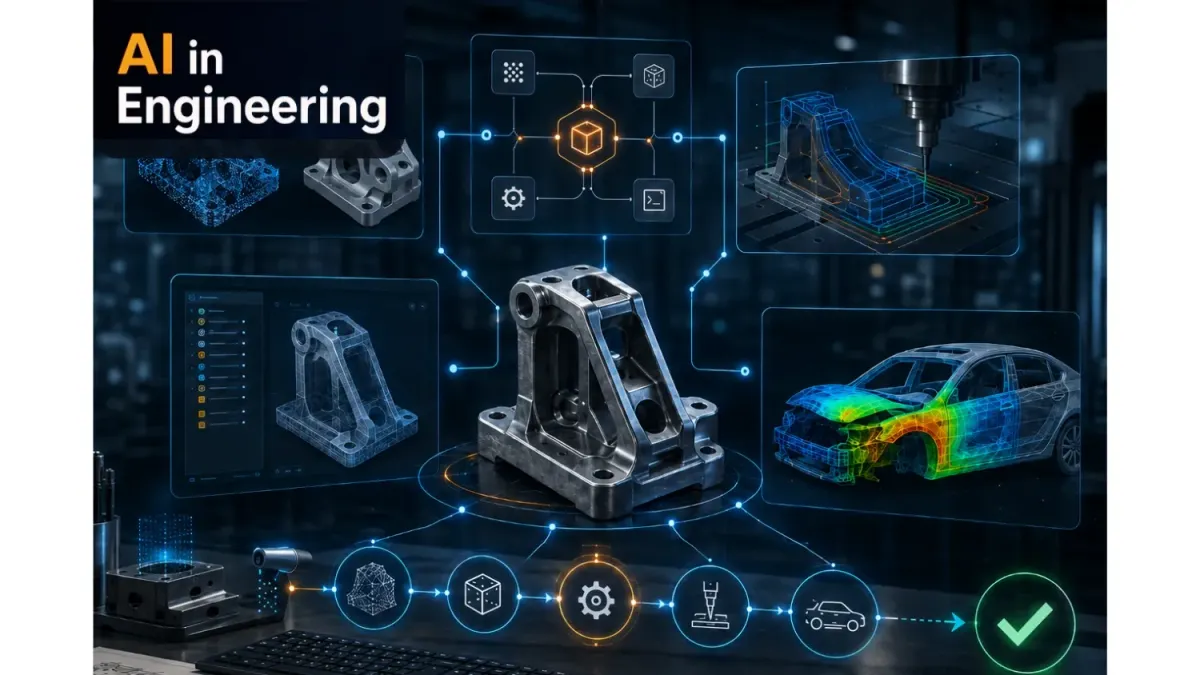
Artificial intelligence has officially moved past the phase of speculative hype and into the gritty, complex reality of day-to-day engineering. Rather than replacing human designers or writing entire products from scratch, AI is embedding itself directly into the "messy middle" of technical work.
Recent developments across computer-aided manufacturing (CAM), scan-to-CAD processing, cross-platform interoperability, and finite element analysis (FEA) show a clear trend: AI is being deployed to accelerate repetitive tasks, bridge persistent software silos, and democratize access to advanced simulation. However, these innovations also reinforce a core truth of modern engineering: while algorithms can dramatically accelerate workflows, they cannot replace human judgment.
Main Facts: The Current State of Engineering AI
The engineering software landscape is undergoing a significant transformation. Recent announcements from industry leaders like Synera, Mastercam, and Luminary illustrate how AI is altering the core components of the product lifecycle—from initial concept and 3D scan cleanup to machining and crash testing.
- Synera’s AI Agent Platform Integration: Synera has expanded its ecosystem by integrating add-ins for Autodesk Fusion and nTop (nTopology). This move is designed to unify CAD, CAE, CAM, and PLM tools into a single, automated workflow, minimizing data silos and hand-off errors.
- Mastercam 2026 and CAM Copilot: Mastercam is introducing an AI assistant that allows machinists and programmers to use natural language—via text or voice commands—to adjust feed rates, spindle speeds, and toolpath parameters across nearly 200 toolpath types.
- AI-Powered Scan-to-CAD Translation: Advances in artificial intelligence are finally helping engineering teams overcome the massive data bottlenecks associated with 3D scanning. New algorithms are automating geometry recognition, surface segmentation, and feature fitting, converting raw point clouds into editable parametric models.
- Luminary Shift-Crash: Luminary has launched Shift-Crash, a physics-based AI model capable of predicting full-vehicle crash deformation, stress fields, and responses in mere seconds rather than hours, targeting early-stage structural exploration.
Chronology: The Evolution Toward AI-Assisted Engineering
The integration of artificial intelligence into engineering software has followed a deliberate, phased trajectory over the past decade.
Phase 1: Point Solutions and Automated Generative Design (Late 2010s – Early 2020s)
Initially, AI in engineering manifested as isolated generative design algorithms. Software packages began offering topology optimization—creating organic, lightweight shapes based on boundary conditions and loads. While powerful, these tools often operated as "black boxes," producing geometries that were difficult to manufacture or integrate into traditional CAD pipelines.
Phase 2: Workflow Automation and Interoperability (2022 – 2024)
As machine learning models matured, software developers shifted their focus toward workflow friction. Companies like Synera began building orchestration platforms designed to connect disparate software packages (such as PLM, CAD, and CAE systems). The goal evolved from merely generating shapes to automating the repetitive transfer of data between engineering departments.
Phase 3: Conversational Assistants and Real-Time Physics (2025 – Present)
Today, AI tools are entering the operational environment of the engineer and machinist. The introduction of conversational interfaces—such as Mastercam Copilot—brings AI directly to the programming desk. Simultaneously, deep learning models like Luminary’s Shift-Crash are breaking the traditional computational bottlenecks of high-performance computing (HPC) clusters, bringing high-fidelity physics predictions into the early design exploration phase.
Supporting Data and Technical Architecture
To understand the practical impact of these new tools, it is necessary to examine the underlying metrics, hardware requirements, and operational capacities cited by developers and industry analysts.
Synera’s Interoperability Matrix
Synera’s platform targets the manual hand-offs that plague cross-functional engineering teams. By introducing direct add-ins for Autodesk Fusion and nTop, the platform addresses distinct engineering needs:
- The nTop Add-in: Specifically engineered to support complex design workflows—most notably additive manufacturing (3D printing). It allows users to dynamically update lattice structures, modify parameters, and execute upstream analysis while preserving a complete, replayable digital thread for auditing.
- The Fusion Add-in: Focuses heavily on cloud-based design sharing, automated design and simulation iterations, cost estimation, and Request for Quote (RFQ) preparation.
Mastercam 2026: Capabilities and Constraints
Mastercam 2026’s new CAM Copilot introduces targeted machine-learning assistance into everyday NC programming:
- Scope: Supports approximately 200 distinct toolpath types.
- Functionality: Operators can speak commands or type text descriptions to build complete machine groups and alter feed rates and spindle speeds across multiple operations simultaneously.
- Safety Architecture: Includes mandatory confirmation prompts for safety-critical adjustments, a hands-free voice-activation mode triggered by the keyword "Copilot," and an integrated search tool tied to the myMastercam video library to deliver timestamped training solutions.
Scan-to-CAD: Solving the Interpretation Bottleneck
According to insights shared by industry contributors from Artec 3D, T3DMC, OR3D, and Backflip, 3D scanning hardware has outpaced the software workflows used to interpret scan data.
- The Bottleneck: Data acquisition (capturing point clouds and dense polygon meshes) is fast, but turning those millions of data points into intelligent, editable engineering models has traditionally required intensive manual reverse engineering.
- AI Solutions: Modern machine learning models excel at surface segmentation, automatic plane and cylinder identification, hole detection, and feature fitting. These systems propose parametric CAD surfaces or pass/fail inspection checks that human engineers can review and accept.
Luminary Shift-Crash: Physics AI Metrics
Luminary’s Shift-Crash model represents a major leap forward in physics-informed machine learning for automotive safety:
- Training Data: Built upon an extensive dataset of 5,000 baseline crash simulations derived from a 2010 Toyota Yaris model.
- Speed Improvement: Traditional National Highway Traffic Safety Administration (NHTSA) New Car Assessment Program (NCAP) frontal crash simulations (performed at 56 km/h) typically demand 10 to 12 hours of computation on heavy High-Performance Computing (HPC) clusters. Shift-Crash utilizes transfer learning to cross-pollinate crash physics insights across different vehicle programs, delivering predictions in seconds.
- Accuracy: Luminary reports a Root Mean Square Error (RMSE) of under 3% when predicting deformation patterns and stress distributions.
Official Responses and Industry Perspectives
The rapid adoption of AI across mechanical and manufacturing sectors has sparked diverse reactions throughout the engineering community. Software vendors emphasize efficiency, speed, and democratization, while veteran engineers maintain a pragmatic, cautious stance.
Software Vendors: Accelerating Innovation and Reducing Repetitive Strain
Developers argue that these tools are essential for keeping pace with modern manufacturing demands.
- Synera representatives stress that engineering teams lose countless hours to manual data formatting and software interoperability gaps. By creating unified automated workflows, platforms like Synera aim to free engineers from administrative friction, allowing them to focus on design iteration rather than file management.
- Mastercam developers highlight that CAM programming involves significant repetitive data entry. By embedding a Copilot directly into the software interface, the objective is to lower the barrier to entry for junior machinists while speeding up complex modifications for seasoned programmers, all while embedding safety checks to prevent catastrophic programming errors.
The Engineering Community: Trust, Validation, and Judgment
While management and software vendors champion productivity gains, practicing engineers and simulation experts emphasize the irreplaceable nature of human oversight.
- The Reality of Scan-to-CAD: Industry experts note that an AI model can accurately fit geometry to a point cloud, but it cannot know why a part was designed that way. A scanned component may exhibit wear, manufacturing defects, or thermal warping. The AI can describe physical reality, but engineers must still determine design intent.
- The Caveat of AI Crash Simulation: Regarding tools like Luminary’s Shift-Crash, veteran simulation specialists caution that early screening tools must not be confused with final validation. Official NCAP ratings rely on rigorously defined regulatory test conditions and high-fidelity Finite Element Analysis (FEA). While AI is revolutionary for early-stage trade-off studies, it cannot yet replace certified physical testing or detailed numerical validation in high-stakes compliance scenarios.
Implications: The Evolving Role of the Engineer
As artificial intelligence reshapes the software stack, the professional profile of the modern engineer is undergoing a structural evolution.
1. The Shift from Creation to Curation
Historically, an engineer’s value was heavily tied to the manual execution of tasks: drafting lines in CAD, cleaning up polygon meshes, manually punching in feed rates, or setting up FEA boundary conditions. As AI assumes responsibility for these foundational mechanics, the engineer’s role transitions from a creator of geometry to a curator of automated outputs.
2. The Premium on Systems-Level Judgment
Future career advancement in engineering will favor professionals who can:
- Connect Tools: Bridge the gaps between disparate software suites (CAD, CAE, CAM, and PLM) using orchestration platforms.
- Question Outputs: Critically evaluate AI-generated suggestions, recognizing when a CAM toolpath violates machine limits, when scan-to-CAD geometry introduces erroneous assumptions, or when an AI-driven crash prediction is missing critical edge-case physics.
- Validate Decisions: Retain ultimate legal, ethical, and practical accountability for the safety and manufacturability of the final product.
3. Practical Summary for Industry Professionals
The overarching takeaway for the engineering sector is clear: AI does not remove the need for engineering judgment; it amplifies it.
Tools like Mastercam Copilot, Synera’s agent platform, advanced scan-to-CAD algorithms, and Luminary’s Shift-Crash provide unprecedented velocity, enabling teams to explore more design variants, iterate faster, and eliminate tedious administrative tasks. However, the ultimate responsibility for verifying structural integrity, machining safety, and regulatory compliance remains firmly on the shoulders of the human engineer.