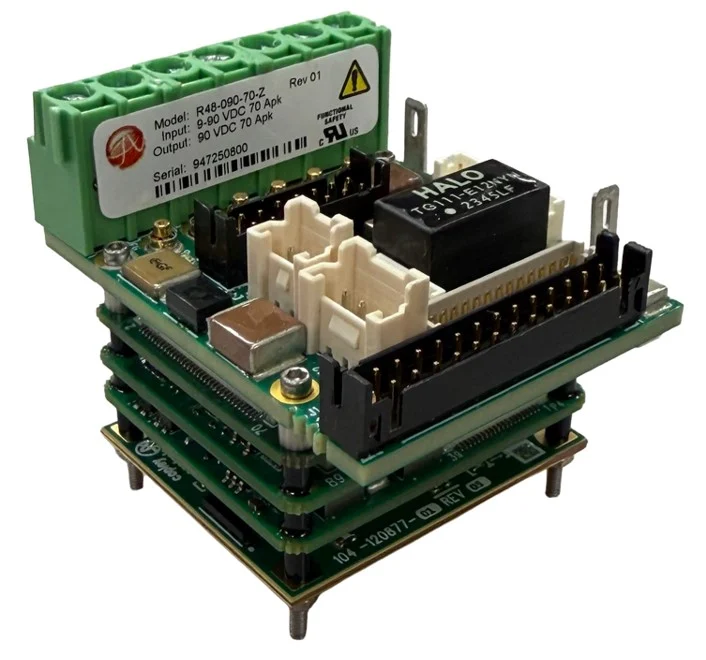
In an era where industrial automation and defense technology are pushing into increasingly hostile environments, the demand for compact, high-performance motion control has never been higher. Copley Controls, a recognized leader in precision motion technology, has officially launched its new R47 and R48 NanoPlus Micro Module servo drives. Designed to serve as the hardened, mission-ready counterparts to the company’s established NPS series, these new drives are engineered to withstand the extreme rigors of military, marine, aviation, and heavy-duty industrial applications.
By marrying the high-performance NanoPlus architecture with ruggedized hardware, Copley Controls aims to bridge the gap between commercial off-the-shelf (COTS) convenience and the stringent reliability requirements of high-stakes sectors like oil refining, aerospace, and defense.
Main Facts: The Evolution of NanoPlus
The R47 and R48 drives represent a significant technical evolution in the Copley Controls product portfolio. Built upon the proven FPGA-based NanoPlus architecture, these modules deliver superior processing power and control flexibility in a footprint small enough for the most space-constrained systems.
The distinction between the two models lies primarily in their communication protocols:
- The R47: Utilizes the robust CANopen protocol, an industry standard for distributed control systems.
- The R48: Leverages the high-speed EtherCAT protocol, specifically utilizing the CANopen application protocol over EtherCAT (CoE), catering to applications requiring rapid, deterministic data transmission.
Despite these differing communication interfaces, both models share an identical mechanical footprint, feature set, and internal logic architecture. This modularity allows engineers to swap or upgrade between protocols without necessitating a redesign of the underlying mechanical assembly, significantly reducing development time for complex motion control systems.
Furthermore, the drives offer extreme flexibility in integration. They are available as bare micro modules, allowing for direct mounting onto a user’s proprietary circuit board, or as preassembled units on a ruggedized "EZ board," which simplifies the installation process for those prioritizing rapid prototyping or standardized mounting.
Chronology of Development: From Concept to Deployment
The journey to the R47 and R48 series began with the market success of the standard NPS NanoPlus line. Copley Controls recognized that while the NPS series was highly efficient, its commercial-grade specifications were often insufficient for the extreme temperatures, vibration profiles, and electromagnetic interference (EMI) found in defense or heavy industrial environments.

- Phase 1: Architecture Validation: Engineers utilized the existing NanoPlus FPGA platform as the baseline, ensuring that the control algorithms—which govern high-precision positioning and velocity—would remain consistent across the new series.
- Phase 2: Hardening and Materials Selection: The design team focused on material science, selecting components capable of handling thermal cycling and high-frequency vibration. This included upgrading substrates and protective coatings to resist high humidity and corrosive environments.
- Phase 3: Compliance Testing: The development process was driven by the necessity of meeting international and military standards. Throughout 2025 and into 2026, the units underwent rigorous testing to ensure compliance with IEC, ISO, and MIL-STD specifications.
- Phase 4: Market Introduction: The final product launch marks the transition of the R-Series from an engineering concept to a commercially available solution, intended to provide immediate support for high-end automation projects.
Supporting Data: Power and Performance
The R-Series drives are designed to handle significant power demands while maintaining a compact physical size. They operate within two primary voltage ranges: 9 to 90 VDC and 20 to 180 VDC. This flexibility ensures compatibility with everything from battery-powered mobile robots to high-voltage industrial power grids.
Performance Specifications
- Continuous Current: Up to 35 Amps.
- Peak Current: Up to 70 Amps.
- Continuous Output Power: Up to 3.15 kW.
- Peak Output Power: Up to 6.3 kW.
These figures suggest that the drives are capable of handling high-torque motor applications where rapid acceleration and precise deceleration are required. The high peak power output is particularly critical for applications involving high-load starts or sudden shock-loading, which are common in aerospace actuators and heavy-duty robotic manipulators.
Compliance and Regulatory Standards
A defining feature of the R47 and R48 series is their comprehensive commitment to international safety and reliability standards. The drives have been designed to conform to the following:
- Safety Standards: IEC 61508 (SIL 3) and ISO 13849-1 (Category 3, Performance Level e), ensuring that the drives can be safely integrated into systems requiring high levels of functional safety.
- Environmental and EMC: IEC 61800-5-1 and IEC 61800-5-2 for electrical safety, and IEC 61800-3 for electromagnetic compatibility.
- Military-Grade Durability: The R-Series is designed to meet an array of MIL-STD requirements:
- MIL-STD-461: EMI and EMC performance.
- MIL-STD-704: Aircraft electrical power characteristics.
- MIL-STD-810: Environmental engineering considerations and laboratory testing (shock, vibration, temperature).
- MIL-STD-1275: Characteristics of 28V DC electrical systems in military vehicles.
- MIL-STD-1399: Interface standard for shipboard systems.
While UL recognition and other agency approvals are currently pending, the commitment to these standards places the R-Series at the top tier of the ruggedized motion control market.
Implications for Industry
The release of the R47 and R48 drives has profound implications for industries that have historically struggled to find high-performance motion solutions that do not require custom, "one-off" engineering.
Defense and Aerospace
In modern defense, the trend is toward "smart" platforms—drones, autonomous ground vehicles, and missile guidance systems—that require high-density electronics. The R-Series allows defense contractors to use COTS components that are already hardened to military standards, thereby reducing the time-to-market for new equipment without sacrificing reliability.
Oil, Gas, and Harsh Industrial Environments
Oil refineries and offshore drilling platforms present some of the most challenging environments for electronic hardware. Humidity, corrosive gases, and extreme temperature fluctuations can cause standard servo drives to fail prematurely. By utilizing the R-Series, engineers can ensure that their motion systems—whether for valve control or automated drilling assemblies—maintain performance consistency over the lifetime of the equipment.

Marine and Vehicle-Based Systems
Marine environments, characterized by salt spray, constant vibration, and unpredictable power quality, have historically required bespoke solutions. The R47 and R48 provide a standardized solution that can handle the electrical noise and physical stress common on naval and commercial vessels.
Official Perspective and Future Outlook
While Copley Controls continues to refine its product lineup, the R-Series represents a strategic pivot toward specialized vertical markets. By focusing on the "ruggedization" of the NanoPlus architecture, the company is positioning itself as a primary partner for integrators of mission-critical systems.
The decision to offer these drives as both bare micro modules and preassembled units on EZ boards highlights an understanding of the diverse needs within the engineering community. It empowers researchers and original equipment manufacturers (OEMs) to tailor their integration strategy to their specific production scale.
As the industry moves toward greater levels of autonomy and digitalization, the importance of reliable motion control cannot be overstated. The R47 and R48 series are not merely incremental upgrades; they are foundational components designed to thrive where standard hardware would falter.
For professionals working in motion control, the R-Series offers a path to simplifying complex designs. Whether a project requires the determinism of EtherCAT or the widespread compatibility of CANopen, Copley Controls has provided a robust, standardized framework for the most demanding environments on (and off) the planet.
For further information, technical datasheets, or to consult with a Copley Controls representative regarding a specific application, interested parties are encouraged to visit copleycontrols.com.
About the Author: This report was compiled by the editorial team at Design World, specializing in the latest advancements in motion control, robotics, and industrial computing.