CUISINE, CALIF. — For over a decade, Apple Inc. has been synonymous with the pocket-sized supercomputer that revolutionized modern communication: the iPhone. Yet, as the Cupertino-based tech giant expanded its empire into smartwatches, wireless audio, mixed-reality headsets, and smart home ecosystems, it cultivated a robust supporting cast intended to diversify its revenue streams and bind consumers ever tighter to its proprietary ecosystem.
Today, however, that supporting cast is facing a severe reality check. Apple’s “Wearables, Home and Accessories” segment—once hailed as the explosive engine of the company’s hardware diversification—has struggled significantly to keep pace with the hyper-growth of the rest of the corporation. After experiencing a meteoric rise during the remote-work and digital-lifestyle boom of the early pandemic era, this crucial division has hit a prolonged plateau, sparking rigorous debates among industry analysts regarding product saturation, consumer upgrade cycles, and long-term strategic missteps.
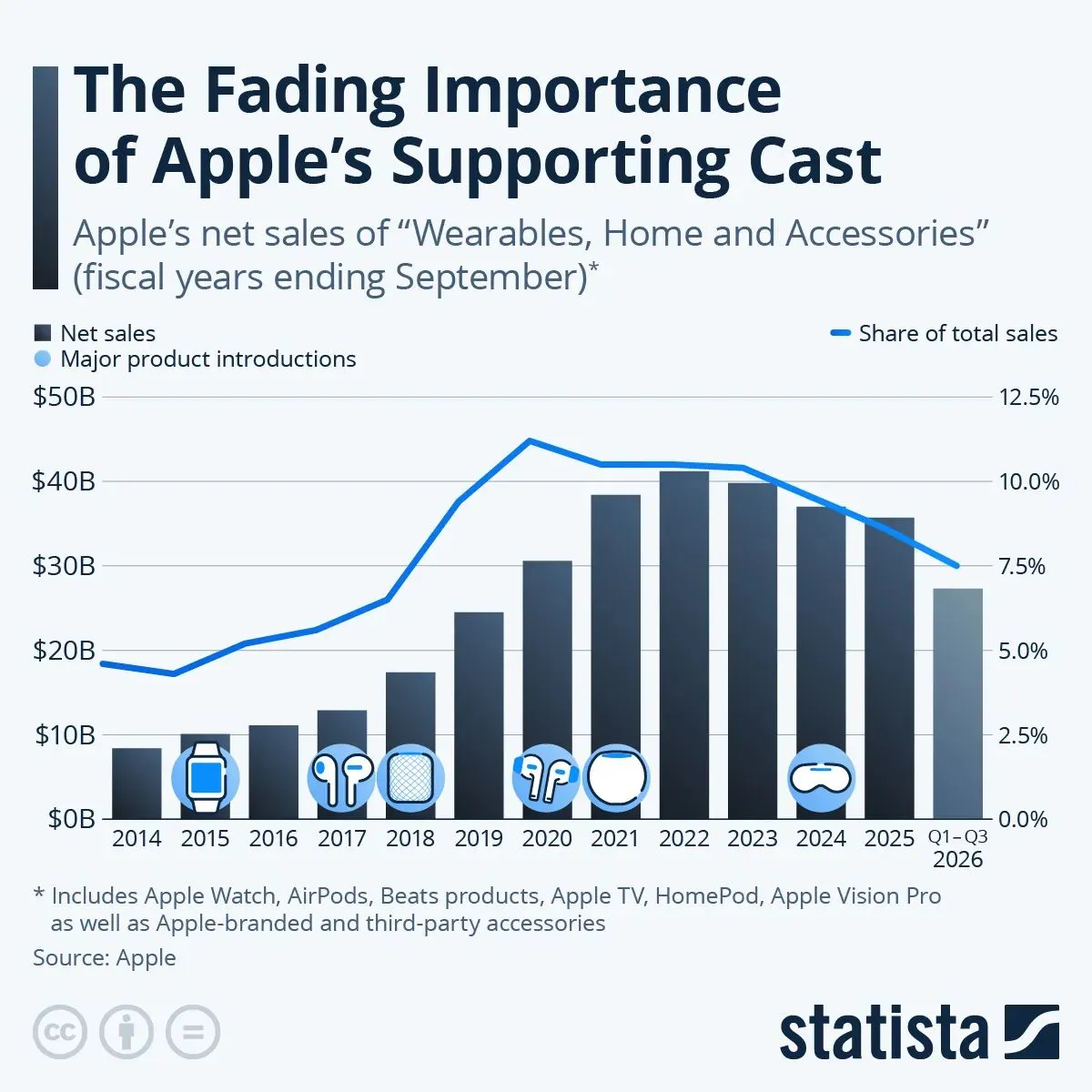
Despite generating a formidable $27.3 billion in the first three quarters of fiscal 2026, the segment’s performance reveals a sobering narrative of contraction relative to Apple’s overarching financial footprint. As the tech titan navigates a rapidly shifting landscape defined by artificial intelligence integration and fierce global competition, the trajectory of its non-iPhone hardware demands a comprehensive examination.
Main Facts
The Wearables, Home and Accessories segment encompasses some of the most recognizable consumer electronics on the market, including the Apple Watch, AirPods, smart home products (such as the HomePod and Apple TV), and the high-end spatial computing device, the Apple Vision Pro.
Key structural facts regarding the division’s current standing include:
- Revenue Contraction: Sales within the Wearables, Home and Accessories segment have declined in each of the past three fiscal years, breaking a multi-year streak of double-digit expansion that characterized the late 2010s.
- Shrinking Revenue Share: The division’s contribution to Apple’s total corporate revenue has experienced a notable downward trajectory. From a peak of 11.2% in fiscal 2020, its share has eroded to just 7.5% through the first three quarters of fiscal 2026.
- Hierarchy of Revenue: Despite these declines, the segment remains Apple’s third-largest revenue contributor overall. It sits comfortably behind the titan of the company’s balance sheet—the iPhone, which has brought in $196.5 billion over the same recent comparative period—and the rapidly expanding Services division, which generated $91.7 billion.
- Product Disparities: Industry estimates indicate that the Apple Watch and AirPods command the vast majority of the segment’s revenue. Meanwhile, newer or more niche entries, such as the ultra-premium Apple Vision Pro and the company’s various smart home offerings, occupy smaller footprints in terms of raw sales volume, even if they consume substantial research and development resources.
Chronology: The Rise, Peak, and Plateau of Apple’s Ecosystem Expansion
To understand how Apple’s supporting cast reached its current crossroads, it is essential to trace the historical timeline of the Wearables, Home and Accessories division from its conceptual infancy to the present day.
2014–2016: Planting the Seeds of the Post-iPhone Era
Recognizing the eventual maturity of the smartphone market, Apple began diversifying aggressively.
- September 2014: Apple unveiled the original Apple Watch, entering the wearable technology market under the leadership of CEO Tim Cook.
- April 2015: The Apple Watch officially went on sale, quickly establishing dominance in the nascent smartwatch category despite initial skepticism regarding battery life and utility.
- September 2016: Apple introduced the AirPods alongside the iPhone 7, stripping away the traditional headphone jack. Mocked initially for their design, AirPods rapidly became a cultural phenomenon and a dominant revenue driver, effectively inventing the modern true-wireless stereo (TWS) earbud market.
2017–2020: The Golden Age of Wearables and Pandemic Boom
During this era, non-iPhone hardware transitioned from a side project into a formidable economic pillar.
- December 2017: Apple launched the HomePod, attempting to capture the high-end smart speaker market dominated by Amazon Echo and Google Home.
- 2018–2019: The Apple Watch Series line matured with advanced health tracking features, including electrocardiogram (ECG) capabilities and fall detection, transforming the device from a tech accessory into an indispensable health monitor.
- 2020 (The Peak): Catalyzed by the COVID-19 pandemic, consumer spending shifted heavily toward home office upgrades, remote work accessories, and personal fitness tech. The Wearables, Home and Accessories segment reached its historical zenith, capturing 11.2% of Apple’s total sales.
2021–2024: Saturation and Economic Headwinds
As global economies reopened and consumer spending patterns normalized, the division began to encounter structural headwinds.
- 2021–2023: For three consecutive fiscal years, the segment posted year-over-year revenue declines. Upgrade cycles for the Apple Watch and AirPods began to lengthen; consumers realized that older models—such as the Apple Watch Series 6 or AirPods Pro—remained fully functional for years, dampening the urgency of annual replacements.
- February 2024: Apple released the Apple Vision Pro at a steep starting price of $3,499. While hailed as a technological tour de force in spatial computing, its high cost and niche appeal meant it could not immediately move the needle on a multi-billion-dollar scale.
2025–2026: Strategic Reassessment
- Fiscal 2026 (Present): With year-to-date segment sales standing at $27.3 billion and accounting for 7.5% of total corporate revenue, Apple finds itself forced to re-evaluate its product roadmap. While the company is reportedly shelving or scaling back certain hardware experiments, internal signals indicate a stubborn refusal to abandon the smart home space entirely.
Supporting Data and Financial Analysis
A granular look at Apple’s financial disclosures over the past half-decade highlights the shifting weight of its product portfolio. While Apple’s overall revenue has continued to scale—bolstered by resilient iPhone upgrade cycles and a booming Services sector encompassing iCloud, Apple Music, and the App Store—hardware adjacencies have failed to match that momentum.
| Fiscal Year | Total Apple Revenue (Approx.) | Wearables, Home & Accessories Revenue | Segment Share of Total Revenue | Key Market Dynamics |
|---|---|---|---|---|
| 2020 | ~$274.5 Billion | ~$30.6 Billion | 11.2% | Pandemic-driven demand for remote work gear, wearables, and home tech. |
| 2022 | ~$394.3 Billion | ~$41.2 Billion | 10.4% | Post-pandemic normalization begins; supply chain constraints weigh on production. |
| 2024 | ~$391.0 Billion | ~$37.0 Billion | 9.5% | Lengthening replacement cycles; lack of breakthrough form-factor updates. |
| 2026 (First 3 Qtrs) | N/A | $27.3 Billion | 7.5% | Continued erosion of revenue share; heavy reliance on legacy Apple Watch/AirPods sales. |
The data paints a clear picture: while the Wearables, Home and Accessories unit generates more revenue annually than many Fortune 500 companies achieve in total, its relative shrinkage within Apple’s corporate ecosystem is undeniable.
Market researchers point out that the Apple Watch and AirPods face a classic "victim of their own success" dilemma. Having achieved massive market penetration among affluent consumer demographics, finding new buyers in developed markets has become increasingly difficult. Furthermore, innovation in smartwatches and wireless earbuds has hit an incremental plateau. Annual iterations now focus on subtle refinements—brighter screens, marginally better battery life, or minor sensor tweaks—which are rarely compelling enough to convince owners of two- or three-year-old devices to upgrade immediately.
Official Responses and Executive Strategy
Apple’s executive leadership has historically remained tight-lipped regarding short-term product line fluctuations, preferring to frame hardware initiatives through the lens of long-term ecosystem integration and user retention rather than quarterly unit sales.
During recent earnings calls, CEO Tim Cook and Chief Financial Officer Luca Maestri have consistently emphasized the unprecedented size of the active installed base of Apple devices, which surpassed the 2.2 billion active device milestone globally. Within this massive installed base, the company views wearables and smart home hardware not merely as standalone profit centers, but as critical "glue" that deters users from migrating to competing ecosystems like Android.
Regarding the smart home category—a sub-segment that has lagged behind expectations due to fierce competition from Amazon and Google—Apple’s stance has evolved. While products like the original HomePod faced initial criticisms over pricing and Siri’s relative linguistic limitations at launch, the introduction of the more affordable HomePod mini helped stabilize the company’s presence in connected living rooms.
Industry insiders and supply chain analysts have reported that Apple is currently developing a new category of smart home displays—devices that would combine smart speaker functionality, FaceTime camera integration, and a localized command center for HomeKit-enabled appliances, powered heavily by upcoming iterations of Apple Intelligence.
As a high-ranking executive close to Apple’s product development—who spoke on the condition of anonymity—noted:
"We do not measure the success of the home or wearable ecosystems solely by year-on-year unit growth. These form factors are vital conduits for our services and health initiatives. The strategy is to deepen utility, not merely chase volume."
Similarly, regarding the Apple Vision Pro, Apple executives have consistently defended the spatial computing platform as a foundational multi-year play. Rather than viewing the headset’s current low shipment volume as a failure, leadership characterizes the device as a first-generation developer kit and a preview of underlying technologies that will eventually power lighter, more accessible augmented reality (AR) glasses in the late 2020s.
Implications for Apple and the Consumer Tech Industry
The cooling growth of Apple’s Wearables, Home and Accessories division carries profound implications—not only for Apple’s financial valuation, but for the broader consumer electronics landscape.
1. The Imperative of Artificial Intelligence Integration
For years, hardware differentiation relied primarily on silicon speed, camera megapixels, and physical form factors. Today, those vectors of competition are rapidly commoditizing. For Apple’s wearables and smart home initiatives to reignite growth, they must successfully harness artificial intelligence. The rollout of Apple Intelligence across iPhones, iPads, and Macs sets the stage for a natural expansion into AirPods and smart home hubs. Imagine conversational audio accessories that can locally process complex requests, or smart home displays that proactively anticipate household routines. If Apple fails to infuse its supporting cast with advanced, contextual AI, consumer apathy toward upgrades will likely deepen.
2. Diversification Pressure on the Core Business
With the Wearables segment shrinking from 11.2% to 7.5% of total revenue, the burden of corporate growth falls even heavier on the iPhone and the red-hot Services division. While Services continues to post record-breaking margins, Wall Street analysts closely monitor hardware diversification to gauge Apple’s ability to invent the next paradigm-shifting product category. If the smart home push or future spatial computing iterations fail to capture mainstream imagination, Apple risks becoming even more reliant on its flagship smartphone than it was at the start of the decade.
3. Pricing Pressures and Consumer Fatigue
The economic realities of the mid-2020s—characterized by persistent inflation, cautious consumer spending, and longer product retention cycles—mean that luxury pricing strategies face diminishing returns. The lukewarm mass-market adoption of the $3,499 Apple Vision Pro demonstrates that consumers are increasingly unwilling to pay barrier-to-entry prices for nascent technology. To reverse the slide in its accessories segment, Apple may be forced to recalibrate its pricing architecture, introducing more accessible entry-level smart home devices and mid-tier wearables that target budget-conscious consumers without diluting the brand’s premium cachet.
4. A Test of Ecosystem Resilience
Ultimately, Apple’s ultimate moat has never been a single gadget; it is the seamless synergy tying the hardware together. The Apple Watch unlocking a Mac, AirPods switching effortlessly between an iPad and an iPhone, and home automation responding instantly to a voice command are what keep users locked into the Apple ecosystem. Even if the direct sales of the Wearables, Home and Accessories segment have plateaued, its strategic value as a retention tool remains immense.
As Apple prepares its next wave of product announcements, the overarching question is no longer whether the company can launch successful accessories, but whether it can reinvent them to spark a new era of consumer desire. For a company built on defying expectations, reigniting its supporting cast will be one of its defining challenges for the remainder of the decade.