The landscape of modern industrial manufacturing is undergoing a profound structural evolution. As supply chains grow more complex, consumer demands shift toward mass customization, and labor shortages persist across global markets, factory floors must become more adaptable than ever. Traditional, rigid infrastructure—such as fixed conveyor belts and magnetic-tape-guided vehicles—is rapidly giving way to flexible, intelligent, and space-efficient intralogistics systems.
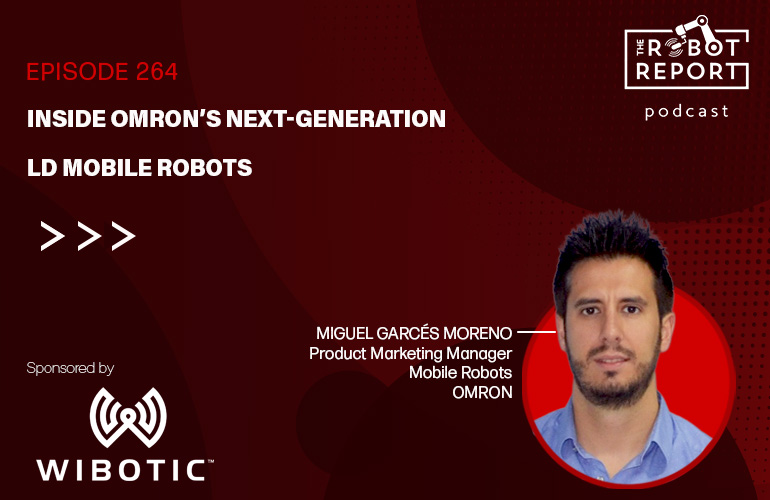
At the forefront of this industrial transformation are Autonomous Mobile Robots (AMRs). In Episode 264 of The Robot Report Podcast, co-host Mike Oitzman sat down with Miguel Garcés Moreno, Product Marketing Manager for Mobile Robots in Europe, the Middle East, and Africa (EMEA) at OMRON Industrial Automation Europe. The conversation offered a rare, behind-the-scenes look at how Omron is engineering its next-generation mobile robotics portfolio, focusing particularly on the company’s flagship LD mobile robots and their integration into modern smart factories.
Main Facts: The Evolution of Omron’s Mobile Robotics Strategy
The discussion highlighted how Omron has positioned itself as a comprehensive automation powerhouse. Garcés Moreno, whose background spans an industrial engineering degree and a Master’s degree in Industry 4.0, oversees product strategy across a wide spectrum of advanced technologies. His purview includes AMRs, traditional industrial automation, collaborative robots (cobots), and force- and power-limited systems.
With deep technical expertise spanning AI-driven vision, advanced motion control, and Programmable Logic Controllers (PLCs), Garcés Moreno approaches mobile robotics not as isolated hardware products, but as interconnected nodes within a broader factory ecosystem.
Key takeaways from his strategy include:
- Holistic Factory Integration: Modern AMRs must seamlessly communicate with fixed automation assets, safety controllers, and enterprise resource planning (ERP) software.
- Intralogistics Agility: Omron’s next-generation systems aim to eliminate downtime by optimizing path planning, dynamic obstacle avoidance, and fleet management in highly congested environments.
- The Rise of Smart Ecosystems: Technologies like AI vision and advanced motion control are no longer supplemental; they are foundational to ensuring that mobile robots can operate safely alongside human workers in unstructured spaces.
Chronology: The Journey to Next-Gen Industrial Autonomy
To understand the weight of Omron’s current innovations, it is helpful to contextualize the timeline of factory automation and how mobile robotics evolved from simple automated guided vehicles (AGVs) to sophisticated AMRs.
Phase 1: The Era of Rigid Infrastructure (Pre-2010s)
Historically, moving materials across a manufacturing plant or warehouse relied on manual labor using forklifts or fixed mechanical systems like conveyors and gravity rollers. Where automation existed, it predominantly took the form of AGVs. These legacy machines required physical modifications to the facility—such as magnetic tape embedded in the floor, wire guides, or reflective triangulation beacons—to navigate. If a production line changed or an obstacle blocked the path, the entire system would halt, requiring costly and time-consuming manual intervention.
Phase 2: The Introduction of Natural Feature Navigation (2010s–2020)
The introduction of Simultaneous Localization and Mapping (SLAM) and LiDAR-based navigation revolutionized the industry. Robots no longer needed external infrastructure to know where they were; instead, they could map their environment using onboard sensors and navigate dynamically. During this era, companies like Adept Technology pioneered foundational mobile robotics technologies that would later form the bedrock of Omron’s mobile robot lineup following strategic acquisitions and internal R&D expansions.
Phase 3: The Smart Factory and Industry 4.0 Integration (2020–Present)
Today, factories operate under the paradigm of Industry 4.0, where data connectivity, machine learning, and flexible manufacturing cells dominate. Omron’s development of the LD mobile robot series represents the pinnacle of this era. Rather than simply moving from point A to point B, modern AMRs make real-time decisions, coordinate seamlessly within large fleets, integrate with enterprise fleet management software, and adapt dynamically to human workers and shifting factory layouts.
Supporting Data: The Metrics Driving AMR Adoption
The push toward next-generation mobile robots is driven by compelling market dynamics and measurable operational efficiencies. While specific proprietary sales figures for individual Omron product lines remain tightly guarded, broader industry metrics highlight the explosive growth and necessity of AMR adoption:

- Compound Annual Growth Rate (CAGR): Global market analyses consistently project the AMR market to expand at a CAGR exceeding 20% over the decade, propelled by increasing labor scarcity and the rapid expansion of e-commerce and electronics manufacturing.
- Downtime Reduction: According to industrial automation benchmarks, transitioning from traditional material handling to dynamic AMR fleets can reduce internal transport bottlenecks by up to 30%, directly improving overall equipment effectiveness (OEE).
- Safety and Compliance Standards: Modern AMRs must comply with stringent international safety regulations, such as ISO 3691-4, which governs the safety requirements for driverless industrial trucks. Omron’s engineering approach prioritizes functional safety to ensure compliance without sacrificing operational speed or throughput.
- Energy and Fleet Optimization: Collaborative technologies—such as wireless charging solutions provided by industry partners like WiBotic—enable autonomous battery management. Automated wireless charging eliminates manual battery swaps, increasing fleet uptime and maximizing return on investment (ROI).
Official Perspectives: Insights from Miguel Garcés Moreno
During the podcast episode, Garcés Moreno emphasized that the true value of an autonomous mobile robot lies not just in its mechanical prowess, but in its software intelligence and ease of deployment.
"Closing the loop of autonomy takes more than a great robot," Garcés Moreno noted in discussions surrounding total factory integration. Achieving true lights-out or highly flexible manufacturing requires an orchestration layer that bridges the gap between hardware and high-level factory software.
By leveraging his multidisciplinary background in industrial engineering and smart automation, Garcés Moreno highlighted several key engineering philosophies driving Omron’s current product roadmap:
- User-Centric Deployment: Factory operators should not need advanced robotics degrees to deploy or reroute a fleet of AMRs. Intuitive fleet management software and user-friendly setup interfaces are critical to lowering the barrier to entry for small- and medium-sized enterprises (SMEs) as well as global automotive and electronics giants.
- Safety as a Catalyst for Productivity: Rather than viewing safety protocols as a limitation on speed and efficiency, Omron integrates safety laser scanners and collision-avoidance algorithms as core performance features. When an AMR can safely and predictably navigate around a human worker, it doesn’t need to slow down prematurely or trigger unnecessary emergency stops, thereby maintaining high workflow throughput.
- Cross-Technology Synergy: The integration of AMRs with other Omron automation assets—such as fixed robotic arms, vision systems, and safety PLCs—creates a unified automation ecosystem where mobile manipulators (AMRs equipped with robotic arms) can perform complex tasks like machine tending and automated assembly.
Implications: What Next-Gen AMRs Mean for the Future of Manufacturing
The evolution of Omron’s LD mobile robots and the broader intralogistics landscape carries profound implications for the global manufacturing sector.
1. The Realization of Flexible Manufacturing
Mass production is increasingly being replaced by mass personalization. Factories must be capable of retooling or shifting production lines overnight to accommodate new product variants. Fixed conveyors cannot adapt to this volatility; flexible AMR fleets can. By dynamically updating navigation maps and task assignments via fleet management software, manufacturers can reconfigure their floor layouts digitally rather than physically.

2. Easing the Burden of the Labor Shortage
Manufacturing facilities worldwide continue to struggle with chronic labor shortages, particularly in repetitive, physically demanding, and ergonomically hazardous roles such as heavy material transport. By deploying AMRs to handle these dull and dangerous tasks, companies can upskill their human workforce, shifting personnel toward higher-value supervisory, maintenance, and quality-control roles.
3. The Convergence of Mobile Robots and Fixed Automation
As demonstrated by Garcés Moreno’s multidisciplinary product oversight, the boundaries between different automation categories are blurring. The future is not just about mobile robots moving bins from one side of a warehouse to the other; it is about mobile manipulators that can interact dynamically with their environment—opening doors, pressing elevator buttons, picking parts from shelves, and loading CNC machines.
4. Scalability and Fleet Energy Management
As fleets grow from a handful of pilot robots to dozens or hundreds operating simultaneously, energy management becomes a critical bottleneck. Innovations in wireless charging, automated battery-swapping protocols, and intelligent dispatch algorithms (ensuring low-battery units head to chargers only when demand allows) will dictate which automation deployments succeed at scale.
Conclusion
The conversation between Mike Oitzman and Miguel Garcés Moreno on Episode 264 of The Robot Report Podcast underscores a fundamental truth about modern industry: the factory floor of the 21st century is a living, breathing ecosystem. Omron’s next-generation LD mobile robots represent a vital step forward in making this vision a reality. By combining robust hardware, advanced navigation, rigorous functional safety, and seamless integration with the broader industrial automation stack, Omron is equipping manufacturers to meet the challenges of tomorrow with confidence, flexibility, and unmatched operational efficiency.