Main Facts
Power Usage Effectiveness (PUE) has long reigned as the undisputed gold standard for measuring data center energy sustainability. Promoted heavily in regulatory frameworks, corporate sustainability disclosures, and competitive operator benchmarks, PUE evaluates how efficiently a facility delivers energy to its IT infrastructure, tracking overhead elements like cooling systems, lighting, and power distribution units.
However, a critical blind spot exists in modern digital infrastructure: PUE stops measuring the moment electricity crosses the physical threshold of a server.
As artificial intelligence (AI) and machine learning (ML) workloads drive unprecedented power densities—pushing rack consumption from historical baselines of 5 to 8 kilowatts (kW) up to 100 kW or more—facility-level metrics are no longer enough. The complex Power Delivery Network (PDN) residing inside the server, stretching from the initial AC-DC conversion down to the point-of-load (POL) modules powering high-current AI accelerators, remains an invisible black box.
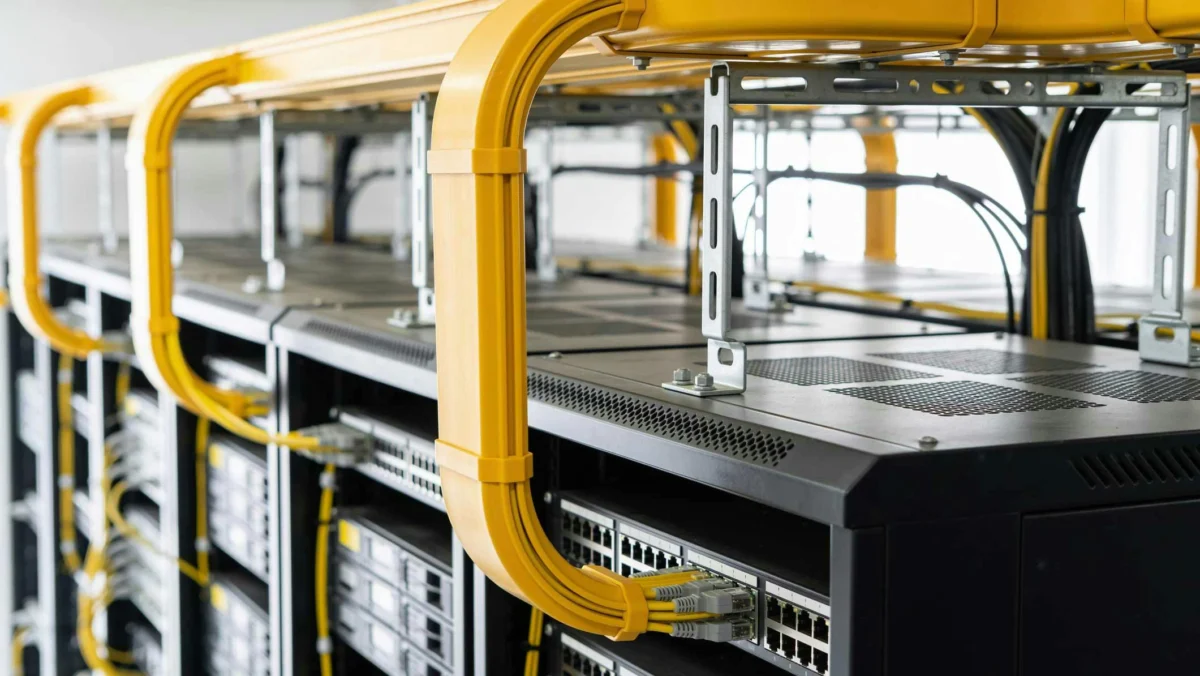
Without granular visibility into internal conversion stages, data center operators can report stellar PUE figures while simultaneously leaking massive amounts of energy as waste heat directly at the chip level. This hidden inefficiency inflates operational expenses, strains electrical grids, and demands excessive cooling capacity, signaling an urgent industry-wide need to expand how data center efficiency is monitored, evaluated, and managed.
Chronology: The Evolution and Limitations of Efficiency Metrics
The Era of Modest Compute (Early 2000s to 2010s)
- Inception of PUE: Introduced to help the rapidly expanding internet infrastructure ecosystem quantify facility overhead. It provided a clear ratio of total facility energy to IT equipment energy.
- CPU-Dominated Racks: Data centers primarily relied on uniform, predictable central processing unit (CPU) workloads. Rack power densities remained modest, hovering between 5 kW and 8 kW. Losses inside the server were relatively negligible and uniform across deployments, making facility-level overhead the primary target for optimization.
The Shift Toward High-Density Acceleration (Late 2010s to Early 2020s)
- The Rise of Specialized Hardware: The emergence of deep learning, large language models (LLMs), and graphics processing units (GPUs) fundamentally altered computational architectures.
- Escalating Rack Densities: AI hardware began demanding significantly higher current levels at aggressive, highly unpredictable load transients. Power-per-rack specifications jumped dramatically, moving past 15 kW to 50 kW, and eventually eclipsing 100 kW in GPU-dense clusters.
The Current AI Era (Present Day)
- The PDN Blind Spot: Although PUE successfully tracks facility cooling and power distribution, it fails to capture the compounding conversion losses occurring inside the server chassis.
- The Push for Comprehensive Metrics: Industry stakeholders, semiconductor innovators, and power electronics experts are increasingly advocating for holistic evaluation frameworks that account for internal power delivery paths, particularly at the point of load.
Supporting Data & Technical Realities: The Inside Story of Server Power Losses
To understand why PUE falls short in the age of AI, one must examine the arduous journey electricity takes from the electrical grid to a silicon processor.
The Conversion Chain
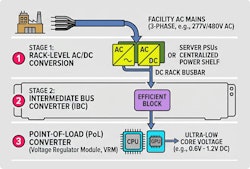
Getting power to an AI accelerator is not a single-step transmission; it is a multi-stage conversion gauntlet:

- AC-to-DC Conversion: Power enters the facility as alternating current (AC) and is converted into a high-voltage direct current (DC) bus.
- Intermediate Voltage Conversion (IBC): High-voltage DC is stepped down through one or multiple intermediate DC-DC conversion stages.
- Point-of-Load (POL) Regulation: The final stage before the processor. POL converters regulate voltage down to the exact levels required by delicate silicon architectures, maintaining stability under extreme, rapid load transients.
Each of these transitions operates on a specific efficiency curve. None of them are 100% efficient.
Multiplied Inefficiencies
At modest power draws, minor conversion inefficiencies acted as statistical rounding errors. In modern AI installations, however, those same percentage losses translate into staggering amounts of wasted electricity.
Because power loss inside a server manifests entirely as thermal energy, it triggers a compounding penalty:
- Wasted Electricity: Energy is burned off as heat before performing any useful compute work.
- Cooling Overhead: The resulting heat must be actively dissipated by high-powered cooling fans or liquid coolant systems, drawing even more power from the facility.
- Financial and Environmental Impact: Electricity bills rise directly, and the total carbon footprint expands—all while facility PUE metrics remain unaffected.
Official Perspectives and Expert Insight
Industry veterans emphasize that questioning PUE is not about dismissing its historical value, but rather acknowledging its boundaries.
"PUE still does what it was built to do," notes Hans Hasselby-Andersen, CEO of Lotus Microsystems and a veteran semiconductor executive with decades of experience spanning Texas Instruments, Infineon, and Nokia. "It gives companies a clean, comparable number to track facility-level waste, and it has worked well for years. What PUE was never designed to do is look inside the server."
According to Hasselby-Andersen, treating the internal server architecture as a black box is no longer viable given the scale of modern AI deployments.
"An operator relying on PUE alone is seeing part of the cost and emissions picture, not the whole one," Hasselby-Andersen explains. "The energy lost inside the server still shows up on the power bill, still generates heat that needs to be cooled, and still carries an emissions footprint. It’s just not attributed to anything, because there’s no metric currently assigned to catch it."
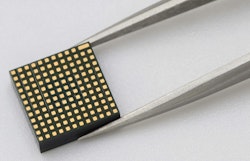
Rather than abandoning facility-level metrics, industry leaders suggest pairing PUE with stage-by-stage efficiency disclosures or demanding granular performance specifications from server vendors. Special attention must be paid to vertical power modules and advanced POL regulation, where high current densities concentrate remaining losses.
Implications for Data Center Operators and Architects
The disconnect between facility-level efficiency and internal server performance carries wide-ranging operational, financial, and environmental implications:
1. Financial Discrepancies
Operators who optimize solely for a PUE target of close to 1.0 may experience an illusion of peak efficiency. If their internal power delivery networks suffer from poor conversion efficiencies at the motherboard level, they are effectively bleeding capital through unmonitored thermal waste.
2. Grid Capacity and Siting Pressures
Global power grids are already feeling the strain of unprecedented data center demand. Inefficient server-internal power delivery exacerbates local grid stress by requiring more total generation capacity to accomplish the same volume of AI model training or inference.
3. Hardware Procurement Shifts
As internal losses become a primary bottleneck for thermal design power (TDP) and performance scaling, procurement teams are shifting how they evaluate hardware vendors. Moving forward, data center architects are being urged to ask direct questions about stage-by-stage conversion efficiencies rather than accepting rated input figures at face value.

4. Regulatory and Sustainability Reporting
Corporate environmental, social, and governance (ESG) reporting often relies heavily on PUE metrics to substantiate green claims. Because internal server losses bypass PUE calculations, organizations may be underreporting their true operational carbon footprint. Establishing a standardized internal efficiency metric could soon become necessary for regulatory compliance and transparent sustainability accounting.
Conclusion
The rapid proliferation of AI infrastructure has fundamentally transformed the parameters of computational power. While PUE remains an invaluable instrument for auditing facility-level overhead, it cannot illuminate the invisible power losses occurring within the server chassis.
By looking past the server door, evaluating stage-by-stage conversion paths, and focusing on point-of-load efficiency, data center operators can bridge the gap between apparent facility greenness and true end-to-end operational sustainability. In the high-density era of artificial intelligence, managing the last few inches of the power delivery network is no longer optional—it is the next frontier of digital efficiency.