HOUSTON, TX — As the commercial space race shifts from mere exploration to the establishment of a robust orbital economy, Axiom Space is cementing its position at the vanguard of space-based infrastructure. The Houston-headquartered human spaceflight and infrastructure specialist has announced significant advancements in its ambitious "orbital compute" strategy, anchored by its flagship Axiom Resilient Compute (ARC) platform.
This development represents a fundamental paradigm shift in how data is processed, managed, and secured beyond Earth’s atmosphere. By pioneering a distributed model for space-based workload orchestration, artificial intelligence and machine learning (AI/ML) processing, and post-quantum secure communications, Axiom Space is addressing one of the most pressing bottlenecks in modern aerospace operations: the tyranny of bandwidth.
Main Facts
The core of Axiom Space’s recent announcement centers on the maturation of its distributed orbital compute infrastructure, highlighted by two pivotal milestones: the successful deployment and operation of on-orbit nodes, and a ground-based demonstration of post-quantum cryptography (PQC) migration.
- Operational On-Orbit Nodes: Axiom currently operates two ARCs in low Earth orbit. Launched earlier this year, these compute units are integrated into Kepler Communications’ optical data relay satellite constellation. The companies have already verified successful ARC-to-ARC and ARC-to-ground communications.
- Post-Quantum Security Migration: In a recent ground test, Axiom successfully migrated a PQC-encrypted workload. This achievement serves as early proof of concept for securing edge networks in space and on Earth against the looming threat of quantum computing decryption capabilities.
- The Bandwidth Bottleneck: Modern satellite sensors and operational systems generate exponentially more telemetry and raw data than legacy communication systems can downlink to terrestrial ground stations during a single pass.
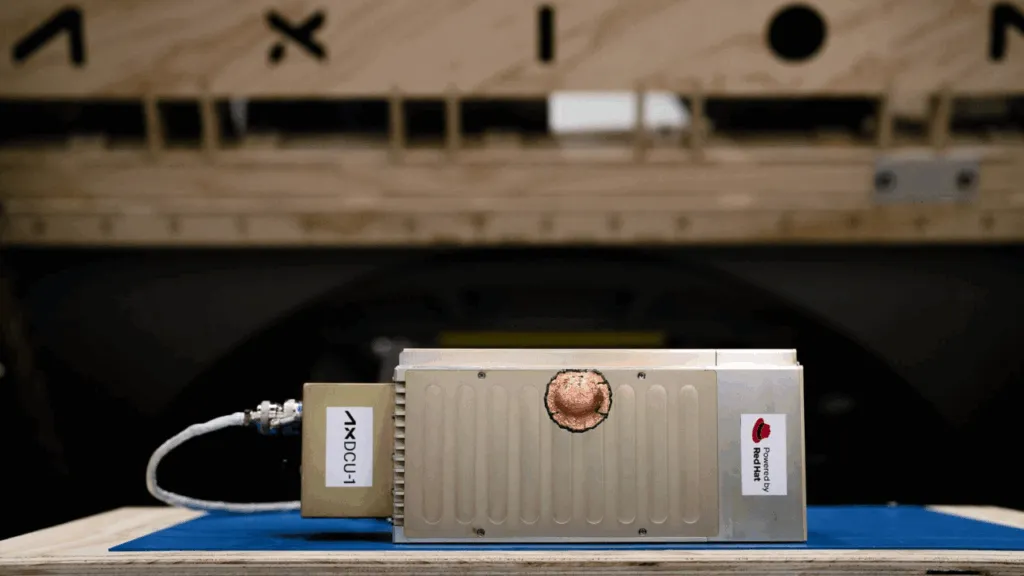
- Strategic Partnerships: The initiative relies heavily on strategic collaborations, notably with Kepler Communications and Red Hat. The latter provided the enterprise-grade foundation (Red Hat’s Device Edge platform) for the Axiom Data Center Unit-1 (AxDCU-1) tested on the International Space Station (ISS).
- Broader Enterprise Context: Axiom Space is one of NASA’s three primary commercial space station partners—alongside Orbital Reef and Starlab—tasked with designing and developing the next generation of commercial orbital destinations to succeed the ISS.
Chronology of the Orbital Compute Evolution
The realization of an orbital data ecosystem has been decades in the making, transitioning from science fiction concepts to rigid engineering roadmaps over the last several years.
Phase 1: Laying the Groundwork (2021–2023)
As commercial constellations proliferated in low Earth orbit (LEO), ground stations quickly became choked with data. Earth-observation satellites, synthetic aperture radar (SAR) systems, and high-resolution optical imagery generators began producing petabytes of data daily. Axiom Space recognized that traditional store-and-forward architectures were unsustainable. The company began conceptualizing a decentralized framework where data could be filtered, analyzed, and acted upon directly in orbit.
Phase 2: The ISS Data Center Demonstration (August 2024)
A major milestone occurred when the Axiom Data Center Unit-1 (AxDCU-1) was launched to the International Space Station. Developed as an ISS National Lab technology demonstration in partnership with Red Hat, the AxDCU-1 was designed to test localized processing and data storage within a microgravity environment. Running on Red Hat Device Edge, this unit validated that commercial-grade containerized workloads could survive the harsh thermal and radiation environment of space while executing complex computing tasks.
Phase 3: Kepler Constellation Deployment (Early 2025)
Moving beyond the confines of the ISS, Axiom expanded its footprint by integrating two ARC nodes into Kepler Communications’ optical data relay constellation earlier this year. This deployment marked the transition from isolated testing on the space station to a networked, distributed architecture. By leveraging Kepler’s optical links, the ARC nodes established operational ARC-to-ARC and ARC-to-ground communication capabilities.
Phase 4: Quantum-Resistant Milestones (Late 2025–Present)
Most recently, Axiom achieved a breakthrough in cybersecurity infrastructure by successfully executing a post-quantum cryptography workload migration in a ground-based simulation. This step ensures that data processed at the orbital edge will remain secure even as quantum computing advances to a point where legacy encryption standards become obsolete.
Supporting Data and Technical Architecture
The technical challenge Axiom Space is solving lies in the physics of data transmission and orbital mechanics. Satellites in LEO travel at approximately 17,500 miles per hour, maintaining line-of-sight with any given terrestrial ground station for only a fraction of their orbit—typically 8 to 12 minutes.
The Mathematics of Data Saturation
According to Axiom Space leadership, modern satellite payloads routinely outstrip the downlink capacity of radio frequency (RF) and optical links.
- A single hyperspectral imaging satellite can generate hundreds of gigabits of data per minute.
- Terrestrial ground station networks suffer from geographic limitations, weather interference, and limited contact windows.
- Transmitting raw data down to Earth for processing, only to send analytical commands back up, introduces unacceptable latency for time-sensitive applications such as maritime tracking, disaster response, and tactical defense operations.
The ARC and AxDCU-1 Specifications
The Axiom Resilient Compute platform and the AxDCU-1 unit are engineered to bypass these limitations through edge computing. By embedding robust processing nodes directly into the satellite bus, spacecraft can perform initial AI/ML inference—such as cloud masking, anomaly detection, or object classification—in orbit.
- Edge Processing: Only the refined metadata or actionable insights are downlinked, reducing required bandwidth by orders of magnitude.
- Containerized Workloads: Utilizing Red Hat Device Edge, the architecture allows developers to deploy standard Linux-based containers in space seamlessly, lowering the barrier to entry for space-based software development.
- Optical Networking: By pairing ARC with Kepler’s optical data relay network, data can hop between satellites in orbit before finding an optimal downlink path, creating a true mesh network in space.
Official Responses and Industry Perspectives
The convergence of cloud computing, edge processing, and commercial spaceflight has elicited strong reactions from aerospace and technology executives.
Dr. Jonathan Cirtain, CEO and President of Axiom Space, emphasized that the future of space infrastructure lies in reducing, rather than merely expanding, bandwidth dependencies.
"Satellite sensor and operations systems generate more data than communication systems can transmit to ground stations during an orbit," stated Dr. Cirtain. "The capacity to generate space-based data will only increase, and the solution isn’t just more bandwidth, it’s less dependence on bandwidth in the first place, by securely processing data close to where it’s captured. That’s the problem ARC exists to solve."
The integration with Kepler Communications has further amplified the reach of Axiom’s compute strategy. Caitlin Marsh, recently appointed President of Kepler U.S., highlighted how on-orbit computing fundamentally changes the value proposition for commercial satellite customers.
"Our customers need security now more than ever," said Marsh. "On-orbit compute is a core capability of Kepler’s constellation, supporting customer workloads such as orchestration and AI/ML processing in space. This capability is already in orbit and works with Kepler’s optical data relay network to get customers the data they need, when they need it, while helping to futureproof their operations for a changing security landscape."
Details surrounding Axiom’s broader strategic maneuvers also point toward deep integration with academic and institutional research. The company recently expanded its University Alliance program to include institutions such as the University of Edinburgh and King’s College London (KCL), signaling a concerted effort to cultivate the next generation of aerospace software and hardware engineers.
Implications for the Future of Commercial Spaceflight
Axiom Space’s progress on its orbital compute strategy carries profound implications for multiple sectors, ranging from telecommunications and national security to commercial space station development.
1. The Commercial Space Station Transition
As NASA prepares to deorbit the International Space Station by the end of the decade, commercial partners are racing to build habitable platforms that can support microgravity research and manufacturing. Axiom Space, alongside competitors Orbital Reef and Starlab, is designing these next-generation orbital destinations.
The integration of advanced data centers like the AxDCU-1 into these designs suggests that future commercial space stations will not merely be laboratories for materials science or biology; they will function as high-performance computing hubs. In a microgravity environment, certain electronics can operate with altered thermal management profiles, and the sheer altitude offers unique advantages for global data routing.
2. National Security and Post-Quantum Resilience
The successful migration of post-quantum cryptography workloads addresses a terrifying prospect for governments and enterprises: "Harvest Now, Decrypt Later" attacks. Adversaries are currently intercepting and storing encrypted satellite communications with the expectation that future quantum computers will break today’s RSA and ECC encryption. By proving that PQC can be deployed at the edge in space, Axiom and Kepler are establishing a blueprint for sovereign, quantum-secure orbital networks.
3. Democratization of Space Software
Historically, writing software for space applications required bespoke, radiation-hardened operating systems and grueling validation processes that took years. By utilizing platforms like Red Hat Device Edge within the ARC and AxDCU ecosystems, Axiom is lowering the barrier to entry. Developers can write standard AI/ML models on Earth and deploy them directly to nodes in orbit. This capability opens the door for commercial software developers, FinTech firms, agricultural monitors, and climate scientists to leverage real-time orbital analytics without needing to build custom aerospace hardware.
Looking Ahead
Axiom Space’s multi-pronged approach—combining human spaceflight infrastructure, commercial station development, and resilient orbital computing—positions the company as a foundational architect of the space economy. As the Kepler-integrated ARC nodes continue to process workloads and validate optical mesh routing, the vision of a self-sustaining, secure, and intelligent orbital data center moves rapidly from concept to operational reality.