In the high-stakes world of Consumer Packaged Goods (CPG), where consumer loyalty is fleeting and product cycles are relentless, manufacturing efficiency is the difference between market leadership and obsolescence. Yet, despite the industry’s push toward Industry 4.0, a staggering 18% of total product costs in U.S. CPG manufacturing is currently being cannibalized by preventable delays, unplanned downtime, and systemic inefficiencies.
According to Neil Smith, Segment President of Consumer Packaged Goods at Schneider Electric, the solution to this profit-draining phenomenon is not necessarily a heavier investment in generative AI or advanced machine learning models. Instead, the solution lies in the fundamental task of data connectivity. In a recent interview with IIoT World, Smith argued that CPG manufacturers are suffering from a "data paradox": they have more information than ever before, yet it remains siloed, manual, and disconnected, rendering it useless for predictive analysis.
The Hidden Tax: The Financial Impact of Disconnected OEE
The core metric for manufacturing health is Overall Equipment Effectiveness (OEE). For decades, OEE has served as the industry standard for measuring how well a production line performs relative to its theoretical capacity. However, the methodology used to track OEE in many CPG plants is shockingly antiquated.
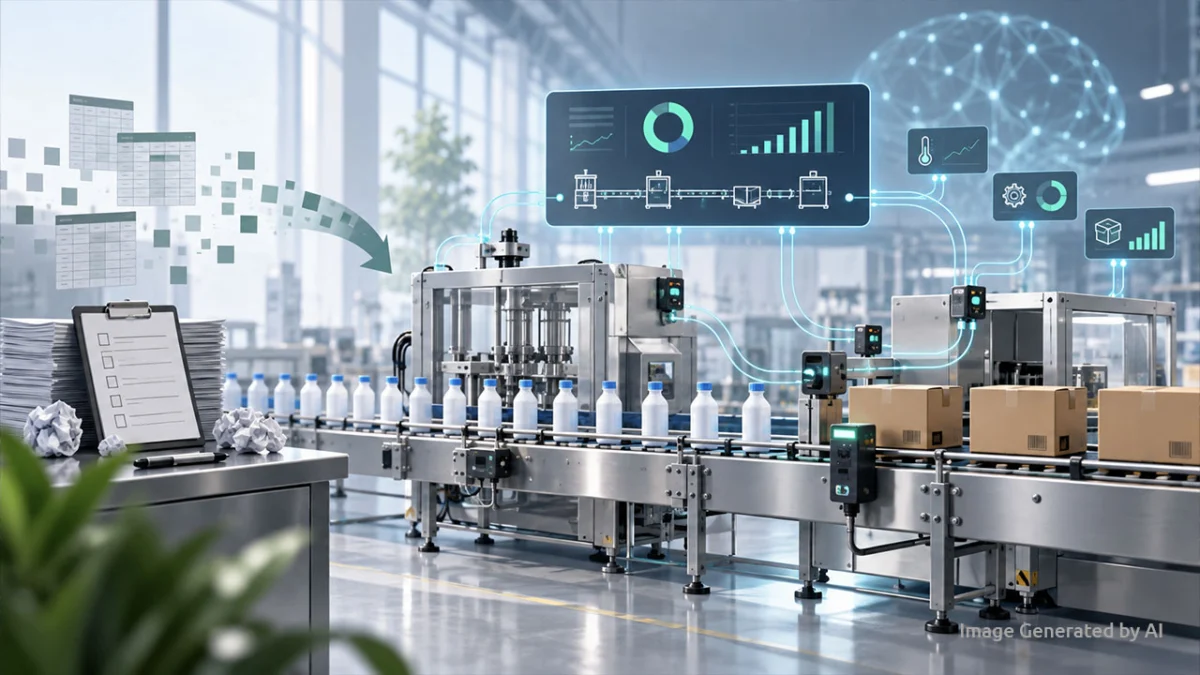
Across the U.S. manufacturing landscape, many production facilities still rely on a "paper-and-pencil" approach. Operators document downtime on clipboards, which are later transcribed into offline spreadsheets or disconnected legacy software. This creates a temporal gap between the event occurring and the data being analyzed.
When a production line stalls, operators are typically tasked with manually assigning "reason codes" to explain the stoppage. This process is inherently subjective and prone to human error. If an operator is busy fixing a jam, the reason code might be assigned hours later—or not at all—leading to inaccurate reporting. Because this data exists in isolated systems, it cannot reveal the hidden patterns behind recurring production problems. Information sits in digital silos, unable to communicate with other parts of the plant floor or the enterprise, preventing the cross-referencing necessary to identify root causes.
Chronology of a Digital Transformation: From Manual to Autonomous
The path to a smart, efficient factory does not begin with an AI rollout. It follows a distinct, logical chronology that prioritizes infrastructure before intelligence.
Phase 1: Establishing the Data Backbone (The Connectivity Layer)
Before any AI model can "learn," it must have access to a clean, continuous stream of data. The initial priority for CPG manufacturers is the automation of reason code allocation and the integration of OEE tracking systems into a unified plant network. This involves replacing manual entries with automated sensor-based reporting that captures machine states in real-time.
Phase 2: The Correlation Era (The Analytical Layer)
Once connectivity is established, the data becomes actionable. With integrated systems, manufacturers can perform sophisticated cross-system causality analysis. For example, a recurring jam on a carton infeed might seem like a mechanical issue. However, once data flows across systems, the software can correlate that jam with floor humidity, ambient temperature, or specific shift patterns. What was once viewed as a maintenance problem is revealed to be a process control problem.
Phase 3: The AI and Predictive Layer (The Optimization Layer)
Only after the data architecture is unified should manufacturers deploy sophisticated AI models. These models act as an amplifier, building upon the "first generation of AI"—which many in the industry recognize as advanced process control—to provide predictive insights, automated adjustments, and long-term strategic forecasting.
Supporting Data: The Capability Gap
To understand the transformation required, one must look at the transition from current manual processes to the target state of a fully connected, software-defined enterprise.
| Capability | Current State (Manual) | Target State (Connected) |
|---|---|---|
| OEE Tracking | Offline spreadsheets, clipboards | Connected, real-time automated systems |
| Reason Codes | Manual operator allocation | Automated, sensor-driven pattern detection |
| Data Correlation | Isolated per sensor or PLC | Cross-system, holistic causality analysis |
| Decision Execution | Human-in-the-loop (slow) | AI-guided supervision and approval |
This transition highlights that the "intelligence" of the factory is not just about the software; it is about removing the friction between the data source and the decision-maker.
The Role of Software-Defined Automation (SDA)
A significant hurdle in this transformation is the "closed loop" problem. Even if an AI platform identifies that a machine set point needs adjustment, there is often no native, secure path to transmit that instruction back to the physical equipment, especially in plants running legacy control systems.
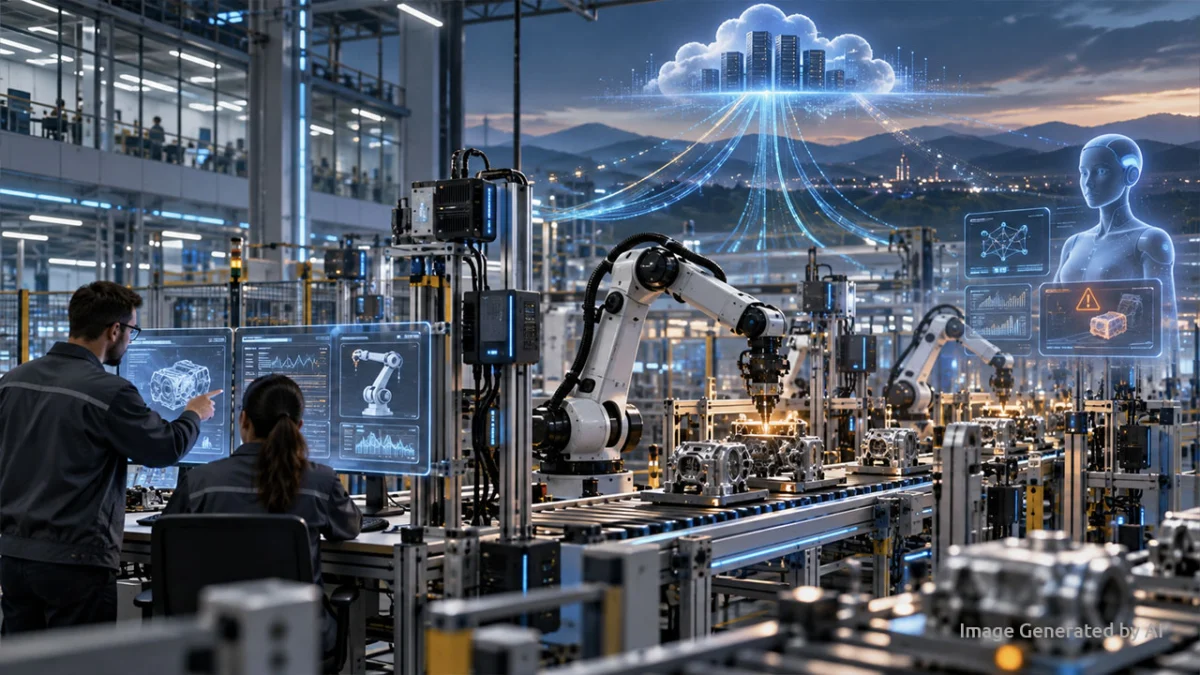
This is where open, software-defined automation (SDA) becomes critical. SDA acts as an "action broker" that sits between enterprise-level AI platforms and the shop-floor equipment. By utilizing open standards, SDA allows manufacturers to interface with existing programmable logic controllers (PLCs) while gradually migrating to a native, more flexible platform. This allows for a modular, low-risk approach to digital transformation, enabling companies to restart lines, optimize yield, and adjust set points without a massive, "rip-and-replace" capital expenditure.
Preserving Intellectual Capital: The Human Element
A common misconception regarding AI in manufacturing is that it is intended to replace the workforce. Neil Smith offers a different perspective: AI should be used to capture and preserve the invaluable institutional knowledge of the aging manufacturing workforce.
"Who knows your plant better than anyone else in the enterprise?" Smith asks. "It’s the guys running it."
As experienced plant operators reach retirement age, they take decades of "tribal knowledge"—the nuance of how a machine sounds before it fails or how a specific product batch behaves in high humidity—with them. By connecting human expertise with automated systems, manufacturers can encode this institutional knowledge into their digital infrastructure. When AI is trained on data validated by these experts, it becomes an extension of their experience rather than a replacement for it. This creates a symbiotic relationship where the AI gains the "wisdom" of the operator, and the operator gains the "scale" of the AI.
Implications for the Future of CPG
The implications of this shift are profound. For the CPG industry, the goal of digitization is not to build a "lights-out" factory, but to build a responsive one. As consumer demands shift toward personalized, sustainable, and varied product offerings, manufacturers must deal with increasingly frequent line changeovers.
In a manual environment, frequent changeovers are a nightmare for efficiency. In a connected, AI-optimized environment, these changeovers can be managed through predictive scheduling and automated set-point adjustments, significantly reducing the "downtime tax" that currently consumes nearly a fifth of total production costs.
Furthermore, as global supply chains remain volatile, the ability to rapidly optimize production based on real-time inputs—such as raw material quality or energy costs—will separate the industry leaders from those struggling with margin compression.
Conclusion: The Path Forward
The message from industry experts is clear: stop buying AI tools and start building data foundations. The allure of advanced machine learning is strong, but without the connectivity to support it, it is merely a high-tech veneer on a broken process.
For CPG manufacturers, the roadmap is defined by connectivity, standardization, and the integration of human expertise into digital workflows. By automating the data flow from the shop floor to the cloud, and by utilizing software-defined automation to close the loop between analysis and action, manufacturers can finally unlock the 18% of value currently lost to the digital void.
This article is based on a video interview with Neil Smith, Segment President, Consumer Packaged Goods at Schneider Electric, and Lucian Fogoros of IIoT World. AI tools were used to help summarize and organize the content. Reviewed and edited by the IIoT World editorial team.