By William G. Wong
Senior Content Director — Electronic Design and Microwaves & RF
Introduction: A Larger Footprint for Industrial Innovation
The landscape of edge computing, industrial automation, and ruggedized system design continues to evolve at a breakneck pace. This year’s Embedded World North America (EWNA 2026) in Anaheim, California, proved to be significantly larger and more dynamic than its predecessors. The exhibition floor featured a comprehensive showcase of pioneering hardware, advanced software solutions, and an ever-present emphasis on artificial intelligence (AI) integration at the far edge.
While general-purpose consumer electronics frequently grab headlines, the foundational hardware driving industrial, aerospace, automotive, and IoT systems requires an entirely different engineering philosophy. This hardware must withstand extreme environmental conditions, offer long lifecycles, and deliver deterministic, low-latency performance.
A thorough review of the show floor reveals several distinct engineering trends shaping the future of embedded design:
- Ruggedization and Reliability: Higher reliability demands mean utilizing components engineered for broad thermal envelopes and severe shock and vibration tolerances, which naturally introduces a higher initial cost offset by minimized field failures.
- Modular Architectures: Manufacturers are increasingly relying on core compute modules that pair with application-specific carrier boards, allowing engineers to balance customization with accelerated time-to-market.
- Advanced Networking: The widespread adoption of higher-speed Ethernet ports coupled with time-sensitive networking (TSN) is transforming deterministic control in industrial networks.
- Pervasive Peripheral Expansion: M.2 slots have firmly established themselves as the standard form factor for peripheral expansion, accommodating fast NVMe solid-state drives (SSDs) and dedicated AI inference accelerators.
- Edge AI Integration: AI-enabled processors and high-performance neural processing units (NPUs) have transitioned from specialized novelties to baseline requirements across multiple compute tiers.
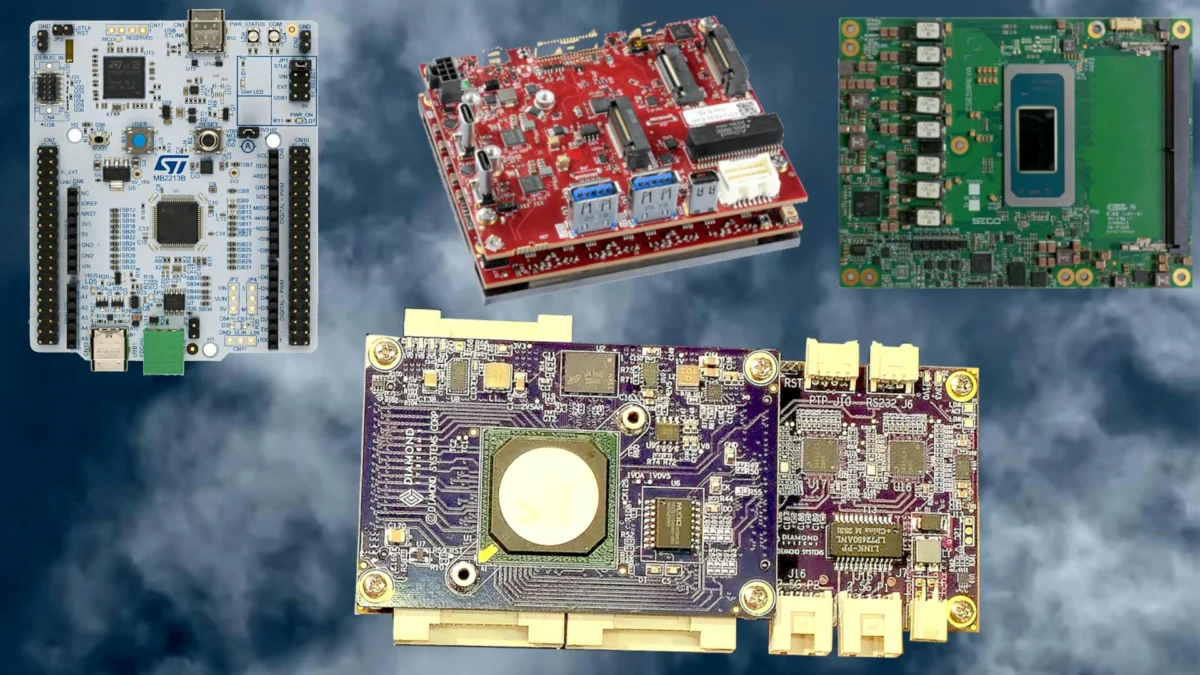
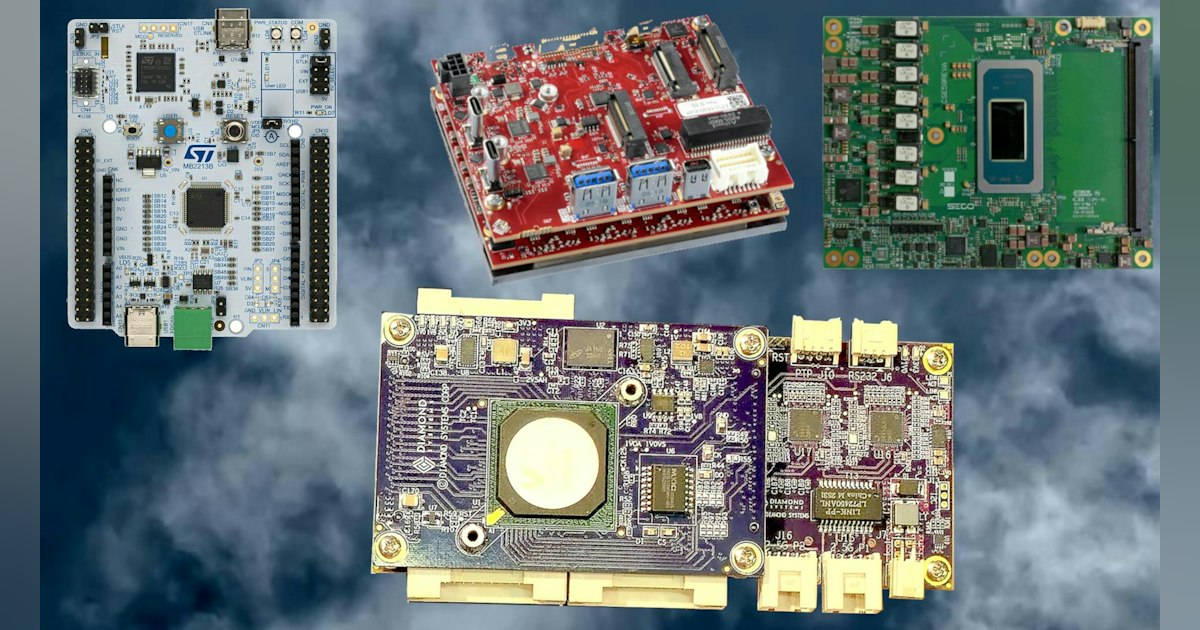
Below is an in-depth look at four standout hardware items that captured the attention of systems engineers and developers at EWNA 2026.
1. Main Facts: STMicroelectronics STM32C5 Microcontroller
High Performance Meets Ultra-Low Power Consumption
At the microcontroller level, STMicroelectronics introduced the STM32C5, an advanced low-cost, low-power processing solution built around a 144-MHz Arm® Cortex®-M33 core. Designed to bridge the gap between high-end application processors and traditional resource-constrained MCUs, the chip integrates 1 MB of flash memory, 256 kB of RAM, 64 kB of data flash, and 4.5 kB of one-time programmable (OTP) memory.

To accelerate compute-heavy mathematical operations—such as motor control and digital power conversion—the chip features an integrated floating-point unit (FPU) alongside a dedicated CORDIC math processor designed to accelerate trigonometric functions.
Key Technical Specifications:
- Power Efficiency: Dynamic power consumption drops below 80 µA/MHz, making it ideal for battery-monitored and energy-sensitive environments.
- Clock Precision: An integrated, 1% calibrated RC oscillator across a -20°C to 105°C temperature range minimizes the external bill-of-materials (BOM) cost and is offered in ultra-compact packages as small as 3 × 3 mm.
- Connectivity Options: The device supports 10/100 Ethernet, dual FD-CAN interfaces, USB 2.0 host/device configurations, and an octal SPI interface compatible with high-performance HyperFlash and HyperRAM memory architectures. Serial communication includes a single I3C port and dual $I^2C$ ports.
- Analog Capabilities: Three 12-bit analog-to-digital converters (ADCs) support up to 30 channels operating at 2.25 MSPS (or up to 4.5 MSPS in dual interleaved mode), complemented by a single 12-bit digital-to-analog converter (DAC) and an integrated comparator.
Robust Hardware Security Architecture
Recognizing the escalating importance of edge security, STMicroelectronics embedded a comprehensive hardware security framework within the STM32C5. The architecture features dual AES coprocessors equipped with differential power analysis (DPA) resistance, hardware-based accelerators for complex hash functions and public keys, a true random number generator (TRNG), and a 96-bit unique device identifier.
Development Ecosystem
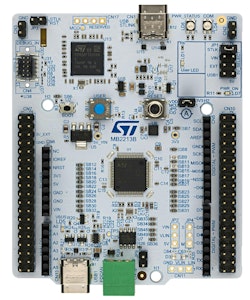
To simplify prototyping, STMicroelectronics offers the STM32C5 Nucleo board. This development platform hosts the STM32C series microcontroller and incorporates both Arduino Uno V3 headers and ST Morpho headers for flexible expansion. The hardware is fully supported by ST’s established STM32Cube IDE and comprehensive software ecosystem.
2. Chronology and Evolution: Diamond Systems EPS-12002C Managed Ethernet Switch
Ruggedized Networking for Extreme Environments
As industrial automation migrates toward high-bandwidth sensor arrays and real-time machine vision, network infrastructure must keep pace. Diamond Systems used EWNA 2026 to showcase its EPS-12002C Managed Ethernet Switch, a high-reliability switching solution purpose-built for harsh environments, including transportation, military, and heavy industrial applications.
The switch can be configured with up to two 2.5G ports and either eight or twelve 1G ports. Designed for efficient thermal management, it operates reliably when coupled with an external heatsink or heat spreader. For deployments requiring fiber-optic backbone connectivity, the companion EPS-12002L variant adds support for high-speed 10G SFP+ sockets.
Protocol Support and Mechanical Resilience
Operating primarily as a Layer 2+ switch, the EPS-12002C also executes sophisticated Layer 3 routing and switching functions. It features native support for the IEEE-1588 Precision Time Protocol (PTP), ensuring tight synchronization across distributed nodes.

- Environmental Hardening: The switch operates reliably across an extended thermal range of -40°C to +85°C.
- Mechanical Durability: To withstand severe operational shocks, all connections utilize latching I/O connectors that comply strictly with MIL-STD-202G shock and vibration standards.
- Power and Configuration: The unit accepts a wide DC input voltage range from 5V to 36V. Initial system setup and configuration are handled via a dedicated RS-232 serial port, while ongoing management is facilitated through an intuitive GUI-based configuration software suite.
3. Supporting Data: SECO SOM-COMe-BT6-PTL COM Express Module
Unleashing Intel Core Ultra Series 3 at the Edge
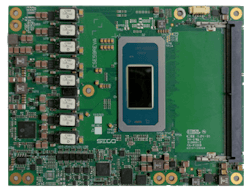
For applications demanding substantial computing horsepower in a standardized modular format, SECO highlighted its SOM-COMe-BT6-PTL, a COM Express Type 6 module powered by Intel’s Core Ultra Series 3 processors (codenamed Panther Lake-H).
This generation of processors represents a massive leap forward for edge AI deployments. The integrated Intel graphics processing unit (GPU) features a dozen Xe cores capable of delivering up to 180 TOPS (Tera Operations Per Second), while the dedicated low-power neural processing unit (NPU) contributes an additional 50 TOPS of AI inference capacity.
High-Speed I/O and Memory Subsystems
The SOM-COMe-BT6-PTL is engineered to handle massive data throughput:
- Memory Architecture: Dual DDR5 SO-DIMM slots support up to 96 GB of memory using high-speed DDR5-5600 modules.
- Expansion Bus: The module exposes 20 PCI Express lanes, enabling extensive peripheral integration.
- Peripheral Connectivity: It provides eight high-speed USB ports, four 10-Gb/s SuperSpeed ports, and dual 40-Gb/s USB 4 ports.
- Networking and Storage: A native 2.5G Ethernet port incorporates time-sensitive networking (TSN) capabilities. For high-reliability data storage, users can specify an optional soldered-down 1TB NVMe SSD.
- Operating System Support: The module is fully compatible with standard enterprise Linux distributions, SECO’s proprietary Clea OS, and Windows 10 IoT Enterprise.
4. Official Responses and Industry Implications: VersaLogic Raptor
Compact Computing Meets Military-Grade Durability
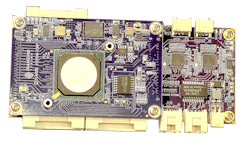
Rounding out the hardware highlights from EWNA 2026 is VersaLogic’s Raptor, a compact single-board computer (SBC) adhering to the COM-HPC Mini form factor (measuring just 80 × 95 mm). Despite its remarkably small footprint, the Raptor is built to satisfy rigorous MIL-STD-202H shock and vibration specifications.
Processor Options and Storage Flexibility
The Raptor is offered with two distinct processor configurations depending on performance and power requirements:
- Intel U300e paired with integrated Intel UHD Graphics.
- Intel Core i5-1345URE paired with higher-performance Iris Xe graphics.
Storage and expansion capabilities are particularly striking for a board of this size. The Raptor features a pair of M.2 2242 slots alongside a standard M.2 2280 slot, providing immense flexibility for local NVMe storage or specialized hardware add-ins. Through these M.2 M-key slots, developers can also implement custom analog-to-digital conversion (ADC) channels or Controller Area Network (CAN) bus interfaces.
Robust Industrial Communication
Communication capabilities on the Raptor are tailored for mission-critical deployments. The board features two magnetically isolated 2.5G Ethernet ports equipped with secure latching sockets and full support for time-sensitive networking (TSN).
USB connectivity is similarly expansive, comprising eight USB 2.0 ports, two USB 3.2 ports, and two USB 4.0 ports, alongside dual legacy serial ports for industrial equipment interfacing.
Implications: The Road Ahead for Embedded Systems
The hardware unveiled at Embedded World North America 2026 points to a clear trajectory for the electronics engineering community. As edge devices absorb increasingly complex workloads—driven largely by computer vision, localized machine learning, and predictive maintenance algorithms—the traditional boundaries between microcontroller units and application processors continue to blur.
Engineers are no longer forced to choose between the extreme power efficiency of basic MCUs and the high processing capability of multi-core industrial PCs. Instead, modern components like STMicroelectronics’ STM32C5 offer sophisticated mathematical accelerators and robust security features within a tiny thermal footprint. Simultaneously, modular standards championed by companies like SECO and VersaLogic ensure that systems architects can rapidly integrate cutting-edge silicon—such as Intel’s Panther Lake processors—into rugged, vibration-resistant enclosures designed for deployment in transportation, aerospace, and factory automation.
Ultimately, the convergence of TSN-enabled high-speed networking, ubiquitous M.2 NVMe and accelerator slots, and deeply integrated AI hardware ensures that the next generation of embedded systems will be faster, smarter, and more resilient than ever before.