In an era defined by economic volatility, supply chain disruptions, and relentless competitive pressure, manufacturing leaders face a recurring, high-stakes question: Are the operational decisions made on the plant floor directly translating into measurable financial success?
For decades, the factory floor and the corporate boardroom operated in relative isolation. Production managers focused on throughput, uptime, and scrap rates, while financial executives tracked margins, cash flow, and return on investment (ROI). Today, however, that traditional divide is rapidly dissolving. Modern manufacturing demands real-time synchronization between physical operations and financial performance.
To explore this convergence, research firm Tech-Clarity has released findings from a comprehensive survey of more than 400 manufacturing professionals. The data reveals a compelling narrative: strategic investments in manufacturing operations software and artificial intelligence (AI) are no longer just technological upgrades—they are fundamental drivers of profitability.
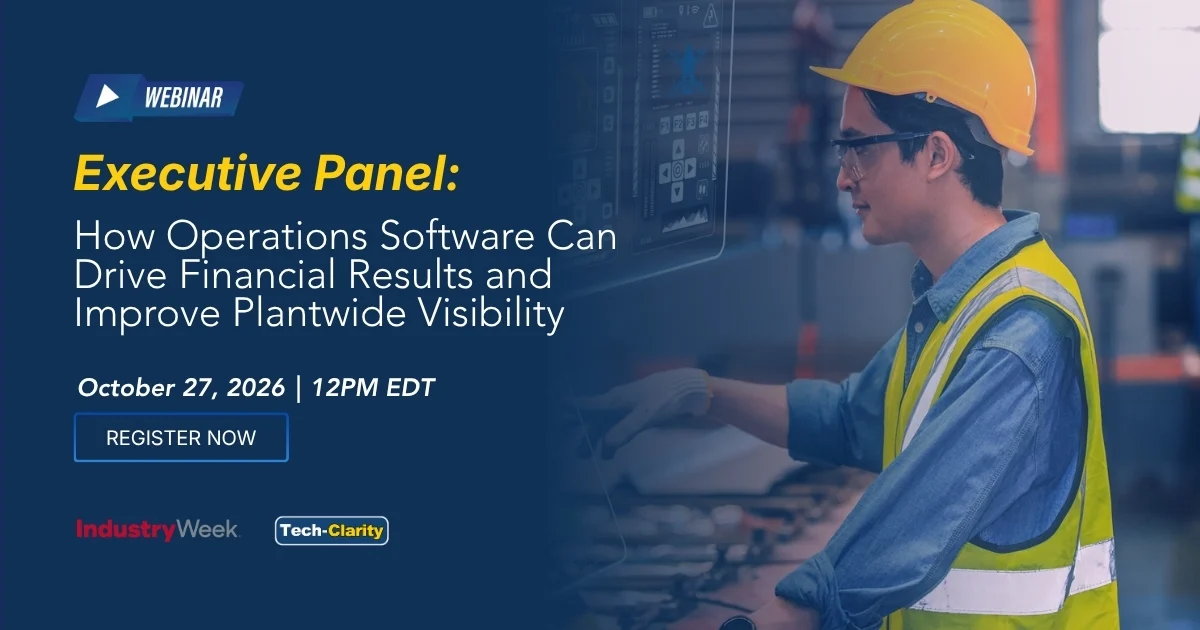
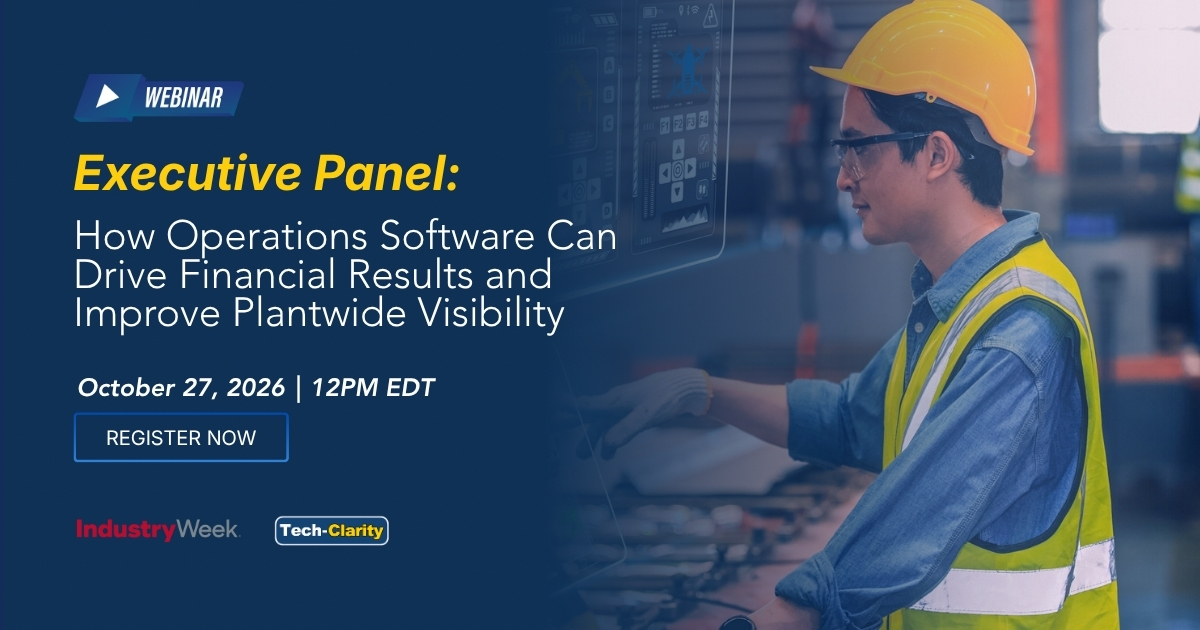
To unpack these insights, IndustryWeek is hosting an exclusive, panel-style executive webinar on October 27, 2026, at 12:00 PM Eastern Time. Titled “How Operations Software Can Drive Financial Results and Improve Plantwide Visibility,” the event will bring together industry veterans and data analysts to examine how digital transformation is reshaping plant floors of all sizes.
Main Facts: The ROI of Digital Transformation
At the heart of the upcoming webinar is a central thesis: operations software—encompassing production execution, maintenance management, quality control, and inventory tracking—delivers tangible, rapid financial returns.
According to Tech-Clarity’s new research, organizations that implement modern manufacturing operations software and AI solutions do not have to wait years to see the value of their investments. Concrete benefits routinely materialize within a year of deployment, and in some accelerated cases, organizations report measurable returns in as little as three months.
Key highlights of the upcoming discussion include:
- The Speed to Value: How modern software architectures and cloud deployments have shortened the time-to-value for manufacturers.
- Plantwide Visibility: Breaking down data silos to provide executives, plant managers, and floor operators with a single source of truth.
- AI’s Practical Role: Moving beyond the hype of artificial intelligence to explore how machine learning algorithms optimize maintenance schedules, predict quality defects, and streamline supply chains.
- Real-World Accountability: Evaluating whether software investments are genuinely living up to pre-implementation expectations across small, mid-market, and enterprise-level manufacturing environments.
Chronology: The Evolution of Plant Floor Intelligence
To understand why the findings from Tech-Clarity’s 400-person survey are generating such significant industry interest, it is helpful to look at how manufacturing software has evolved over the past quarter-century.
Phase 1: The Siloed Era (Late 1990s – Early 2010s)
Historically, manufacturing technology was highly fragmented. Enterprise Resource Planning (ERP) systems managed top-level business logic, while disparate point solutions—such as standalone Computerized Maintenance Management Systems (CMMS) or legacy Manufacturing Execution Systems (MES)—managed the plant floor. Data transfer was often manual, leading to lag times, human error, and a distinct lack of cross-functional visibility. Decisions were frequently made using yesterday’s data to solve today’s crises.
Phase 2: The Push for Integration (Mid 2010s – Early 2020s)
As Industry 4.0 concepts gained traction, manufacturers began recognizing the necessity of integration. Companies invested heavily in bridging the gap between Operational Technology (OT) and Information Technology (IT). While this improved data flow, implementations were often notoriously complex, expensive, and prolonged, sometimes taking multiple years before delivering a clear financial return.
Phase 3: The Modern Era of Rapid-Value Operations Software and AI (Present Day)
Today, the paradigm has shifted dramatically. Driven by cloud computing, modular software architecture, and the infusion of practical artificial intelligence, modern operations platforms can be deployed iteratively. As Tech-Clarity’s research underscores, this new wave of technology is characterized by unprecedented speed-to-value. Manufacturers are no longer waiting half a decade to see ROI; they are reaping financial and operational rewards within months. The upcoming October 2026 webinar captures this exact inflection point in the industry’s digital maturity.
Supporting Data: What the Tech-Clarity Survey Reveals
While the full scope of Tech-Clarity’s research will be unpacked during the live webinar, the baseline metrics paint an encouraging picture for industrial organizations hesitant to commit capital to digital transformation initiatives.
1. Speed to ROI
Traditional enterprise software had a reputation for lengthy, painful deployment cycles where financial payback was a distant horizon. Tech-Clarity’s survey of over 400 industry professionals demonstrates that modern operations software shatters this timeline:
- The 3-Month Benchmark: A significant subset of respondents reported achieving measurable improvements in efficiency, cost reduction, or output within just 90 days of going live.
- The 1-Year Horizon: The vast majority of successful adopters cross the threshold of positive ROI within their first 12 months, proving that rapid deployment models are yielding sustainable business value.
2. The Multi-Faceted Impact on Operations
Manufacturers deploy operations software for various reasons, but the survey highlights that value is typically unlocked across four core pillars:
- Production Execution: Ensuring orders are tracked accurately from raw material intake to finished goods, minimizing bottlenecks and maximizing machine utilization.
- Maintenance: Transitioning from reactive firefighting to predictive maintenance, thereby reducing costly unplanned downtime.
- Quality Management: Catching defects earlier in the production lifecycle to drastically lower scrap rates, rework costs, and warranty claims.
- Inventory Control: Optimizing stock levels to free up working capital without risking stockouts on the assembly line.
Official Responses and Perspectives: Learning from the Front Lines
Statistics and survey data provide the macro view, but execution happens at the micro level. A major focal point of the IndustryWeek panel will be the lived experiences of manufacturing executives who have navigated these software rollouts firsthand.
Rather than listening to software vendors pitch theoretical capabilities, attendees will hear directly from operational leaders who have deployed plantwide and operations-wide systems across diverse manufacturing environments. These panelists will pull back the curtain on:

- Overcoming Cultural Resistance: How they guided workforces through technological change and fostered a culture of data-driven decision-making.
- Navigating Implementation Pitfalls: Honest accounts of what went right, what went wrong, and the lessons learned along the way.
- Measuring Success: The specific Key Performance Indicators (KPIs) they tracked to prove to their boards of directors that the software investments were delivering on their promises.
These seasoned professionals represent companies of all sizes, ensuring that the insights shared are actionable whether the listener manages a single-site custom fabrication shop or a global network of smart factories.
Implications: Why This Matters for the Future of Manufacturing
The intersection of operations software, AI, and financial performance carries profound implications for the manufacturing sector at large.
1. Democratization of Advanced Technology
Historically, advanced plant-floor visibility and AI-driven analytics were luxuries reserved for Fortune 500 multinationals with massive IT budgets. However, as modular software solutions and cloud delivery models mature, small and mid-sized manufacturers (SMMs) are increasingly able to harness these tools. The Tech-Clarity survey, which encompasses feedback from across the manufacturing spectrum, signals that digital agility is becoming a baseline requirement for competitiveness, regardless of company size.
2. Redefining the Role of Plant Managers
As software automates data collection and AI offers predictive recommendations, the role of the plant manager is evolving. Instead of spending hours chasing down paperwork, compiling shift reports, or reacting to emergencies, leaders can focus on strategic optimization, workforce development, and continuous improvement. Enhanced visibility empowers decentralized decision-making, allowing floor-level supervisors to take corrective action before minor issues escalate into major financial liabilities.
3. Strengthening Boardroom Confidence
When operational metrics and financial outcomes speak the same language, the conversation between plant managers and chief financial officers (CFOs) changes. Proving that an investment in an AI-powered maintenance tool or a real-time execution system directly correlates to margin expansion makes securing future capital budgets significantly easier.
How to Participate
For manufacturing leaders, operations directors, IT professionals, and financial executives looking to benchmark their digital strategies against industry peers, this webinar offers a high-value opportunity.
- Event: Executive Panel Webinar: How Operations Software Can Drive Financial Results and Improve Plantwide Visibility
- Host: IndustryWeek in partnership with Tech-Clarity
- Date: October 27, 2026
- Time: 12:00 PM Eastern Time
- Registration: Industry professionals can secure their spot by visiting the official registration page via IndustryWeek’s webinar portal.
As the manufacturing landscape continues to evolve at a blistering pace, bridging the gap between the shop floor and the balance sheet is no longer optional—it is the definitive hallmark of market leaders.