The integration of artificial intelligence into core industrial workflows has officially moved past the era of isolated pilot projects and theoretical proof-of-concepts. Across the engineering, design, and manufacturing sectors, recent developments signal a profound structural shift: GPU acceleration, graph neural networks, conversational AI agents, OpenUSD-based digital twins, and pre-trained Large Physics Models are being embedded directly into the mainstream enterprise software stack.
From automotive tire design and semiconductor fabrication to large-scale factory floor orchestration and aerospace-grade physics simulation, industry leaders are leveraging AI not merely to automate repetitive tasks, but to fundamentally compress iteration loops, shatter departmental silos, and solve computationally intractable engineering challenges.
This comprehensive briefing examines the primary technological breakthroughs driving this industrial transformation, detailing the core facts, supporting datasets, chronological milestones, official responses, and long-term implications for engineers, operators, and enterprise leaders.
1. Main Facts: The Core Technological Breakthroughs
Recent announcements from pioneering technology providers, Tier-1 industrial firms, and specialized AI developers highlight five distinct areas where artificial intelligence is delivering dramatic efficiency gains:
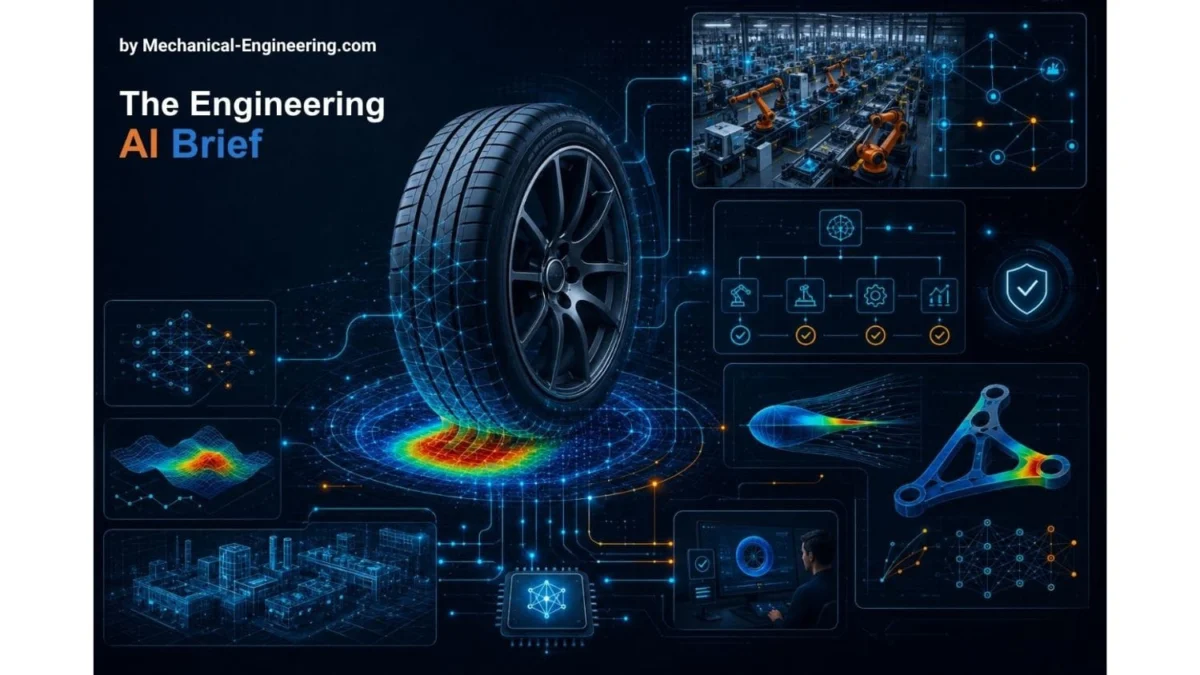
- Dunlop and Fujitsu’s AI Surrogate Model: Dunlop and Fujitsu have successfully developed an AI surrogate model for tire structural analysis utilizing graph neural networks (GNNs). Trained on accumulated finite element method (FEM) results and proprietary design data, the model predicts tire deformation, contact shape, and pressure distribution with an average 87.7% accuracy compared to traditional FEM workflows. Most notably, the model processes roughly 600,000 mesh elements in just 5 minutes—slashing analysis time by approximately 90% from the conventional 45-minute benchmark. Dunlop aims to transition this into a commercial design support tool by April 2027, with Fujitsu actively testing its execution efficiency on its energy-efficient FUJITSU-MONAKA processor.
- Plataine’s Conversational AI Agents for Factory Optimization: Plataine has integrated next-generation conversational AI agents into its Total Production Optimization suite. Moving beyond static manufacturing execution system (MES) dashboards, these agents monitor planning, scheduling, materials, assets, labour, and execution in real time. When disruptions occur—such as material delays, equipment breakdowns, or labor shortages—the system diagnoses root causes, calculates re-optimized production schedules, and allows operators to run natural-language "what-if" scenarios before committing changes to the live shop floor.
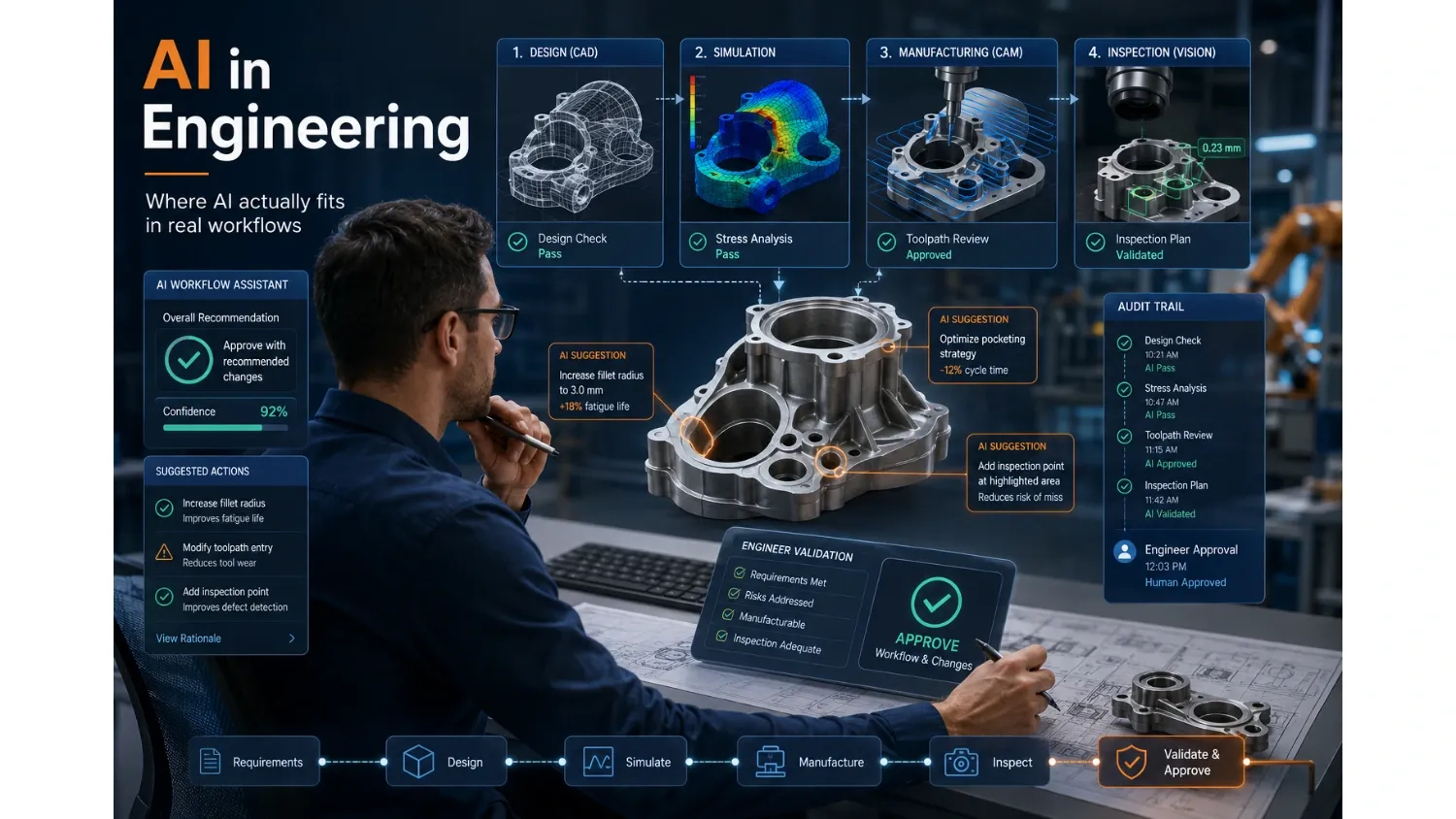
- Siemens Intelligence Center X: Siemens has launched Intelligence Center X, an industrial AI orchestration software designed to bridge the gap between fragmented data environments and actionable enterprise workflows. By combining Mendix, Graph Studio, and AI Studio from the RapidMiner portfolio, the platform orchestrates AI agents within strict governance frameworks, audit trails, and human-in-the-loop controls. Early deployments have yielded staggering operational results, including an 85% reduction in production issue resolution time at Vivix and a 95% reduction in manual pricing effort at Axiz.
- Micron and MetAI’s Simulation-Ready Fab Twins: Micron and MetAI have advanced the development of physical AI-driven, simulation-ready semiconductor fabrication facility ("fab") twins using NVIDIA Omniverse libraries and MetAI’s MetGen platform. The system ingests fragmented CAD drawings and facility metadata to automatically generate parametric, modular, SimReady digital twins of massive cleanroom environments. Integrated with NVIDIA Isaac Sim, these OpenUSD-compliant twins support advanced layout planning, material flow analysis, and synthetic data generation prior to physical construction or reconfiguration.
- PhysicsX’s $300 Million Series C Funding: PhysicsX has secured a monumental $300 million Series C funding round at a reported $2.4 billion valuation, led by Temasek with strategic participation from NVIDIA, Siemens, and Applied Materials. The capital infusion will accelerate the global scaling of the company’s platform and the development of larger, pre-trained Large Physics Models. PhysicsX’s technology enables engineers across aerospace, defense, energy, and semiconductors to predict complex physical behaviors in seconds rather than days, radically expanding the design exploration space.
2. Chronology: The Evolution of Industrial AI Deployment
To understand how the industrial sector arrived at this juncture, it is helpful to trace the chronological progression of software capabilities and enterprise adoption over recent years:
- Phase 1: The Era of Isolated Digital Shadows (Pre-2023): For decades, computer-aided engineering (CAE) and finite element analysis (FEA) operated as isolated computational silos. While highly accurate, traditional simulations required hours or days of high-performance computing (HPC) time. Digital twins were largely static 3D visualizations used for marketing or basic asset tracking rather than real-time operational simulation.
- Phase 2: The Rise of Generative AI and Isolated Pilots (2023–2024): Following the mainstream breakthrough of transformer architectures and generative AI, industrial software vendors began introducing early AI copilots. However, these tools were largely confined to isolated pilot projects, code generation, or basic natural-language querying of maintenance manuals, struggling to integrate deeply with deterministic engineering workflows.
- Phase 3: The Convergence of Physics, Omniverse, and Graph Neural Networks (2025): The technological landscape shifted as specialized developers began training models directly on physical laws and mesh structures. Graph neural networks (GNNs) emerged as the dominant architecture for handling non-Euclidean mesh data in CAE applications. Concurrently, platforms like NVIDIA Omniverse and OpenUSD established open standards for uniting CAD, CAE, and operational technology (OT) data into unified digital environments.
- Phase 4: Orchestration, Agents, and Mainstream Enterprise Scaling (2026 and Beyond): The current landscape is defined by orchestration platforms (such as Siemens Intelligence Center X and Plataine’s operational agents) that connect multiple specialized AI models under strict governance guardrails. Major industrial players are moving aggressively past the pilot phase, embedding AI surrogate models directly into mission-critical product development pipelines—exemplified by Dunlop’s targeted 2027 rollout and PhysicsX’s heavily funded scale-up.
3. Supporting Data: Quantitative Impact on Engineering and Operations
The economic and operational justification for industrial AI is grounded in measurable performance metrics across design, simulation, and manufacturing execution:
| Organization / Initiative | Technology Domain | Core Metric / Performance Gain | Baseline Comparison |
|---|---|---|---|
| Dunlop & Fujitsu | Tire Structural Analysis | 90% reduction in analysis time | From ~45 minutes to 5 minutes per run (600,000 mesh elements) |
| Dunlop & Fujitsu | Contact Shape Prediction | 87.7% average accuracy | Validated against traditional FEM analysis |
| Vivix (via Siemens) | Issue Resolution | 85% reduction in issue resolution time | Traditional manual troubleshooting workflows |
| Axiz (via Siemens) | Pricing Optimization | 95% reduction in manual effort | Legacy manual data processing and quoting |
| PhysicsX | Physics Simulation | Prediction times reduced from days/hours to seconds | Conventional CFD and structural HPC simulations |
| PhysicsX / Investment | Capital & Valuation | $300M Series C / $2.4B Valuation | Led by Temasek with NVIDIA & Siemens backing |
These figures demonstrate that artificial intelligence in engineering is no longer measured by qualitative improvements in user experience, but by hard operational efficiencies: compressed design cycles, eliminated computational bottlenecks, and drastically accelerated incident response times.
4. Official Responses and Industry Perspectives
The convergence of high-performance computing, physical simulation, and generative AI has prompted leading executives and technical architects to outline their strategic visions for the future of industrial software:
- On Industrial AI Orchestration: Industry analysts and software architects note that the primary bottleneck in manufacturing digitalization has never been a lack of data, but the inability to orchestrate workflows across siloed enterprise systems. Platforms like Siemens Intelligence Center X directly address this by combining Mendix application development with RapidMiner analytics, establishing a governed framework where human engineers retain ultimate authority over automated recommendations.
- On Physics AI and Scale: Speaking on the massive influx of venture capital into physics-informed machine learning, investors and founders emphasize that traditional numerical solvers, while mathematically rigorous, cannot scale to meet the exploratory demands of modern multi-physics design. By pre-training Large Physics Models on vast aerodynamic, thermodynamic, and structural datasets, companies like PhysicsX are providing engineers with real-time feedback loops that fundamentally alter how complex systems are conceptualized.
- On Simulation-Ready Digital Twins: Manufacturing technologists involved in the Micron and MetAI collaborations stress that true digital twins must move beyond simple 3D visual fidelity. By leveraging OpenUSD and automated parametric conversion pipelines, modern fab twins serve as living computational models capable of stress-testing layout changes, material flows, and robotics integration before a single brick is laid or tool is installed.
5. Implications for the Future of Engineering and Manufacturing
As these technologies transition from cutting-edge research to standardized enterprise deployments, engineering organizations and manufacturing enterprises must navigate several profound implications:
Redefining the Engineering Iteration Loop
The compression of structural analysis from 45 minutes to 5 minutes—or physics predictions from days to seconds—fundamentally changes the daily routine of design engineers. Instead of waiting hours for a single FEA or computational fluid dynamics (CFD) run to finish overnight, engineers can run hundreds of design variants interactively. This encourages a more exploratory, generative approach to mechanical and structural design, allowing teams to optimize for weight, durability, and cost much earlier in the product lifecycle.
The Shift from Visualization to Execution in Digital Twins
For years, "digital twin" was a buzzword applied to static dashboards and 3D CAD models. The integration of Omniverse, OpenUSD, and parametric fab generation transforms the digital twin into an active simulation and optimization environment. Manufacturers can simulate supply chain disruptions, machine reconfigurations, and cleanroom material flows with high fidelity, reducing capital expenditure risks and shortening time-to-market for new production lines.
Governance, Data Discipline, and Human-in-the-Loop Control
Despite the massive performance gains offered by AI surrogate models, conversational production agents, and physics AI, a recurring caveat unites all recent industry developments: AI accelerates discovery and optimization, but it does not replace engineering validation.
Because surrogate models like Dunlop’s tire analyzer achieve ~87.7% accuracy, and because AI agents rely entirely on the integrity of underlying production data, human oversight remains mandatory. Enterprises must enforce strict data governance, maintain clear process discipline, and implement robust validation checks against physical test data and traditional CAE solvers.
Conclusion
The convergence of accelerated computing, graph neural networks, physics AI, and enterprise orchestration platforms marks the dawn of a new industrial era. Organizations that successfully integrate these tools—balancing aggressive design exploration with rigorous validation protocols—will outpace competitors trapped in legacy, siloed workflows. The future belongs to those who can harness artificial intelligence to think in real-time, simulate in high fidelity, and execute with precision.