As the artificial intelligence boom reshapes global infrastructure, data center operators face unprecedented energy demands. Facilities that once drew modest, steady amounts of power are now transforming into high-density fortresses of compute, grappling with unprecedented thermal and electrical loads.
For years, the industry’s North Star for sustainability has been Power Usage Effectiveness (PUE). Widely adopted by regulators, praised in corporate sustainability reports, and fiercely contested by facility operators aiming for the elusive theoretical ideal of 1.0, PUE has served as the default gauge of energy efficiency.
However, according to industry experts, PUE suffers from a critical blind spot: it stops at the server door.
As AI workloads push power densities to extremes, the traditional metric fails to account for massive energy losses occurring deep within the server chassis. To truly optimize data center efficiency, the industry must look past facility-level accounting and address the final, critical inches of the power delivery network (PDN).
Main Facts: The PUE Blind Spot and AI Power Densities
The core limitation of Power Usage Effectiveness lies in its scope. PUE measures everything that happens to electricity before it reaches the server—including facility cooling systems, lighting, and power distribution units. Once energy crosses the threshold of a server rack, PUE’s visibility ends.
This creates a significant reporting paradox: a data center can boast an industry-leading, highly optimized PUE while silently bleeding a meaningful percentage of its incoming power inside individual servers.
The Scope Gap: PUE treats the server as a black box, completely ignoring internal power conversion stages.
Escalating Densities: Traditional CPU-centric racks historically drew between 5 and 8 kilowatts (kW). In contrast, modern AI and GPU-dense configurations routinely demand 15 to 50 kW per rack, with cutting-edge setups surpassing 100 kW.
The Cost of Inefficiency: At AI-era scale, even a minor percentage loss in conversion efficiency translates into massive amounts of wasted energy, inflated electricity bills, and substantial thermal waste that requires additional cooling resources.
Chronology: From Uniform Computing to High-Density AI Workloads
To understand why the industry is experiencing this measurement crisis, it is necessary to examine how data center architecture evolved over the past two decades.
Era 1: The CPU-Centric Uniformity (Pre-2015)
During the early virtualization and cloud-computing boom, data centers housed predominantly CPU-driven servers. Power draws across facilities were relatively uniform and predictable. PUE was introduced during this era and quickly became the gold standard because it effectively captured the overhead waste (like massive computer room air conditioner units and lighting) associated with these horizontal architectures.
Era 2: The Transition to Accelerated Computing (2015–2020)
As machine learning workloads began to emerge, graphics processing units (GPUs) and specialized accelerators entered enterprise data centers. Power demands began to creep upward. While cooling technologies started evolving—shifting gradually toward liquid-assisted solutions—power delivery architectures inside servers remained largely evolutionary, relying on legacy intermediate voltage buses and standard point-of-load regulators.
Era 3: The Generative AI Power Crisis (Present Day)
The explosion of Large Language Models (LLMs) and generative AI completely shattered historical design paradigms. AI accelerators demand unprecedented current at aggressive, highly unpredictable load transients. Power electronic components inside servers are now forced to operate at extremes. Yet, despite the complete transformation of compute hardware, the industry’s primary efficiency metric—PUE—has remained frozen in time, blind to the thermal and electrical realities unfolding inside the server enclosure.
Supporting Data: Unpacking the Server-Internal Power Chain
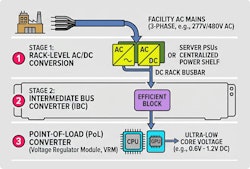
Getting electricity from a local utility grid to a modern AI processor is not a single, monolithic step. It is a complex, multi-stage conversion chain, and every single link in that chain suffers from efficiency losses.
AC-to-DC Conversion: High-voltage alternating current (AC) enters the facility and is converted into a high-voltage direct current (DC) bus.
Intermediate Voltage Bus (IBC): The power is stepped down through one or multiple DC-DC conversion stages to distribute manageable voltages across the motherboard.
Point-of-Load (POL) Regulation: Just before reaching the AI processor, POL converters step the voltage down to the exact, ultra-low levels required by the chip while maintaining extreme stability under heavy, fluctuating loads.
[ Utility Grid ]
       │
       ▼ (AC-DC)
[ High-Voltage DC Bus ]
       │
       ▼ (DC-DC / IBC)
[ Intermediate Voltage Stages ]
       │
       ▼ (POL Regulation)
[ AI Processor / GPU ]  ◄── *Where AI Current Density Concentrates Losses*
Each of these transitions features its own distinct efficiency curve. Energy that fails to convert successfully is not merely lost; it is dissipated as localized heat directly on the motherboard.
Because PUE does not measure this internal journey, facility operators remain unaware of how much electricity is being wasted as heat before it ever performs computational work. Consequently, operators must expend additional energy powering high-speed cooling fans and circulating liquid coolant to remove heat generated by internal power conversion inefficiencies—a compounding energy penalty entirely missed by facility-level metrics.
Official Perspectives and Expert Insights
Industry leaders are increasingly vocal about the necessity of updating how efficiency is tracked. Hans Hasselby-Andersen, CEO of Lotus Microsystems and a veteran with over two decades of semiconductor industry experience, emphasizes that the status quo is no longer sustainable.
"An operator relying on PUE alone is seeing part of the cost and emissions picture, not the whole one," notes Hasselby-Andersen. "The energy lost inside the server still shows up on the power bill, still generates heat that needs to be cooled, and still carries an emissions footprint. It’s just not attributed to anything, because there’s no metric currently assigned to catch it."
Rather than abandoning PUE—which remains valuable for tracking facility-level mechanical and electrical overhead—experts advocate for a dual-pronged approach. This involves pairing PUE with stage-by-stage power conversion metrics and encouraging hardware vendors to transparently report internal power delivery efficiency alongside standard compute specifications.
Implications for Data Center Operators and Architects
The disconnect between facility-level metrics and internal server realities carries far-reaching consequences for the data center industry, carrying implications across financial, operational, and environmental domains.
1. Financial and Operating Expenditures
At a time when energy costs are soaring and grid capacity is heavily constrained, invisible internal power losses directly inflate operational expenditures (OpEx). Millions of dollars in wasted electricity slip past traditional monitoring dashboards simply because no metric exists to track them.
2. Environmental Impact and Grid Strain
AI data centers are placing unprecedented demands on public power grids, sometimes forcing utilities to delay the retirement of fossil-fuel plants or scramble for new generation sources. Wasted power inside servers forces data centers to draw more electricity from the grid than necessary, artificially amplifying their carbon footprint and straining regional energy infrastructure.
3. Thermal Management and Reliability
As power density per rack pushes past 50 kW and climbs toward 100 kW+ configurations, thermal management becomes a razor-thin balancing act. Unaccounted-for heat generated by inefficient point-of-load converters creates localized hot spots, accelerating component degradation and increasing the risk of unexpected hardware failures.
Actionable Steps for Operators
Data center architects and operators do not need to wait for formal regulatory mandates or universal industry standards to begin addressing this gap. Forward-thinking teams can take immediate action:
Interrogate Vendors: Ask hardware suppliers to provide detailed, stage-by-stage power delivery efficiency data rather than relying solely on overall server input ratings.
Focus on Point-of-Load (POL) Performance: Prioritize advanced, ultra-compact vertical power modules designed to handle high-current AI workloads efficiently within tight spatial constraints.
Expand Internal Monitoring: Implement board-level telemetry to track and audit power loss inside the server chassis, bringing hidden inefficiencies out into the open.
Conclusion
Power Usage Effectiveness will undoubtedly remain a vital benchmark for evaluating facility-level infrastructure. However, relying on it as the sole indicator of data center sustainability in the age of generative AI is a costly oversight. By shifting focus to the final few inches of the power delivery network inside the server, the industry can unlock the next frontier of efficiency, curbing waste, reducing thermal loads, and paving the way for truly sustainable high-performance computing.