LONDON — When the United States orchestrated the dramatic ouster of Venezuelan President Nicolás Maduro earlier this year—subsequently flying the long-entrenched leader to face federal narco-terrorism and corruption charges in a New York jail cell—millions of Venezuelans both at home and across the diaspora erupted in jubilation. For the first time in 27 years of Chavismo, the prospect of a genuine democratic transition appeared within touching distance.
Yet, geopolitical reality has quickly sobered those celebrations. Removing an autocrat does not automatically dismantle the complex, deeply entrenched authoritarian apparatus that sustained his regime. This challenge is magnified exponentially when the intervening superpower is led by an administration whose own commitment to democratic norms is viewed with profound skepticism by international observers.
Rather than midwifing a transition to free and fair elections, Washington’s current trajectory suggests a more cynical objective: securing absolute control over Venezuela’s vast hydrocarbon reserves. By injecting billions of dollars in U.S. and multinational capital back into the country’s dilapidated energy sector, Washington risks inadvertently reinforcing the remnants of the Chavista state. In doing so, it may forge powerful economic incentives for future American presidents to preserve, rather than dismantle, the authoritarian political status quo.
Main Facts
The geopolitical landscape of post-Maduro Venezuela is defined by a paradox: the physical removal of the chief dictator has not translated into the liberation of the Venezuelan state. Instead, the apparatus of power has largely remained intact, pivoting from ideological anti-imperialism to pragmatic resource-sharing with Washington.
- The Ouster of Nicolás Maduro: Earlier this year, a high-stakes U.S. law enforcement and geopolitical operation successfully removed Maduro from Caracas, placing him in federal custody in New York.
- The Economic Prize: Venezuela holds the world’s largest proven crude oil reserves—surpassing 300 billion barrels. Decades of underinvestment, mismanagement, and crushing international sanctions have left its state oil company, Petróleos de Venezuela, S.A. (PDVSA), in a state of advanced dereliction.
- The Influx of Capital: The current U.S. strategy hinges on fast-tracking billions of dollars in foreign direct investment (FDI), predominantly from American energy conglomerates, to ramp up production capacity.
- The Political Compromise: To ensure the security of these massive capital investments, Washington has shown a willingness to cooperate with remaining figures within the Chavista military-industrial complex, effectively trading long-term democratic reforms for short-term energy security and corporate profitability.
Chronology: From Maduro’s Fall to the Petro-Realpolitik
To understand how Venezuela’s democratic aspirations were so rapidly sidelined, one must trace the rapid sequence of events that followed Maduro’s removal.
Phase One: The Uprising and the Extraction (Early 2026)
- January–February 2026: U.S. intelligence and tactical operations culminate in the sudden extraction of Nicolás Maduro from Venezuelan soil. Jubilant crowds flood the streets of Caracas, Miami, and Madrid, anticipating an immediate interim government led by democratic opposition figures.
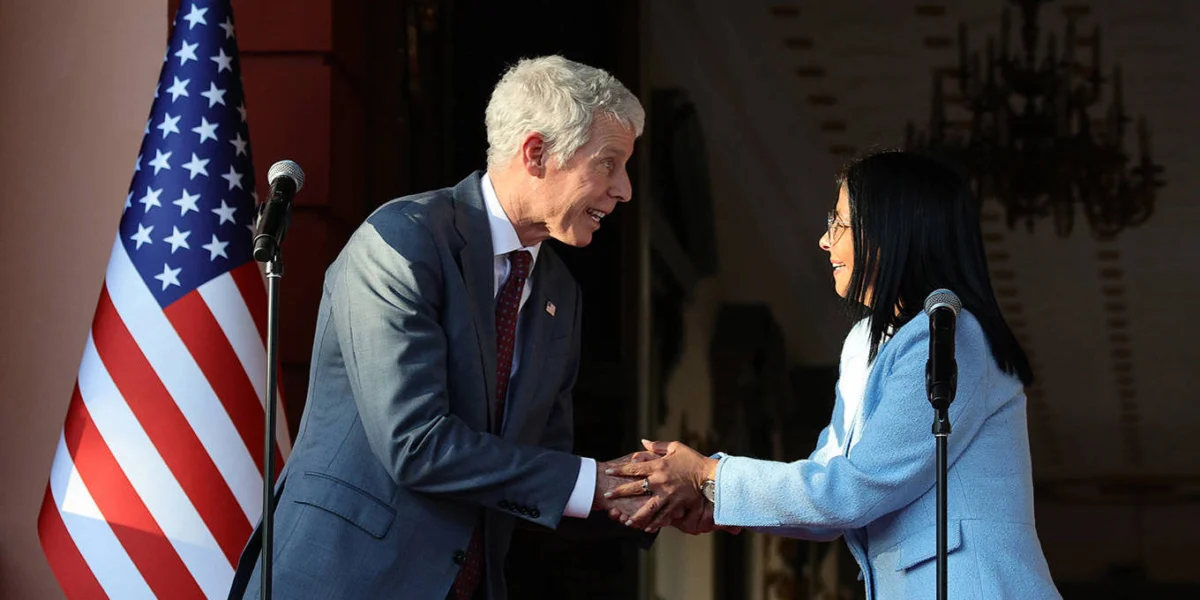
- March 2026: Washington bypasses traditional democratic transition frameworks, moving swiftly to establish direct talks with residual power brokers in Caracas, including key military generals and legislative leaders loyal to the United Socialist Party of Venezuela (PSUV).
Phase Two: The Economic Resurgence (Spring–Summer 2026)
- April 2026: The U.S. Treasury Department issues broad sanctions waivers specifically tailored to major American oil corporations, granting them exclusive licenses to resume heavy crude extraction and export operations in Venezuela.
- June 2026: Major Wall Street energy firms announce multi-billion-dollar rehabilitation packages aimed at modernizing Venezuela’s decaying extraction infrastructure, pipelines, and upgrading ports along the Caribbean coast.
Phase Three: The Democratic Stagnation (Fall 2026)
- September 2026: Hopes for an inclusive national dialogue and a timetable for unhindered presidential elections stall. Civil society organizations and opposition leaders report being marginalized from high-level negotiations between Washington and the interim regime figures.
- October 2, 2026: International analysts warn that the influx of petrodollars is effectively stabilizing the security apparatus, insulating the remaining regime elites from popular pressure and cementing a new transactional alliance between Washington and Caracas.
Supporting Data & Economic Realities
The pivot toward resource extraction is underpinned by stark economic calculations. Venezuela’s energy sector represents both a massive opportunity for global energy markets and a dangerous political narcotic.
- Reserves vs. Production: Prior to the ouster, Venezuela’s crude production had plummeted from a historical peak of over 3 million barrels per day (bpd) down to fluctuating lows of 700,000 to 800,000 bpd.
- Capital Requirements: Industry estimates suggest that restoring Venezuelan infrastructure to pre-crisis output levels will require between $40 billion and $60 billion in sustained capital investment over the next decade.
- U.S. Corporate Exposure: Initial licensing agreements grant major U.S. operators priority access to heavy oil fields in the Orinoco Belt. This creates an immediate corporate lobby within Washington whose financial interests are directly tied to operational stability in Venezuela—regardless of who holds political power.
- The Rentier State Trap: Historically, Venezuela’s reliance on oil revenues fostered a "rentier state" mentality, where governments derived wealth from natural resource extraction rather than taxation, insulating leaders from public accountability. The current influx of foreign capital threatens to supercharge this dynamic, funding regime security forces rather than social welfare or democratic institutions.
Official Responses and Diplomatic Posturing
The divergence between lofty rhetoric about democracy and the realities of resource-driven foreign policy has sparked sharp debates among global stakeholders.
Washington’s Perspective
The White House and the Department of Energy have defended the normalization of economic ties as a pragmatic necessity. Official statements emphasize that stabilizing global energy markets and lowering domestic fuel prices are paramount national security objectives.
"Our engagement with Venezuela is pragmatic, security-driven, and focused on regional stability," a senior administration official noted under condition of anonymity. "We cannot allow a vacuum to persist that threatens energy supplies, nor can we ignore the humanitarian imperative to restart the nation’s economic engine."
The Venezuelan Democratic Opposition
Prominent voices within Venezuela’s fractured democratic movement have expressed deep betrayal, arguing that Washington has traded away democratic leverage for barrels of crude.
"We fought for decades to dismantle a totalitarian regime, not to see it re-engineered with American corporate backing," said a prominent Caracas-based civil rights advocate. "When you finance the same generals and bureaucrats who crushed our civil liberties, you aren’t bringing democracy—you are simply changing the brand on the oil barrels."
International Reactions
European Union capitals have voiced cautious concern over the lack of a clear electoral roadmap. Meanwhile, regional actors in Latin America are divided: some welcome the return of Venezuelan oil to global markets to ease inflation, while others fear that a militarized, resource-rich petro-state backed by Washington will spark regional instability and renewed crackdowns on dissent.
Implications: A Dangerous Precedent for Global Democracy
The unfolding situation in Venezuela carries profound implications that extend far beyond South America. It serves as a test case for the intersection of 21st-century geopolitics, resource scarcity, and the erosion of democratic conditionality in foreign intervention.
1. Institutionalizing Authoritarian Capitalism
By preserving the administrative and security structures of the Chavista state while injecting massive Western capital, Washington is pioneering a model of "authoritarian capitalism." In this framework, political freedoms are suppressed, but commercial and financial access is guaranteed for foreign multinationals. This precedent suggests that human rights violations and democratic backsliding can be overlooked so long as resource extraction flows smoothly.
2. The Chokehold on Future U.S. Foreign Policy
Perhaps the most insidious long-term risk is the creation of entrenched economic interests. Once billions of dollars in American capital are locked into Venezuelan oilfields, pipelines, and refineries, future U.S. administrations will face immense domestic pressure from corporate lobbies to maintain the political status quo. Any future push for genuine democratization could be dismissed by policymakers as a threat to American corporate investments and energy security.
3. The Betrayal of Civil Society
For the millions of Venezuelans who risked their lives protesting, organizing, and fleeing the Maduro regime, the current trajectory feels like a cruel sleight of hand. The promise of democratic renewal has been subordinated to the mechanics of the global energy trade. When the people realize that the removal of a tyrant has merely replaced ideological tyranny with transactional resource extraction, public disillusionment with democratic processes—both domestic and international—will deepen profoundly.
Conclusion
The ouster of Nicolás Maduro was heralded as a historic victory for freedom. Yet, months later, Venezuela finds itself trapped in a familiar and perilous cycle. By prioritizing the extraction of oil over the construction of democratic institutions, Washington risks stabilizing the very authoritarian structures it vowed to dismantle. Unless the international community pivots to demand verifiable political reforms, transparent governance, and the dismantling of the security state, Venezuela’s vast wealth will continue to be both its greatest curse and the anchor of its unfulfilled democratic dreams.