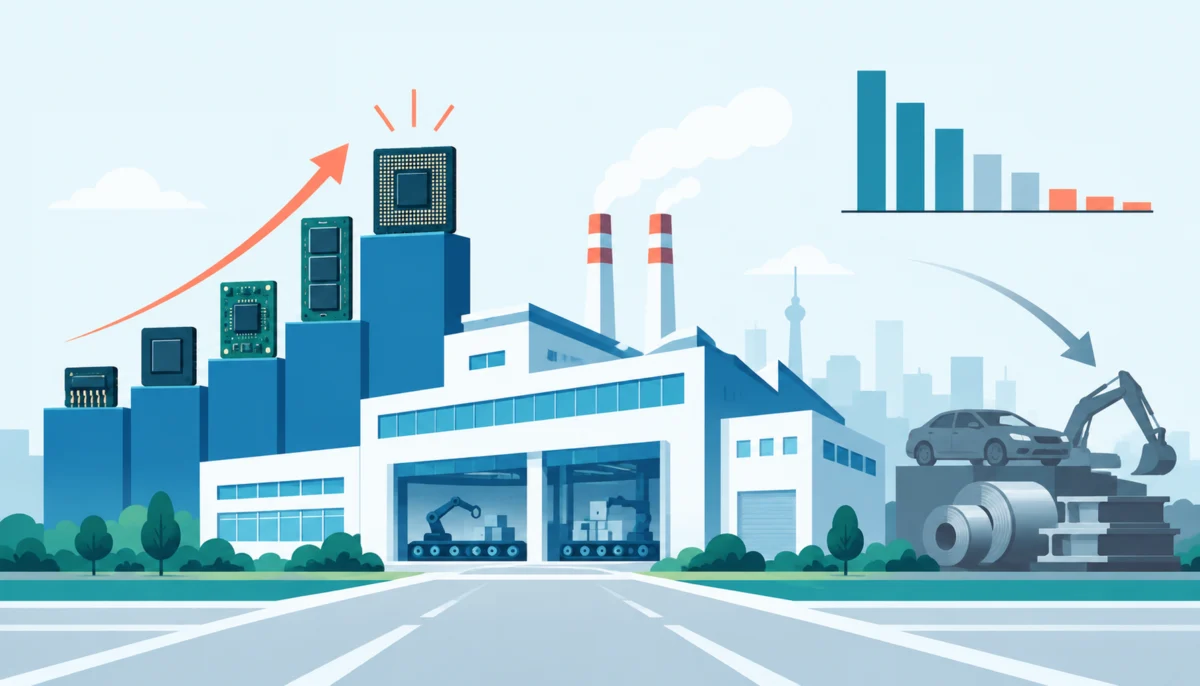
China’s industrial sector is currently navigating a complex economic landscape defined by sharp contradictions. While the headline figures for the first eight months of 2026 suggest a robust recovery, a closer inspection of August data reveals an underlying loss of momentum that has investors and policymakers reassessing the durability of the country’s manufacturing engine. According to the National Bureau of Statistics (NBS), while the cumulative growth remains strong, the rapid pace of earlier months is beginning to moderate, exposing a widening gap between high-tech manufacturing and the struggling traditional industrial sectors.
Main Facts: The August Slowdown
The latest figures released on September 28 by the NBS paint a nuanced picture of China’s industrial health. In August, industrial profits grew by 4.2% year-on-year, a significant deceleration from the 11.2% growth recorded in July.
When zooming out to the broader performance of the year, the picture appears healthier. Profits for the first eight months of 2026 reached 5.272 trillion yuan, representing a 15.7% increase compared to the same period in 2025. However, even this cumulative metric reflects a cooling trend, as the growth rate through July stood at 17.6%. This data confirms that while Chinese firms are still far more profitable than they were a year ago, the explosive growth witnessed in the second quarter is losing its steam.
The core narrative for investors is no longer one of monolithic growth. Instead, it is a story of extreme divergence: the electronics and raw materials sectors are thriving, while the automotive, utility, and construction-related industries are struggling to maintain margins.
Chronology: Mapping the Trajectory of 2026
To understand the current state of China’s industrial output, one must track the trajectory of the last two quarters:
- January–July 2026: This period was marked by a strong recovery, with cumulative profit growth hitting 17.6%. July’s individual monthly performance was particularly strong at 11.2%, buoyed by a resurgence in global demand for consumer electronics.
- August 2026: The momentum shifted. Monthly profit growth fell to 4.2%. The NBS attributed a portion of this decline to a "high base effect"—meaning that August 2025 was a particularly strong month, making it mathematically difficult for August 2026 to show similar percentage gains.
- Late September 2026: Following the release of the August figures, the focus has shifted to whether the September data will confirm a persistent cooling or reveal a temporary dip.
Supporting Data: Where the Profits Are Hidden
The aggregate figures often mask the volatility of individual sectors. The NBS data reveals that the "industrial recovery" is, in reality, a narrow-based phenomenon.
The Electronics Dominance
The computer, communications, and electronic equipment manufacturing sector has been the primary engine of growth. In the first eight months of 2026, profits in this sector surged by 109.9%. According to NBS statisticians, electronics manufacturing accounted for an astonishing 62% of the overall increase in total industrial profits. This implies that if one were to strip away the electronics sector, the "industrial recovery" would look significantly more anemic.
Commodities and Raw Materials
Raw materials also provided a substantial tailwind. Mining profits rose by 35.1%, while chemical raw materials and products saw a 51% jump. Nonferrous metal smelting experienced an 82.9% profit increase. The NBS notes that these gains are heavily tied to global price fluctuations, particularly in oil and base metals.
The Weak Spots: Autos and Construction
Conversely, the "old economy" sectors are facing a difficult environment. Auto manufacturing profits plummeted by 16% over the eight-month period. Industries tied to the property and infrastructure market—such as nonmetallic mineral products and ferrous-metal smelting—saw declines of 46.7% and 62.4%, respectively. These figures highlight a stark reality: China’s industrial growth is currently disconnected from its traditional construction and automotive pillars.
Official Responses and Methodology
The National Bureau of Statistics has been careful to contextualize these figures, warning against over-interpreting month-to-month fluctuations. In their official interpretation, the agency highlighted that gross profit—defined as revenue minus operating costs—actually grew by 7.5% in August, which is 1.9 percentage points faster than in July.
This distinction is crucial. It suggests that while "net profit" (the bottom line) may be pressured by taxes, rising expenses, and structural shifts, the core operational profitability of the average firm remains intact.
Furthermore, the NBS has emphasized the importance of using "comparable statistical bases." Because the population of surveyed firms—those with annual main-business revenue of at least 20 million yuan—changes over time due to business closures and entries, the agency cautions against deriving growth rates by manually dividing current profit totals by previous years’ totals. Relying on the official growth rates is essential to account for these methodological shifts.
Financial Indicators: Debt and Inventory
Beyond pure profit, the balance sheet health of Chinese industrial firms is becoming a focal point for lenders.
- Accounts Receivable: Total accounts receivable rose to 29.48 trillion yuan, a 9% year-on-year increase. The average collection period lengthened to 72.2 days, suggesting that firms are finding it harder to convert sales into cash.
- Inventory Levels: Finished-goods inventory rose by 11%, signaling that some manufacturers are struggling to clear stock, which could lead to production cuts in the coming months.
- Debt Ratios: The asset-liability ratio reached 58.5%, an increase of 0.3 percentage points. While this is not yet a systemic crisis, it underscores the need for cautious credit analysis, particularly in the struggling automotive and construction sectors.
Implications for the Future
The implications of this data for stakeholders are multi-faceted:
For Market Positioning
Investors should move away from broad-based index funds and focus on sector-specific exposure. The concentration risk in the electronics sector is significant; a policy change or a cooling of global tech demand would have an outsized impact on the national profit figures. Conversely, the "weak" sectors like autos and steel represent a value trap or a genuine credit risk, depending on one’s risk appetite.
For Macroeconomic Policy
The disconnect between high profits in tech and low investment in manufacturing is a key concern. While the NBS reported an 8.1% increase in investment in electronics, total manufacturing fixed-asset investment actually fell by 2.3%. This suggests that even profitable firms are hesitant to commit to large-scale capital expenditure, potentially signaling a lack of long-term confidence in the broader economic cycle.
For Credit Risk Management
For financial institutions, the data serves as a prompt for granular analysis. With receivables growing faster than revenue and collection times lengthening, the "health" of a borrower cannot be determined by the national average. Lenders must scrutinize the aging of receivables and inventory quality for any industrial client, especially those operating in the sectors where national profits are shrinking.
Conclusion: A Narrow Path Forward
The August industrial profit data confirms that China is operating in a state of uneven development. While the cumulative growth of 15.7% is a testament to the resilience of specific sectors, the monthly deceleration to 4.2% serves as a warning. The recovery is currently being carried by a "high-tech" cart, while the "traditional" wheels of the economy are struggling to keep pace.
As we look toward the fourth quarter of 2026, the key metric to watch is not just profit, but the spread between producer prices and input costs. If firms can successfully pass on inflationary costs to their customers, the margins may hold. If not, we may see further margin compression that could turn the current "slowdown" into a more permanent cooling of industrial activity. For now, the takeaway is clear: caution is warranted, and selectivity is paramount.