Introduction: The Unprecedented Surge of the Yellow Metal
The global financial landscape has experienced a profound transformation over the past two4 months, characterized by a relentless bullish trajectory in the precious metals market. As traditional fiat currencies face persistent inflationary pressures, shifting geopolitical tensions, and macroeconomic volatility, gold has emphatically reasserted its status as the ultimate safe-haven asset. Central banks, institutional investors, and retail buyers alike have poured unprecedented capital into bullion, driving market valuations to historic milestones.
This comprehensive report examines the multifaceted drivers behind gold’s remarkable performance, analyzing current pricing dynamics across key regional markets—specifically Saudi Arabia and Egypt—while evaluating historical milestones from 2025 and projecting actionable market forecasts through 2026. By dissecting macroeconomic catalysts, central bank accumulation strategies, and technical market indicators, this article provides an exhaustive overview of the factors shaping the global gold economy.
Main Facts: Current Market Valuations and Regional Dynamics
At the heart of the current commodity supercycle is an insatiable global demand for physical gold, standard bullion bars, and investment-grade jewelry. Market indicators point toward sustained bullish sentiment, supported by fluctuating exchange rates and robust domestic demand in key Middle Eastern and North African hubs.
Gold Market Performance in Saudi Arabia
In the Kingdom of Saudi Arabia, the domestic retail and wholesale gold markets have mirrored global upward trends. Reflecting the international spot price adjustments, retail prices for standard purities—most notably 24-karat and 22-karat gold—have maintained elevated levels, aligning with the Islamic calendar milestones and robust local purchasing power.

- Market Resilience: Despite record-high valuations, domestic consumer interest remains remarkably resilient. Rather than deterring buyers, higher prices have stimulated a robust secondary market for gold bars and investment-grade coins, as local investors view the metal as a primary hedge against regional inflation and currency fluctuations.
- Retail Preferences: 22-karat and 21-karat gold continue to dominate the jewelry sector across major urban centers like Riyadh, Jeddah, and Dammam, while 24-karat bullion bars and 50-gram certified ingots remain the preferred vehicle for wealth preservation among high-net-worth individuals.
Market Dynamics in Egypt
Parallel to developments in the Gulf, the Egyptian gold market has navigated a complex economic environment shaped by local currency adjustments, inflationary pressures, and strong domestic hedging behavior.
- Pricing Pressures: Local gold pricing in Egypt has experienced significant upward momentum, driven by a combination of international spot price movements and local demand-supply dynamics. For instance, the price for 24-karat gold has hovered around elevated benchmarks, reaching approximately 216,720 Egyptian Pounds for specific high-weight categories and localized trading volumes.
- The Sachet and Fractional Gold Trend: In response to broader economic adjustments and affordability thresholds for everyday retail investors, the Egyptian market witnessed a surge in innovative retail products, such as fractional gold bars (including popular 1-gram and smaller denominations) and specialized gold sachet products. This democratization of gold investment has allowed retail participants with modest capital to successfully integrate the yellow metal into their personal savings portfolios.
Chronology of Market Movements: From 2025 Peaks to 2026 Projections
To fully comprehend the structural shift in the gold market, it is essential to trace the chronology of price action from the beginning of 2025 through the structural forecasts established for 2026.
The 2025 Supercycle: Breaking Historical Ceilings
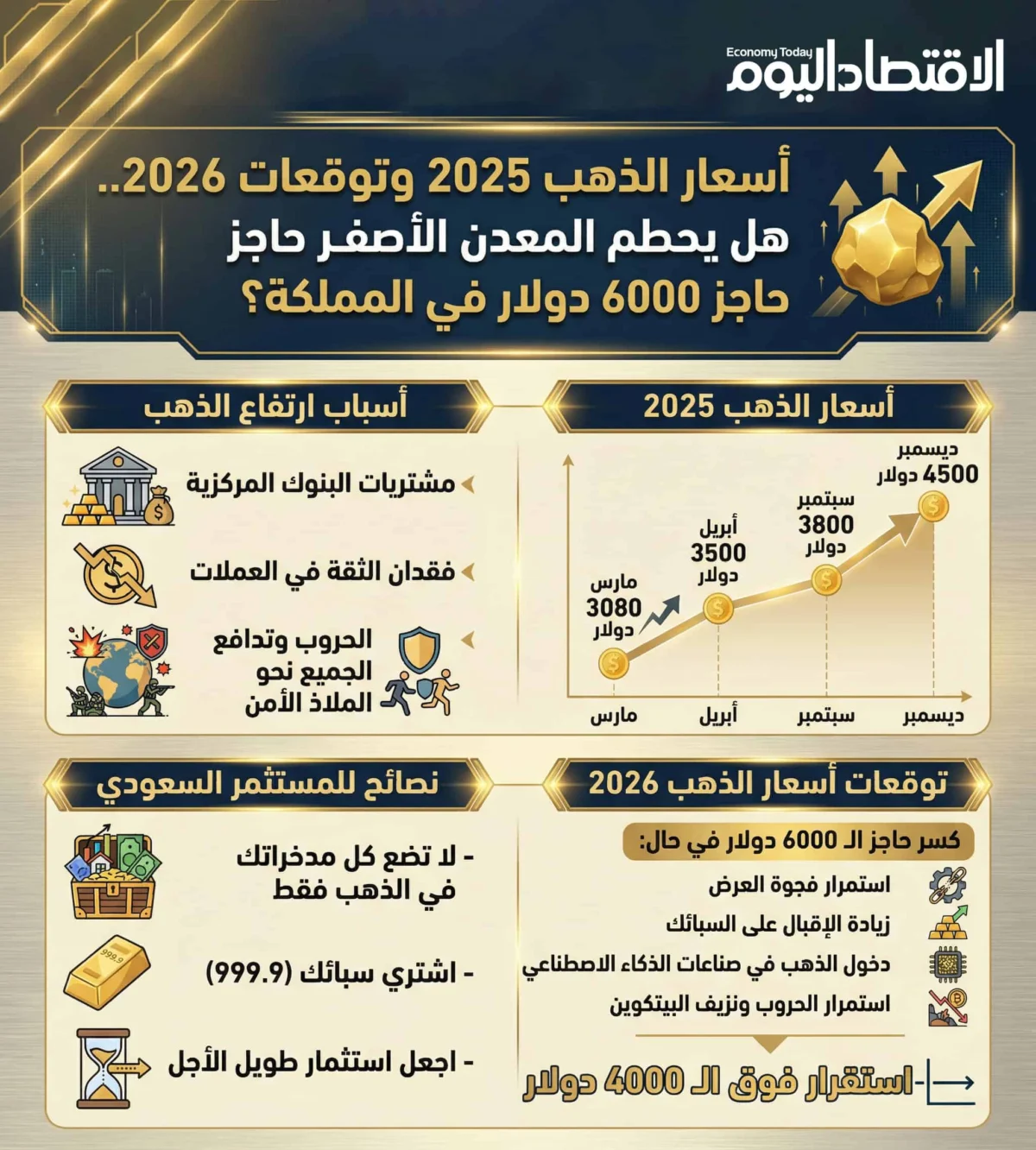
The year 2025 will be remembered in financial history as a watershed moment for precious metals. Early in the year, gold prices shattered longstanding psychological barriers, surging past the $4,500 per ounce threshold as global macroeconomic uncertainty deepened.
- Q1–Q2 2025: Driven by aggressive interest rate recalibrations by major central banks and persistent supply chain bottlenecks, gold experienced steady accumulation phases. Institutional investors reallocated substantial portfolios from risk-on equities into secure commodities.
- Q3–Q4 2025: As geopolitical tensions intensified across multiple trade corridors, safe-haven demand accelerated exponentially. Market analysts began debating whether the precious metal could breach the unprecedented $6,000 per ounce barrier, a milestone previously considered unattainable within a single market cycle.
2026 Outlook: Consolidation and New Highs
Entering 2026, the market entered a phase of calculated consolidation coupled with sustained structural support. While short-term profit-taking occasionally created localized dips, institutional demand placed a solid floor under the market, preventing deep corrections.

- Current Baseline: Spot prices throughout early 2026 have consistently tested and defended historical baselines, frequently consolidating around the $4,000 per ounce range. This consolidation phase has provided a healthy foundation for the market, allowing industrial and retail buyers to absorb previous gains without triggering a speculative bubble collapse.
- Seasonal Catalysts: Major religious and cultural observances throughout the Islamic calendar year 1448 AH have continued to inject predictable liquidity into regional retail markets, ensuring that physical demand remains a stabilizing force during periods of global financial volatility.
Supporting Data: Quantitative Metrics and Comparative Analysis
A rigorous examination of the gold market requires detailed quantitative tracking of bullion specifications, purity grades, and comparative asset performance.
Standard Purity Breakdown and Valuation Metrics
Global and regional transactions rely on standardized purities to ensure transparent pricing for retail and institutional buyers alike:
- 24-Karat Gold (Fine Gold): Representing 99.9% purity, this is the benchmark used for global spot pricing, institutional bullion reserves, and certified investment bars (such as popular 50-gram and 100-gram minted ingots).
- 22-Karat Gold: Comprising 91.6% purity, 22-karat gold is heavily traded across Middle Eastern retail souks, balancing durability with high intrinsic value, making it ideal for traditional craftsmanship.
- 21-Karat and 18-Karat Gold: Widely utilized in intricate jewelry manufacturing, these alloys offer lower price points per gram, allowing broader consumer participation during periods of high absolute market value.
Comparative Table: Key Asset Class Performance (2025–2026)
| Asset Class / Indicator | 2025 Average Benchmark | 2026 Current Projection | Market Sentiment |
|---|---|---|---|
| Spot Gold (per ounce) | $4,500 | $4,000 – $4,500+ | Bullish / Consolidating |
| Saudi Domestic 24K (per gram) | Elevated Regional Index | Stable High Valuation | Strong Investment Demand |
| Egyptian Domestic 24K (per gram) | High Inflation-Adjusted | ~216,720 EGP (Scale Dependent) | High Retail Hedging |
| Central Bank Reserves | Record Net Purchases | Sustained Accumulation | Extremely Bullish |
Official Responses and Expert Commentary
Financial authorities, market analysts, and economic commentators have closely monitored the unprecedented trajectory of gold prices, offering diverse perspectives on the underlying economic fundamentals.
Central Bank Accumulation Strategies
Leading economic analysts note that a primary catalyst behind gold’s long-term floor is the aggressive, sustained accumulation of bullion by sovereign central banks. Seeking to diversify foreign exchange reserves away from traditional fiat holdings and mitigate exposure to systemic sanctions, emerging market central banks have consistently added thousands of metric tons of physical gold to their vaults.

- Expert Viewpoint: Prominent market strategists emphasize that sovereign buying acts as an effective macroeconomic anchor. Even during periods of localized retail profit-taking, central bank demand absorbs excess market supply, cushioning prices against sharp downward corrections.
- Monetary Policy Correlation: Financial institutions continue to monitor global interest rate decisions. Expectations of monetary easing or prolonged pauses in aggressive rate hikes traditionally diminish the opportunity cost of holding non-yielding assets like gold, further reinforcing its appeal among institutional fund managers.
Implications: What Higher Gold Prices Mean for Investors and Consumers
The sustained high valuation of gold carries profound implications for the global economy, institutional portfolio management, and individual household financial planning.
For Institutional Investors
- Portfolio Diversification: In an era of heightened market correlation between equities and traditional bonds, gold has re-established its efficacy as a non-correlated asset class. Portfolio managers are increasingly utilizing gold ETFs, physical bullion allocations, and mining equities to hedge against systemic macroeconomic risks.
- Risk Management: With geopolitical landscapes remaining unpredictable, institutional frameworks are adapting to higher baseline commodity prices, viewing gold not merely as a tactical trade, but as a strategic long-term core holding.
For Retail Consumers and Households
- Wealth Preservation: For everyday savers in regions experiencing currency depreciation or inflation, gold remains the premier vehicle for preserving purchasing power. The proliferation of fractional products, such as smaller bullion bars and gram-specific retail units, ensures that retail investors can continue accumulating wealth regardless of high entry thresholds.
- Consumer Adaptation: The jewelry sector has had to adapt to consumer hesitation driven by elevated per-gram costs. Jewelers are increasingly focusing on lightweight, high-craftsmanship designs that maximize aesthetic appeal while minimizing total gold weight, balancing consumer budgets with timeless cultural traditions.
Conclusion
The global gold market stands at a historic crossroads. Driven by robust central bank accumulation, macroeconomic volatility, and unwavering retail demand across key regions like Saudi Arabia and Egypt, the yellow metal has successfully transitioned into a permanently higher valuation bracket. As market participants navigate the complexities of 2026, gold’s fundamental role as a safe-haven asset, an inflation hedge, and a cornerstone of sovereign and personal wealth preservation remains undisputed.